
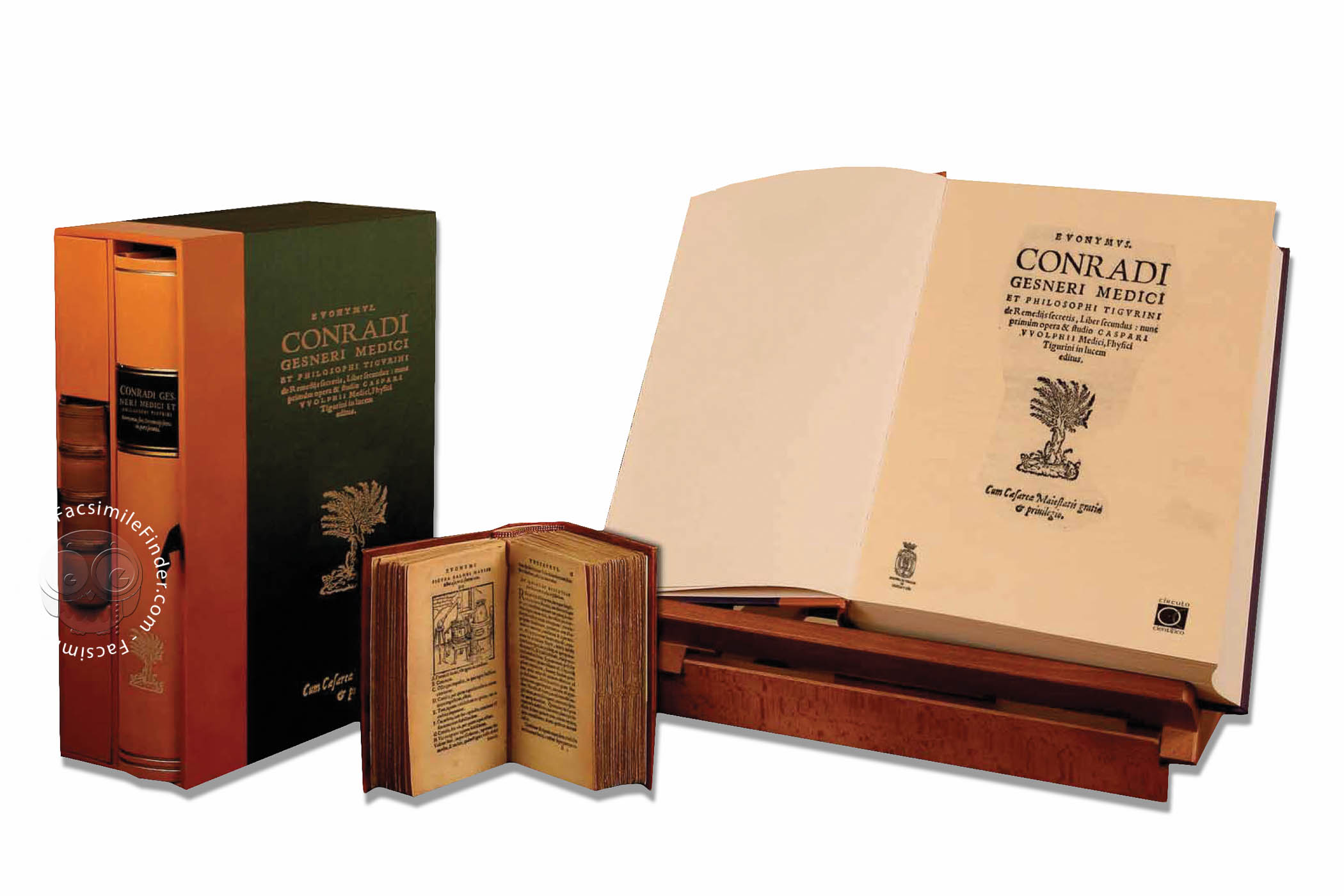
The Thesaurus de Remediis Secretis: Pars Secunda belongs to that fertile moment in the sixteenth century when learned medicine, artisanal practice, and experimental curiosity began to converge in print. Produced in Zurich in 1569, this small Latin volume extends the ambitious pharmacological project associated with Conrad Gessner, one of the great encyclopedic minds of the Renaissance.
Compact in scale yet expansive in intellectual reach, it gathers practical knowledge meant for physicians and apothecaries, shaping the page into a workshop of remedies, processes, and disciplined observation.
A Zurich Book of Medical Practice
Issued posthumously and brought to press through the work of Caspar Wolf, the book stands within the energetic scholarly culture of Swiss humanism. Its world is neither purely theoretical nor merely domestic. Instead, it reflects a period in which medical learning drew authority from classical reading, professional exchange, and direct trial. Gessner’s wider oeuvre reveals the same habit of synthesis: ancient knowledge is not simply repeated, but reorganized for active use.
Print, Order, and Technical Clarity
Its material form reinforces that practical purpose. The modest octavo format makes the book portable, while the disciplined architecture of Latin print gives recipes and procedures a clear, navigable structure. This is a book designed to be handled, consulted, and returned to workbench or study table. Brevity of scale does not lessen its authority; rather, it sharpens its function as a tool of learned reference.
Remedies, Distillation, and Useful Knowledge
At the heart of the volume lies a culture of secret remedies understood not as occult fantasy, but as guarded and valuable technical knowledge. Gessner’s De remediis secretis was closely associated with medicine, botany, chemistry, and especially the art of distillation. The book therefore embodies a Renaissance faith in transformation: substances may be refined, concentrated, and redirected toward healing through method, apparatus, and skilled interpretation.
A Treasury of Renaissance Inquiry
What emerges is more than a pharmacological handbook. This second part preserves the texture of a scholarly culture that prized utility, compilation, and experiment in equal measure. It shows knowledge in motion—collected from texts, tested in practice, and fixed in print for renewed transmission. In that sense, the Thesaurus is both a medical book and a witness to the Renaissance desire to turn learning into something demonstrable, usable, and enduring.
We have 1 facsimile edition of the manuscript "Thesaurus de Remediis Secretis - Pars Secunda": Thesaurus de Remediis Secretis, Pars Secunda facsimile edition, published by Círculo Científico, 2012
Request Info / Price