


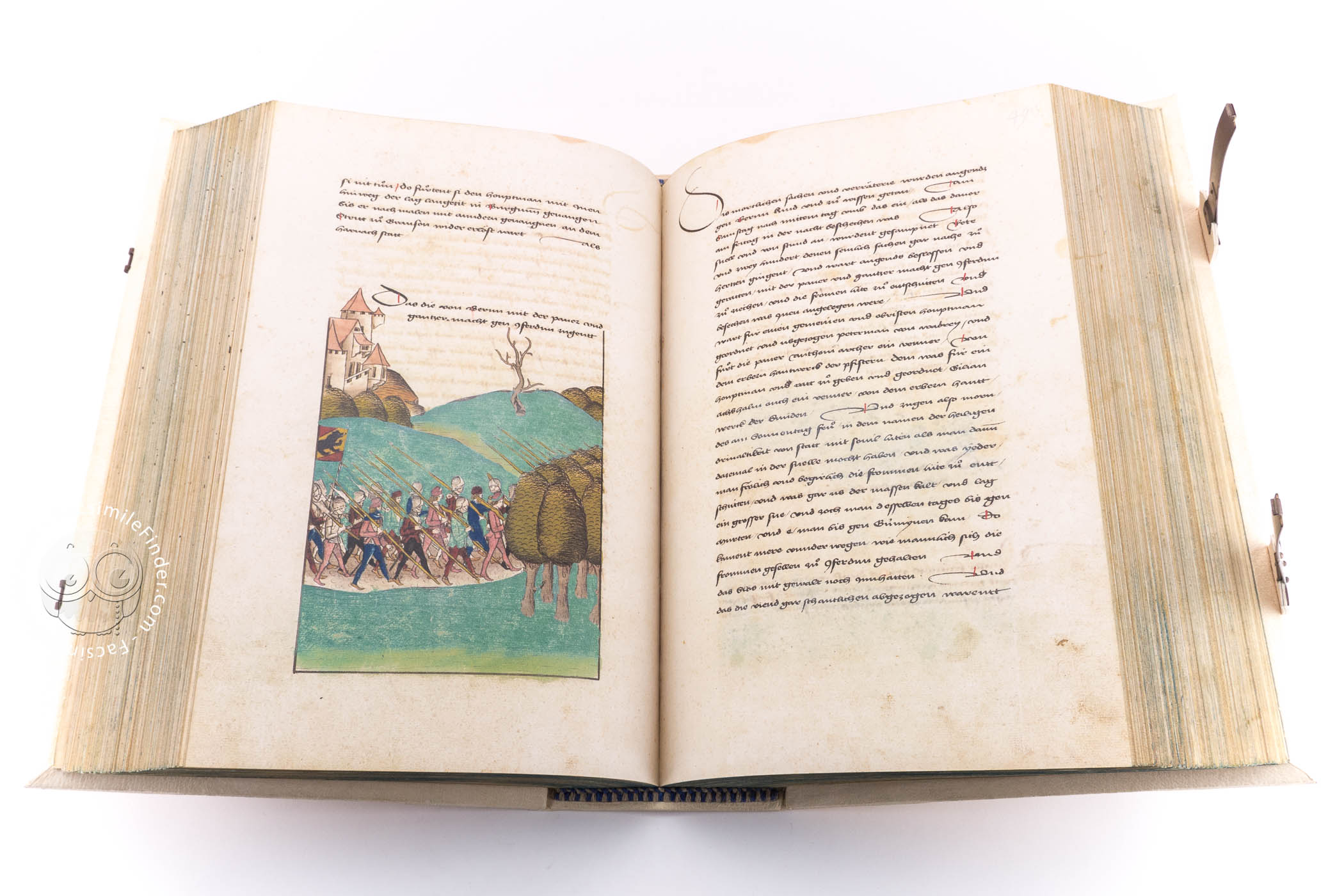


The densely illustrated Great Burgundian Chronicle is an autograph manuscript account of the Swiss-Burgundian Wars by Diebold Schilling the Elder. It was created in Bern around 1480-1484, not long after the events it describes. Its 197 original illustrations are line drawings with color washes executed by a professional artist. They feature bird's-eye views of the locales of many battles, as well as myriad details of the material culture of contemporary warfare and city life. The last illustration is by a different artist, as is the grisaille historiated initial with touches of gold that opens the history.
The illustrations are colored in washes of blue, green, yellow, brown, black, red, and white. Green dominates the thirty images of troops marching through the countryside, and brown fortification walls are a major feature of the dozens of scenes set in cities.
A Conflict of Pan-European Consequences
The Burgundian Wars (1474-1477) were fought between the Swiss Confederation and the forces of Charles the Bold (1433-1477), Duke of Burgundy. The Swiss won important victories but gained neither territory nor regional power; the wars ended with the death of Charles the Bold and the division of the territories he once controlled between France and the Holy Roman Empire.
Pike and Halberd Warfare
The Great Burgundian Chronicle provides an extensive pictorial record of weaponry of the Swiss infantry, which featured the pike (a heavy spear with a long shaft) and the halberd (a long-shafted axe with a sharp rear pick and long spike). The Burgundian armies, but not the Swiss, included mounted soldiers, who are depicted in the manuscript both moving through the countryside and in battle.
Bird's-Eye Viewpoint
The reader/viewer of the chronicle sees all the action from an elevated viewpoint, which allows for detailed views of cities with representations of prominent buildings. The cities that appear in more than one illustration are recognizable as identical, although they are sometimes seen from more than one angle.
There are nine depictions of Murten, including a pair of views from opposite sides (pp. 623 and 670). The city of Bern is pictured four times in accurate detail (pp. 66, 384, 645, and 804). The views include portraits of the Christoffelturm (Saint Christopher Tower) and the newly constructed Untertorbrücke (Lower Gate Bridge).
Four Decisive Battles
The battles at Héricourt, Grandson, Murten, and Nancy are all pictured. Indeed, Grandson, the site of the greatest victory by the Swiss, appears in nineteen illustrations. The images of the four famous massacres emphasize the flight of the Burgundians (pp. 217, 543, 545, 654, 660, and 769).
Author as Scribe
The Great Burgundian Chronicle is an illustrated version of the third and last volume of the Bern Chronicle by Diebold Schilling the Elder (d. 1485). The chronicle is a history in the modern sense, but it was also intended as a moralizing text. Schilling, who was present at the battles of Grandson and Murten, himself wrote the manuscript's Alemannic text in an elegant Gothic Cursiva. He also wrote the two- to three-line captions for the illustrations that describe the depicted events.
Local Concerns
Schilling had settled in Bern in 1460, and he probably copied the chronicle for a local patron. In the event, his widow sold the manuscript in 1486 and, in 1693, Hans Heinrich Holtzhalb donated it to the Zurich Stadtbibliothek, which became part of the Zentralbibliothek in 1914.
We have 1 facsimile edition of the manuscript "Great Burgundian Chronicle of Diebold Schilling": Große Burgunderchronik des Diebold Schilling von Bern facsimile edition, published by Faksimile Verlag, 1981
Request Info / Price