
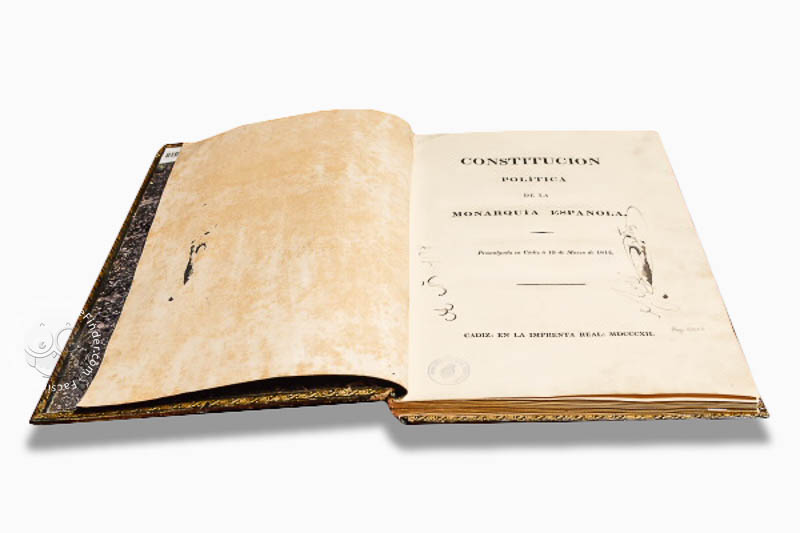
The Constitution of Cádiz stands as one of the defining political texts of modern Spain. Promulgated in Cádiz on 19 March 1812, amid war and institutional upheaval, it gave enduring written form to a new language of sovereignty, representation, and civic order. Known popularly as La Pepa, it became a symbol of liberal aspiration at a moment when the Spanish world was being forced to rethink the foundations of authority.
A Text Forged in Conflict
The Constitution emerged during the Napoleonic invasion, when Cádiz served as both refuge and political laboratory. In this charged setting, the Cortes of Cádiz sought to redefine the relationship between crown, nation, and people. The result was a text shaped by urgency yet marked by remarkable intellectual ambition. It reflects a political culture in transition, one that attempted to reconcile monarchy with constitutional restraint and tradition with reform.
A New Constitutional Order
Comprising 384 articles, the Constitution established a hereditary monarchy limited by law and balanced by the legislative role of the Cortes. It affirmed the principle of national sovereignty, proposed a system of representation extending across the territories of the Spanish monarchy, and set out provisions concerning administration, taxation, military service, and education. At the same time, it declared Catholicism the religion of the nation, revealing how strongly liberal reform remained intertwined with established confessional identity. This tension between innovation and continuity gives the text much of its historical complexity.
Print as Political Form
Its visual and material force lies in the clarity of its printed structure. Articles, headings, and ordered divisions transform political debate into legible law. Typography here is more than presentation: it becomes a vehicle of authority, discipline, and permanence. The page embodies the ideals it proclaims, presenting government as something articulated through reasoned order and public text.
A Charter of Liberal Imagination
The Constitution affirmed national sovereignty, representative government, and a new constitutional framework for the Spanish monarchy and its overseas territories. Though its life in practice was marked by suspension, restoration, and contestation, its historical resonance far exceeded its immediate enforcement. It remained a touchstone for liberal thought throughout the nineteenth century. Even now, the Constitution of Cádiz endures as a powerful witness to the moment when the printed word became an instrument of political transformation.
We have 1 facsimile edition of the manuscript "Constitution of Cádiz (1812)": Constitución de 1812 facsimile edition, published by Círculo Científico, 2012
Request Info / Price