
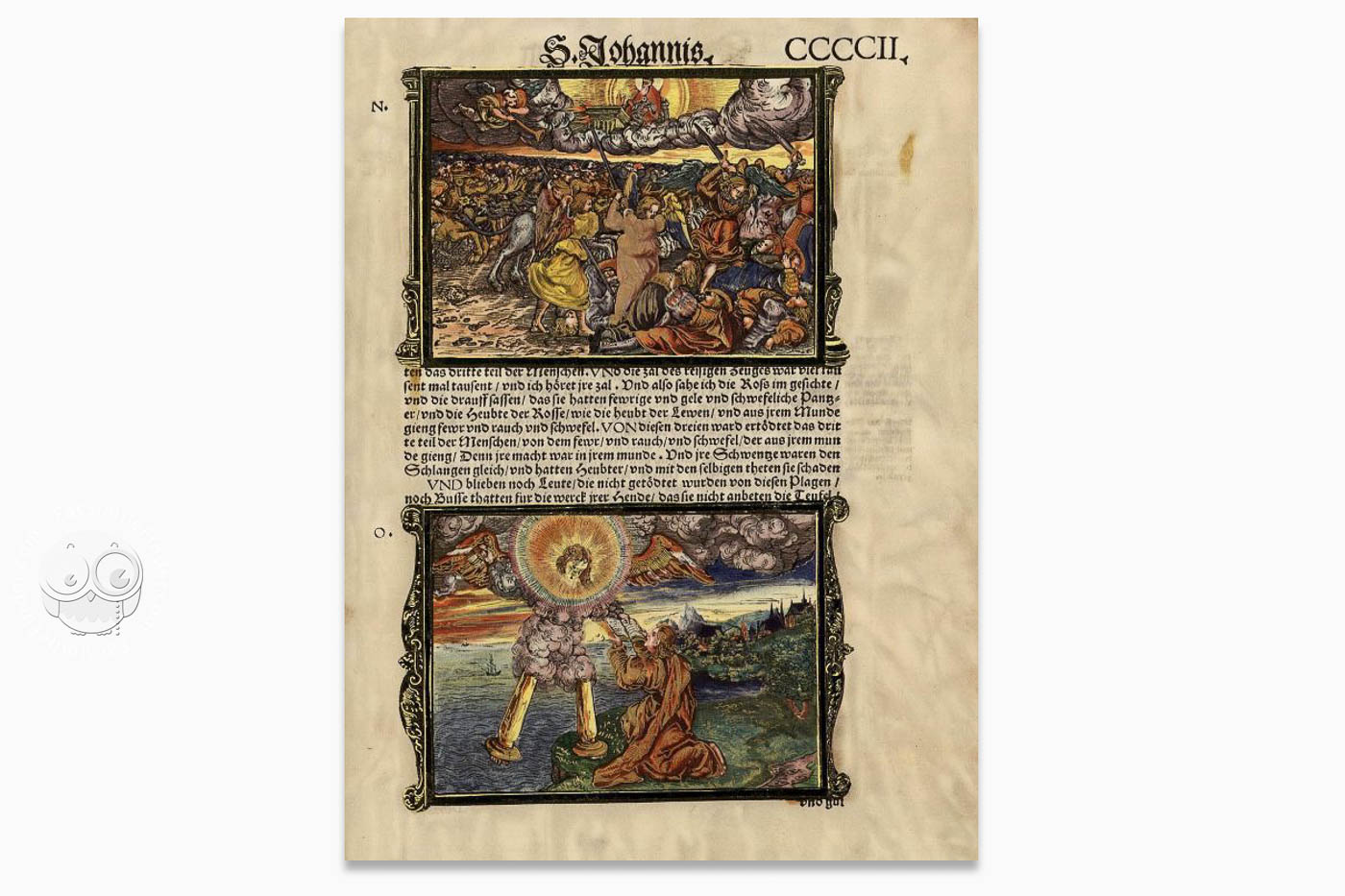
The Zerbster Prunkbibel belongs to that remarkable moment when the prestige of the illuminated book continued to shape the age of print. Produced in Wittenberg in 1541 by Hans Lufft, the printer most closely associated with Lutheran Bible publishing, this lavishly embellished Apocalypse preserves the force of Martin Luther’s German translation while presenting it with exceptional visual richness. Today associated with Stadtarchiv Zerbst, it stands as a rare witness to the ceremonial ambitions of the Reformation book.
A Printed Apocalypse with Courtly Presence
Though not a manuscript in the strict sense, the volume carries forward many of the aspirations of the deluxe codex. Its pages suggest that early Protestant print culture did not reject magnificence, but redefined it. The sacred text is offered not simply for reading, but for display, contemplation, and authority. In this way, the book occupies a fascinating space between typographic reproduction and the lingering aura of the hand-finished volume.
Cranach Workshop Imagery
Its distinction rests above all on the colored woodcuts attributed to the workshop of Lucas Cranach the Younger. These images translate the visions of Saint John into scenes of urgency, judgment, and revelation. The bold clarity of the printed line, intensified by color, gives the cycle a dramatic immediacy well suited to the prophetic character of the text. Word and image work together to make the Apocalypse not only legible, but vividly present.
Reformation, Vision, and Splendor
The Zerbster Prunkbibel reveals how a printed biblical text could still claim the dignity once reserved for princely manuscripts. It embodies a culture in which scripture, image, and material splendor remained deeply intertwined, even in an age increasingly defined by the press.
We have 1 facsimile edition of the manuscript "Zerbster Prunkbibel - The Apocalypse": Zerbster Prunkbibel, "Cranachbibel" : die Apokalypse facsimile edition, published by Edition Leipzig, 2008
Request Info / Price