
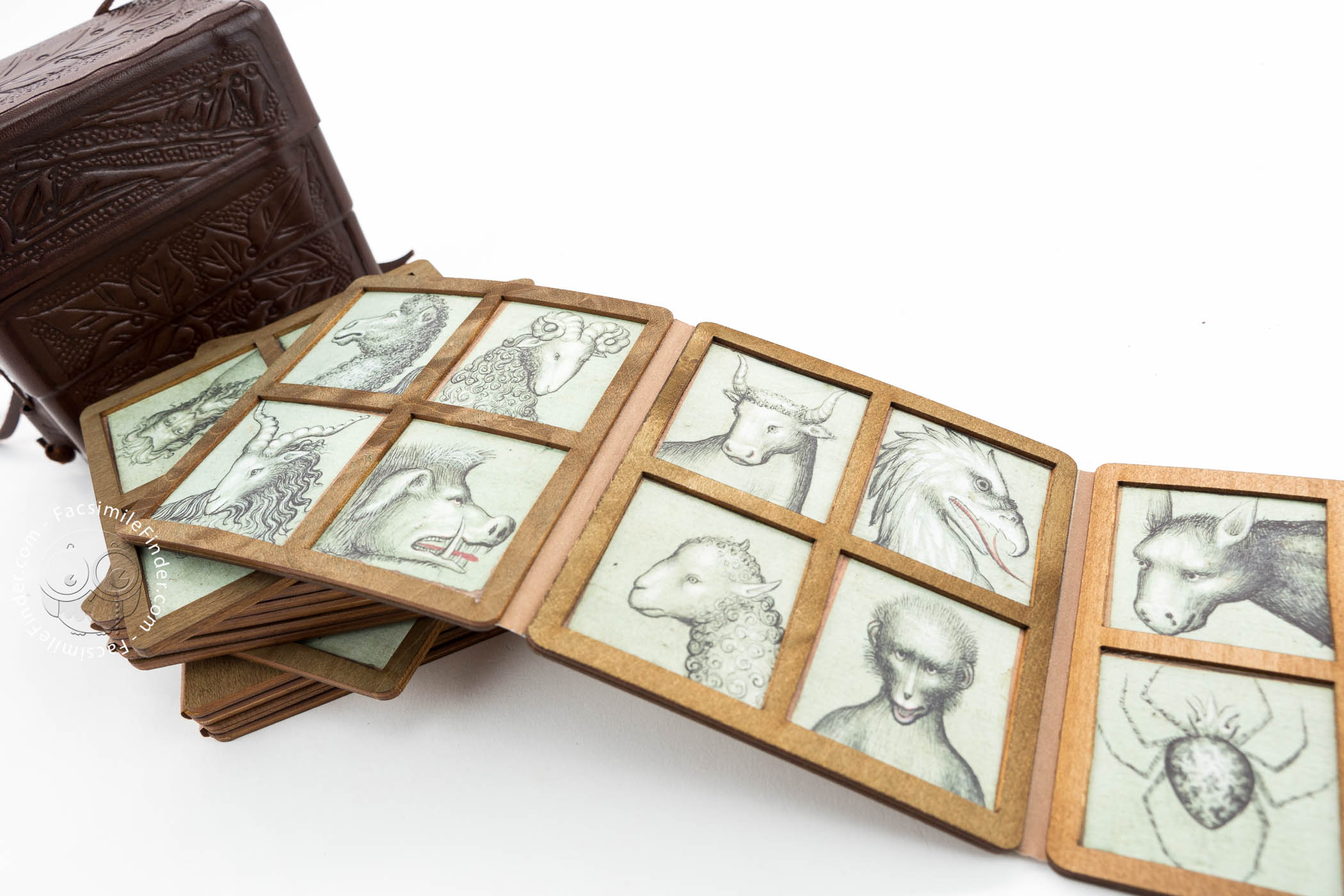
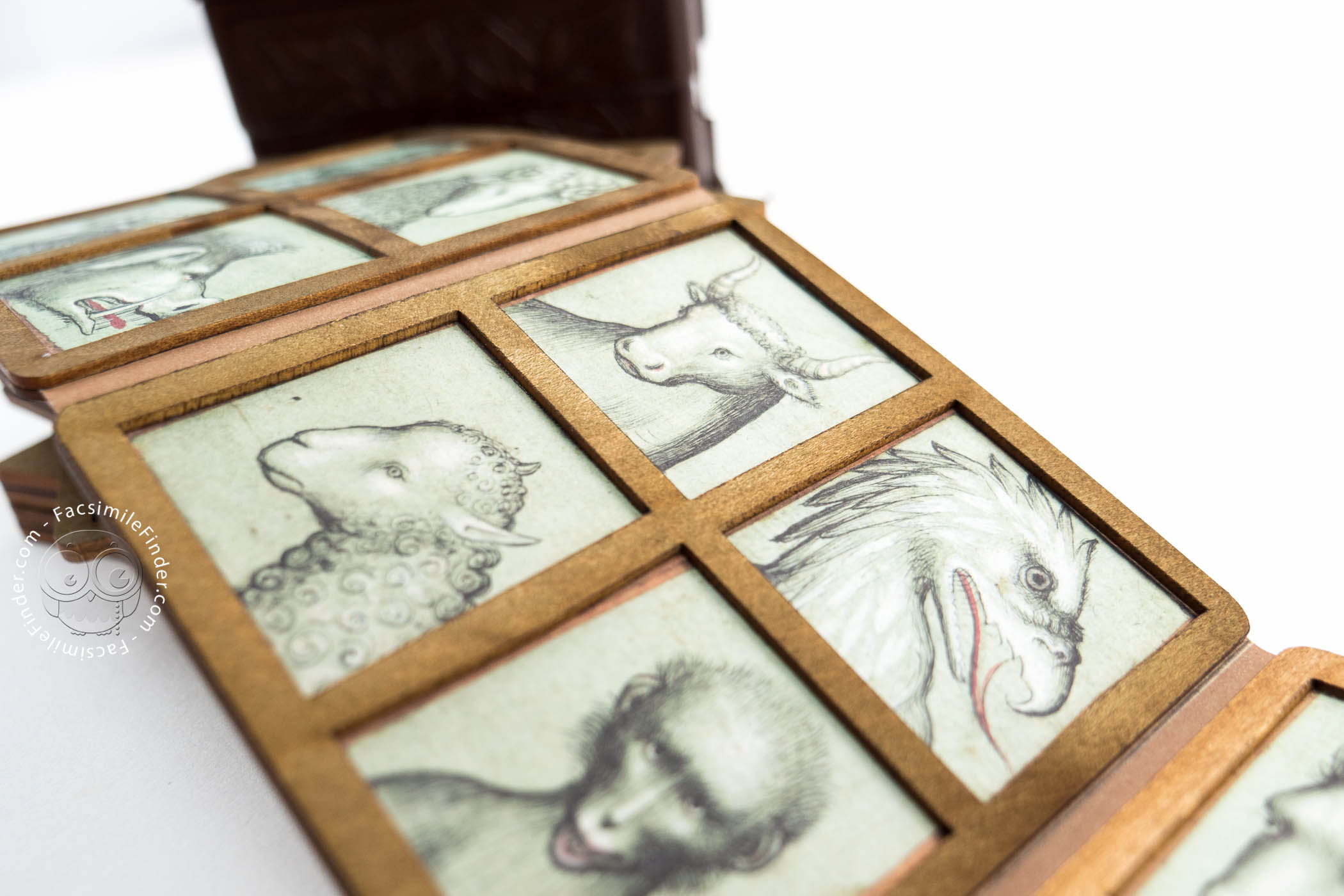
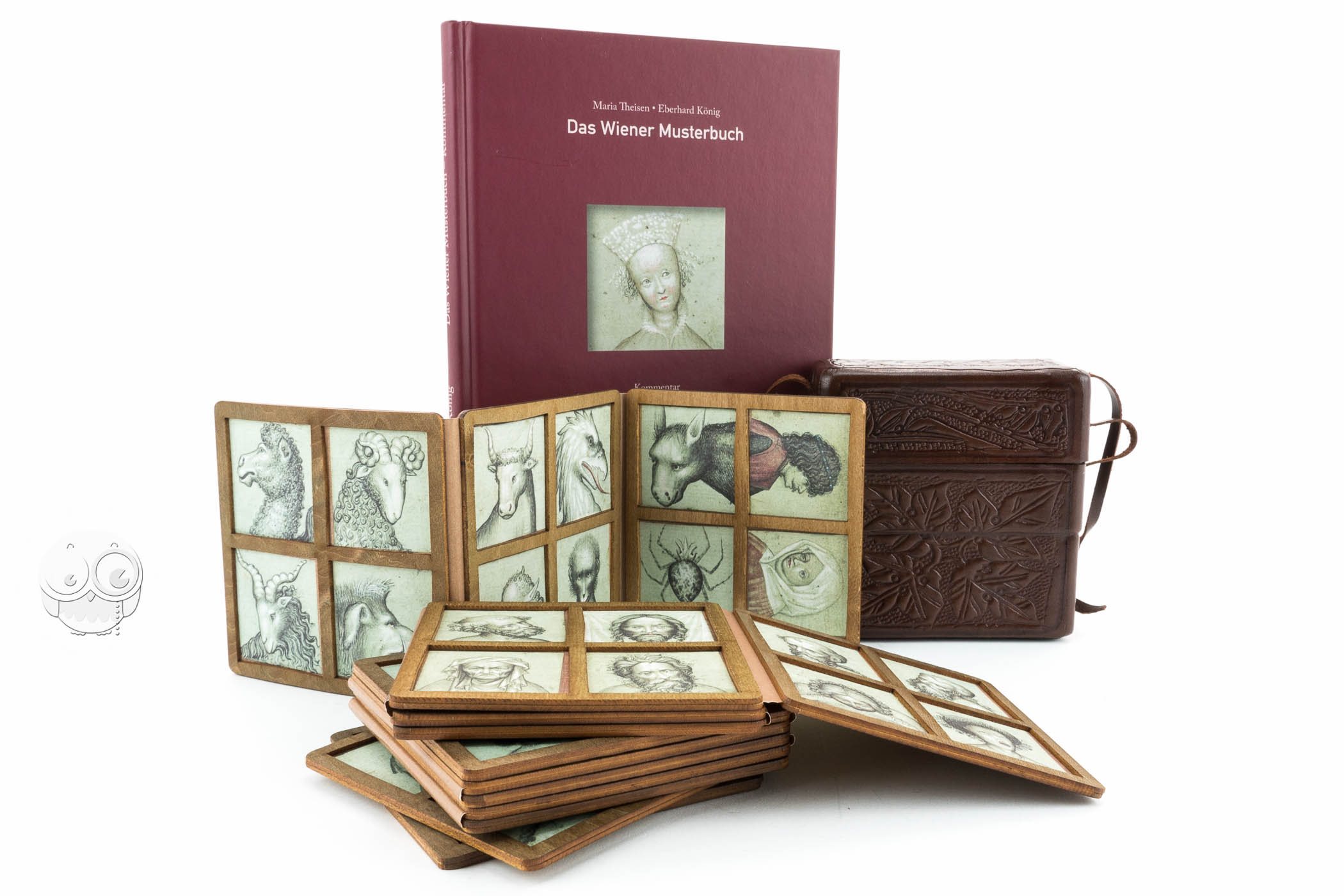
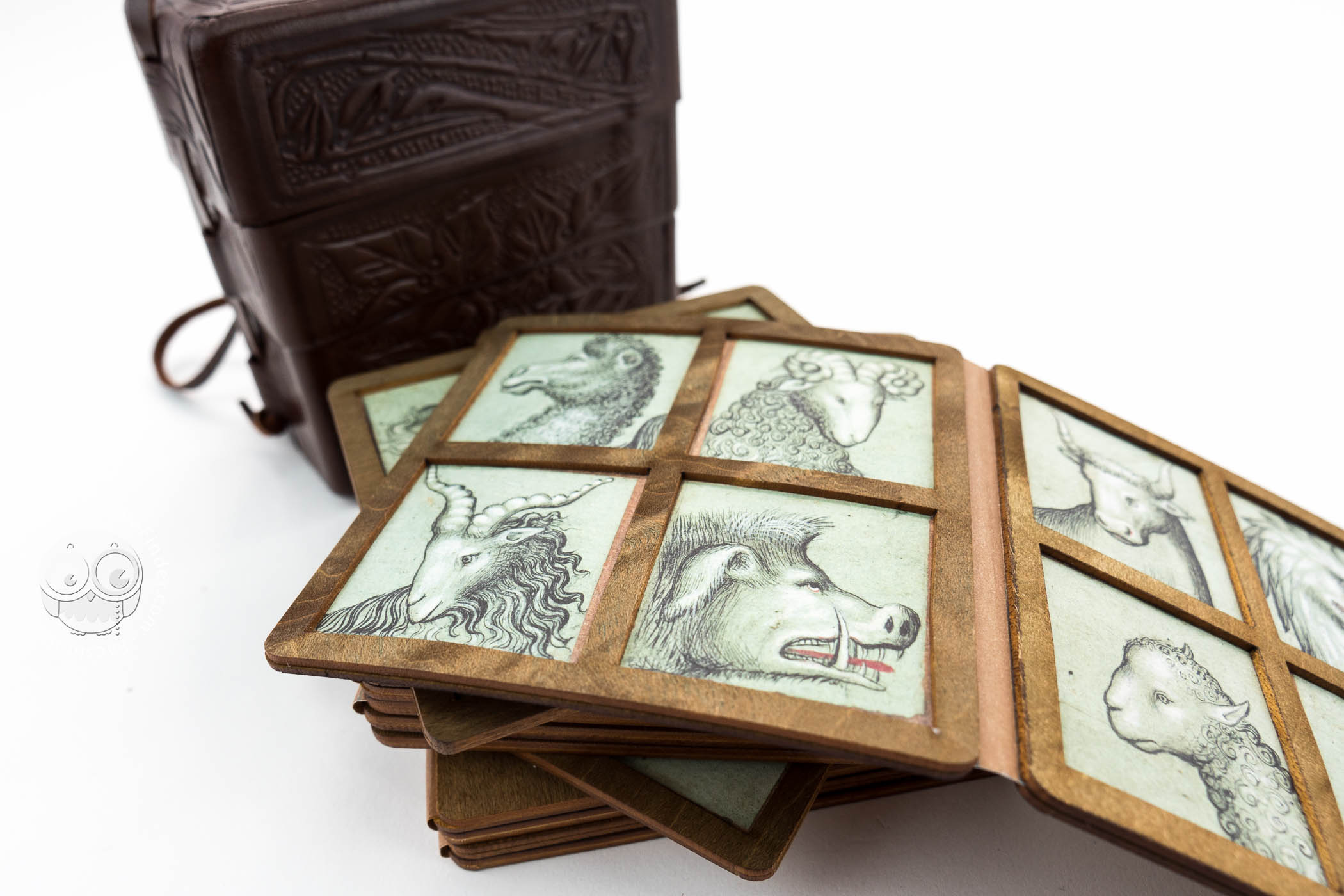
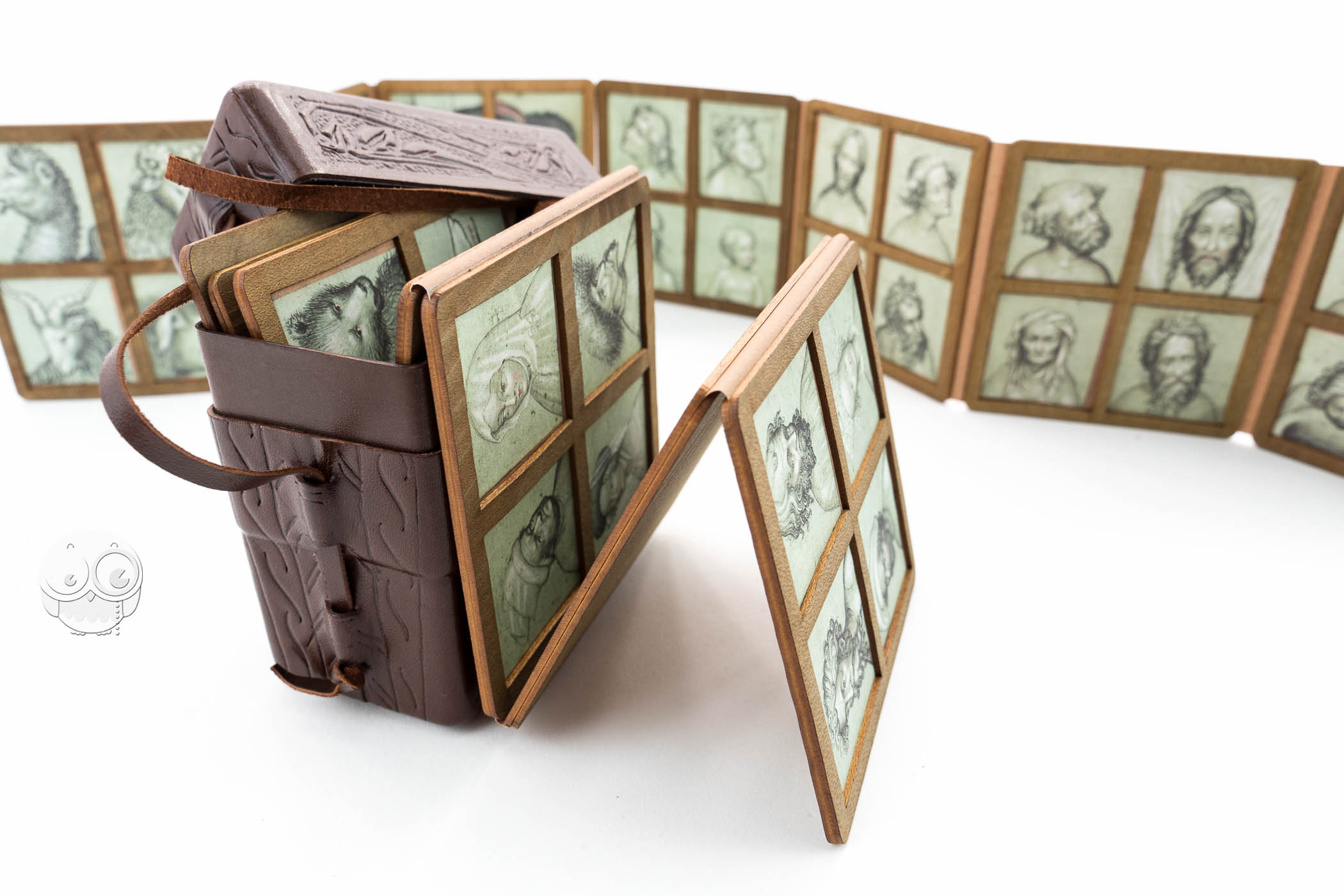
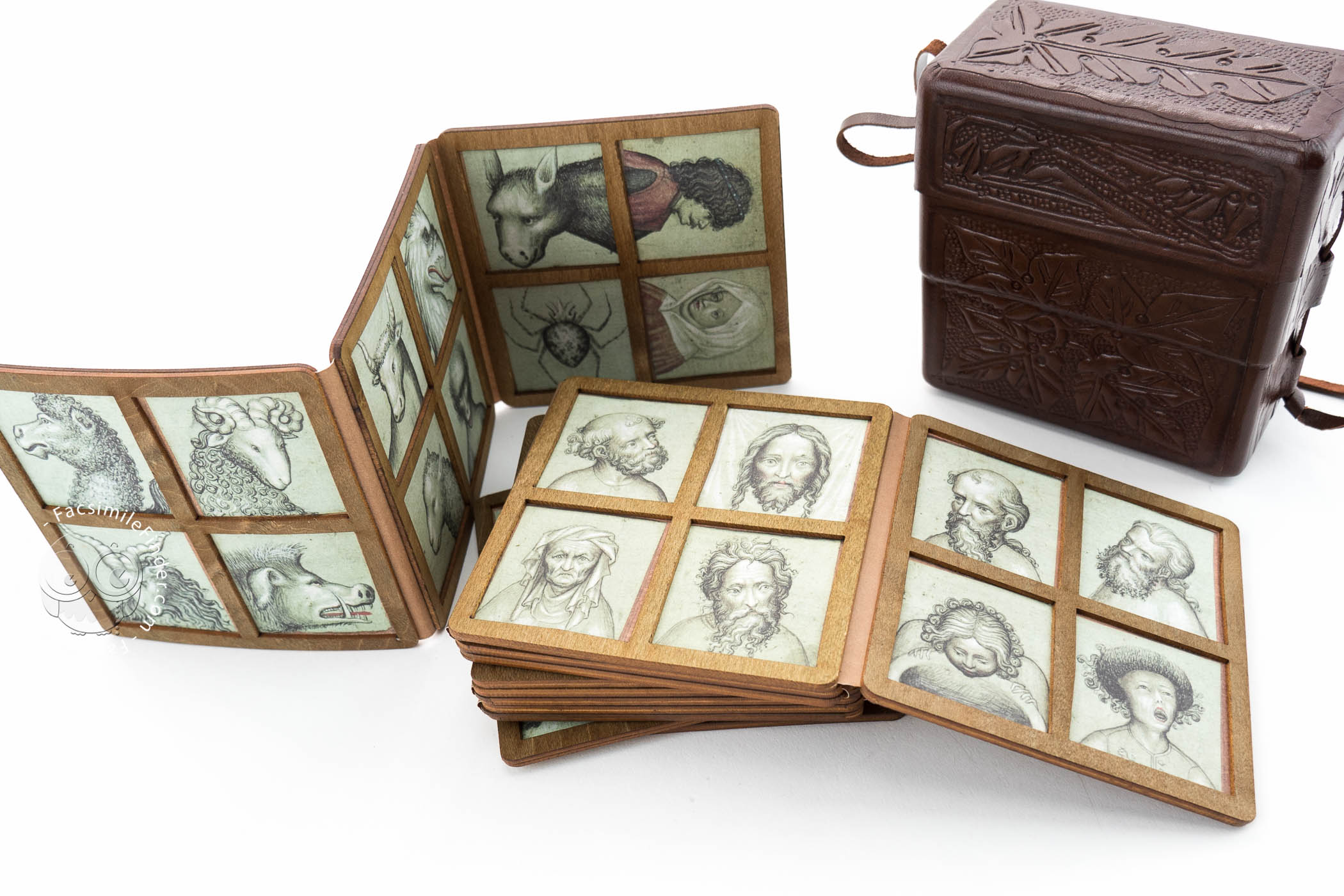
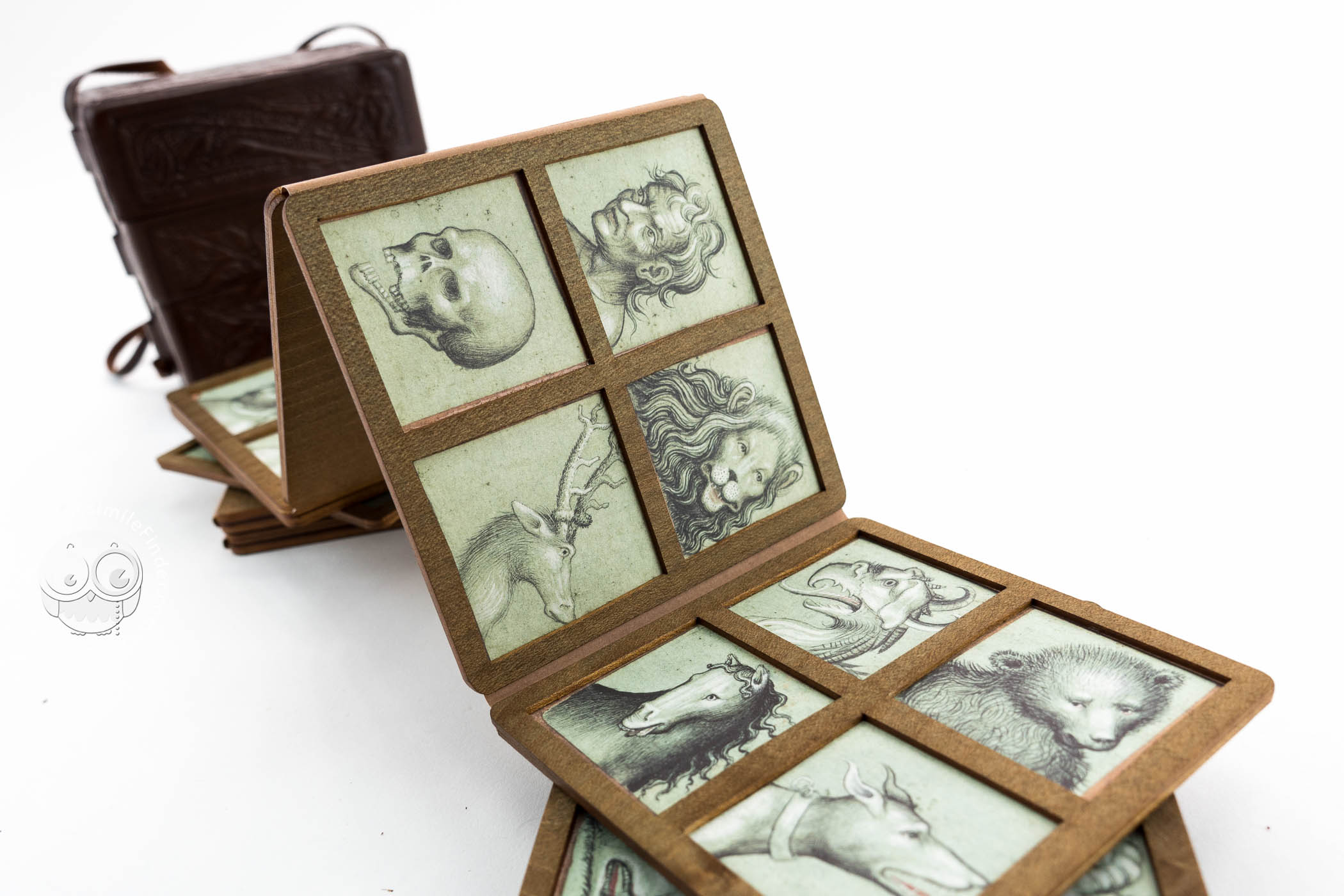

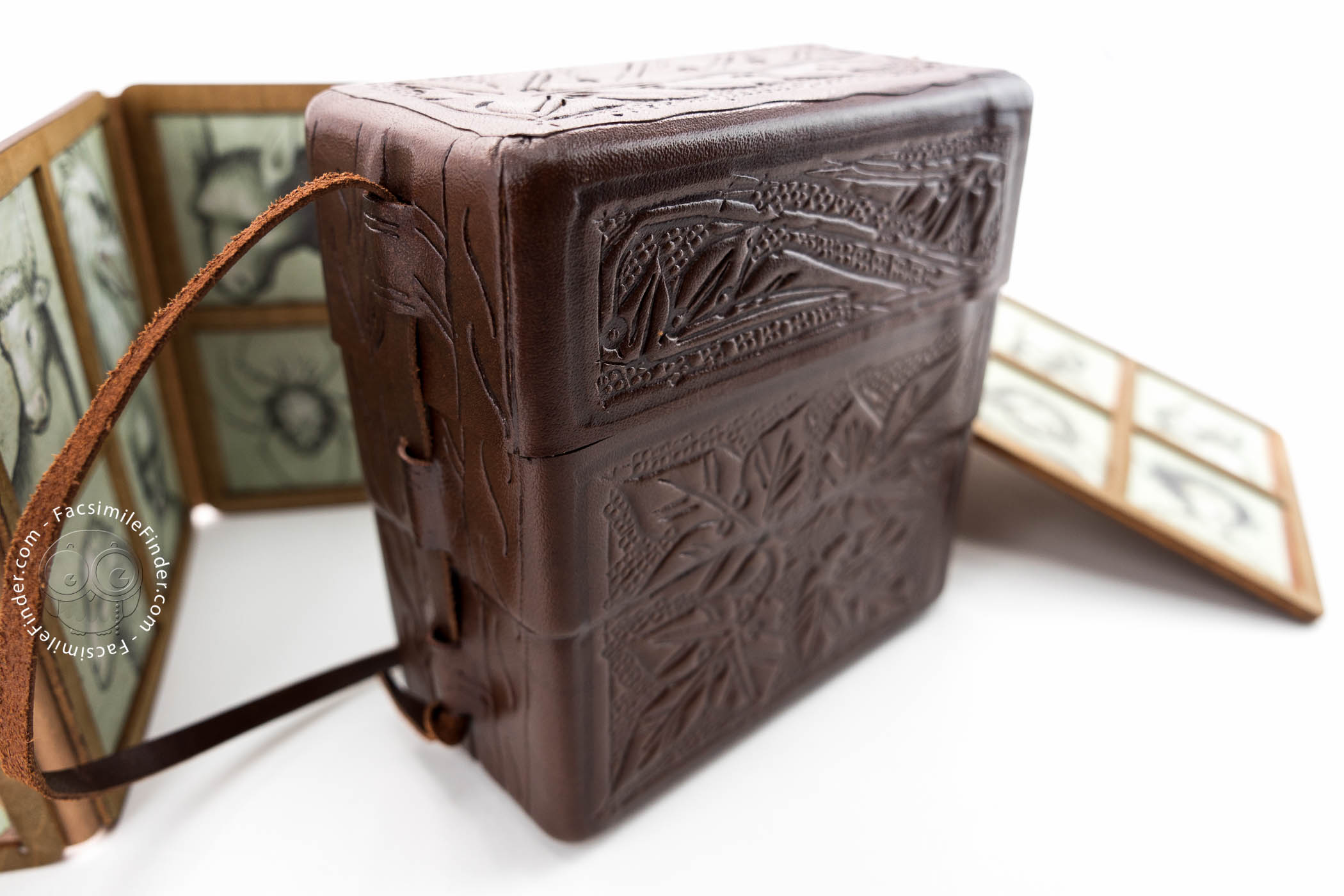

Despite its name, the intended purpose of the Vienna Model Book remains a mystery. It was possibly designed to be carried around by its artist as a collection of work to show potential patrons. Made around 1410-1420 by a Bohemian artist, except for two later drawings, the object comprises fourteen maple panels gathered in a leather case with a strap. It is a collection of silverpoint drawings with touches of white and red, including thirty-nine human heads and seventeen heads of animals and mythical creatures.
The object is unique. Its tiny, captivating drawings (each about 4 cm square) nestle into shallow cavities, four per panel. These panels were joined with parchment strips (most of which survive), folding accordion-style to fit neatly in the case.
The Beautiful Style
The green-tinted paper and the delicate application of white and red found in the model book are strongly reminiscent of the technique of the Master of the Mandeville Travels, named for his work in the London Travels of John Mandeville. Given the small scale and delicacy of the drawings, the artist was certainly a manuscript illuminator.
The model book is a prime example of the Beautiful Style, the distinctly Bohemian version of the International Style fashionable at courts throughout Europe in the years around 1400. There is a courtly elegance to all the figures, even the animals, whose poses often reveal a sinuous neck.
Silverpoint, A Virtuoso Technique
The drawings were created using an instrument with a pointed silver tip on paper specially prepared to receive and retain the delicate lines of silver. In the model book, the mixture of bone and gum or glue spread across the paper's surface included a green pigment. The final touches of white and red paint were applied with tiny brushes of only a few hairs.
No corrections can be made to a silverpoint drawing. Furthermore, all the lines are very fine, so shading can only be achieved through dense hatched lines, a painstaking process. Although the drawings may have served as models for manuscript painting, they were undoubtedly intended to impress.
Identifiable Figures
Some of the drawings include details that allow the subjects to be named. There are two heads of Christ identifiable by the presence of a crown of thorns (panel 1). In another instance, a face on a fictive cloth represents the impression of Christ's face on the cloth of Saint Veronica (panel 4). The crowned women with high foreheads may be images of the Beautiful Madonna, a pictorial type developed in Bohemia (panels 6 and 7).
Unusual Creatures
Among the animals are many that would be familiar in contemporary Bohemia, but others—including a lion, a camel, an ape, and the mythological griffin—owe some of their appeal to their strangeness (panels 10-13). Also included are a human skull and a larger-than-life spider (panels 10 and 14).
A Miniature Picture Gallery
Although four of the connecting strips of parchment have been lost, the original sequence of the panels can be reconstructed, starting with humans (on the left) and ending with the animals (at right). This orderly arrangement suggests the object served as an artist's presentation piece.
Two human portraits, later additions made in Austria, occupy the last two cavities. Perhaps around the same time, a piece of paper was affixed to the back of panel 2. This bears a Latin-language school text in dialogue form written in Gothic Hybrida.
A Case of Stamped, Incised, and Punched Leather
The wooden case is of the highest quality. Its leather covering boasts leaf designs created using an astonishing combination of techniques. The model book may have been owned by Margaret of Austria (1480-1530), Regent of the Netherlands, and it was surely in the collection of Ferdinand II (1529-1595), Archduke of Austria, in 1596.
We have 1 facsimile edition of the manuscript "Vienna Model Book": Wiener Musterbuch facsimile edition, published by Mueller & Schindler, 2012
Request Info / Price