
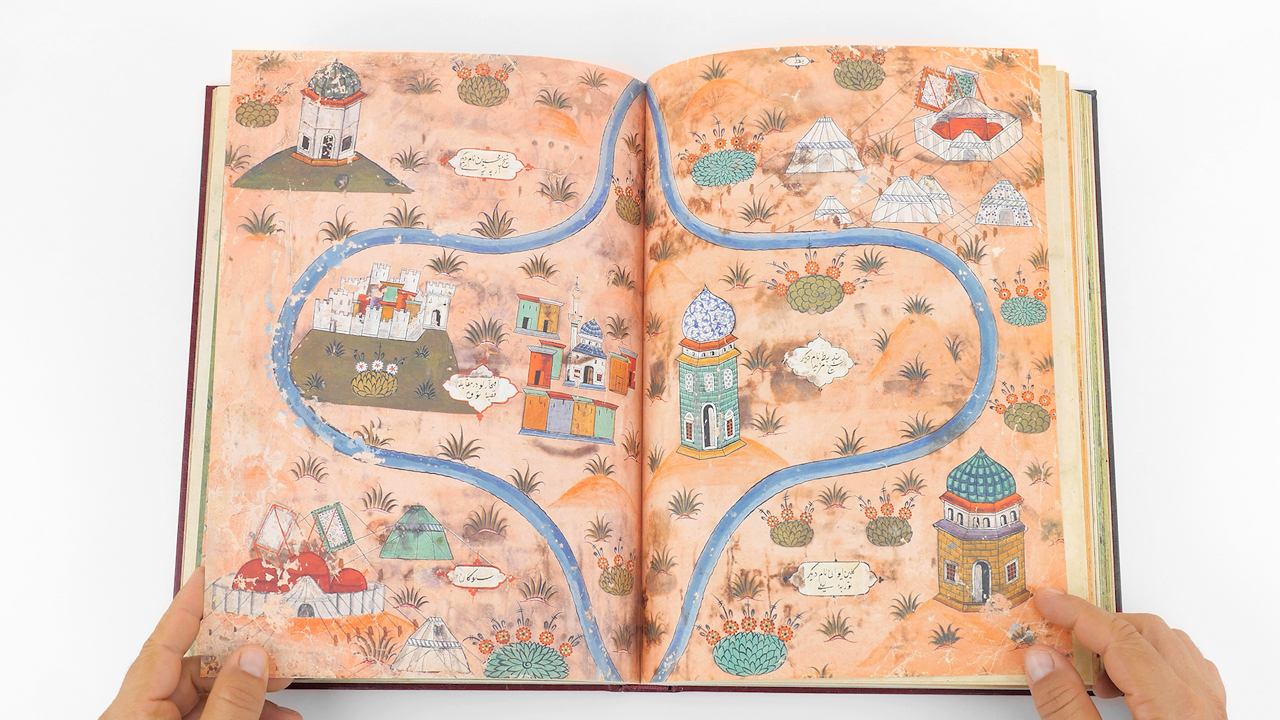
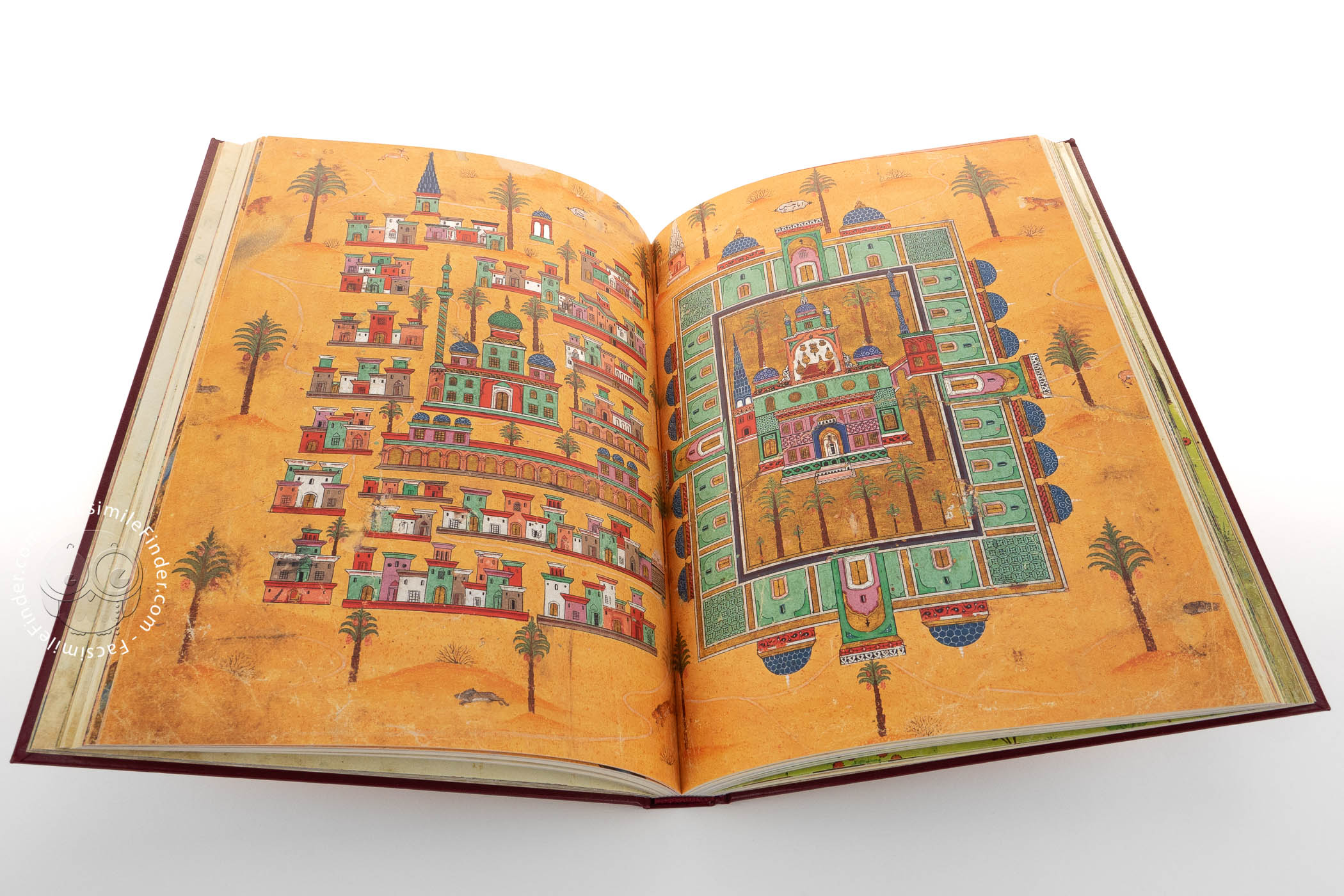

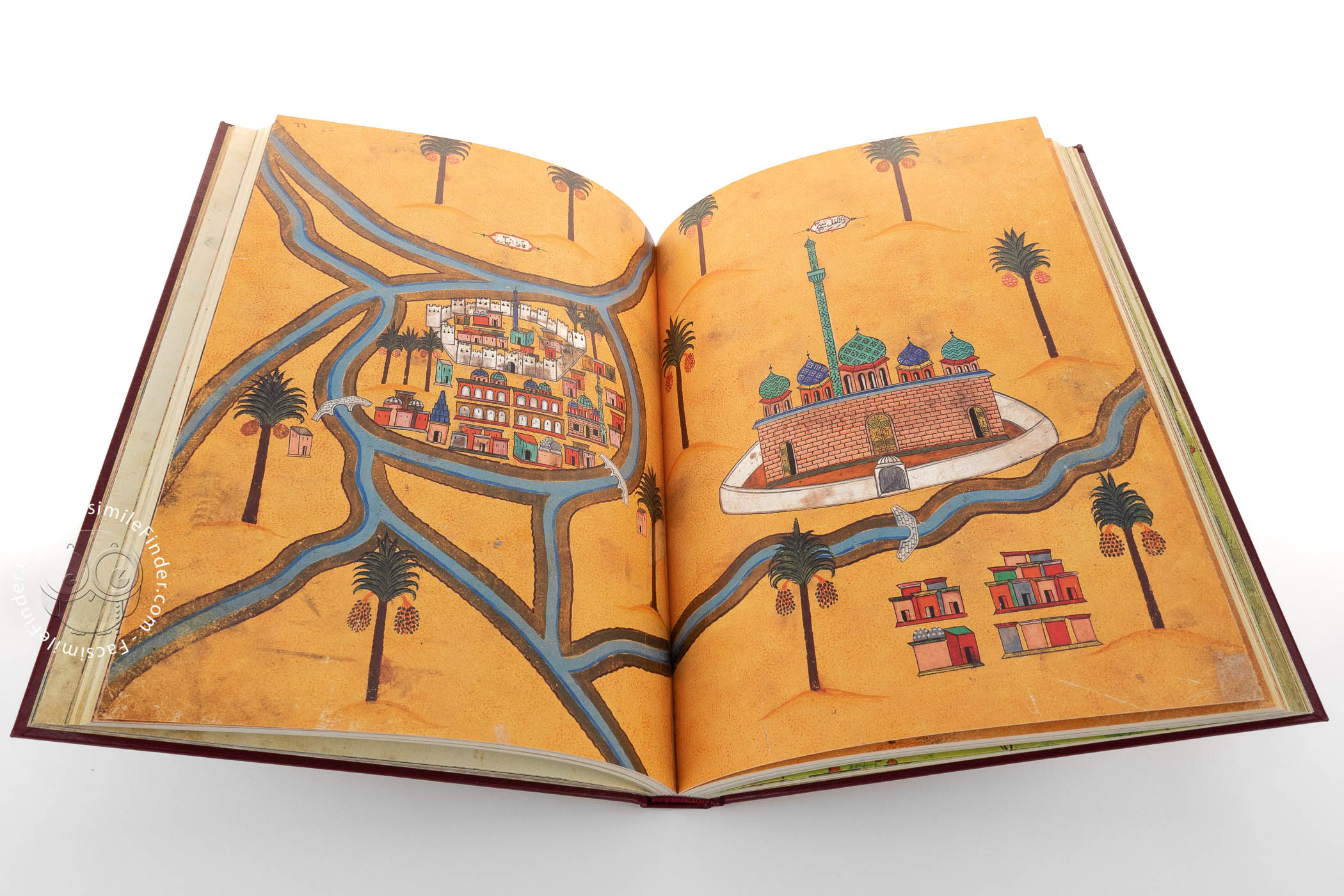
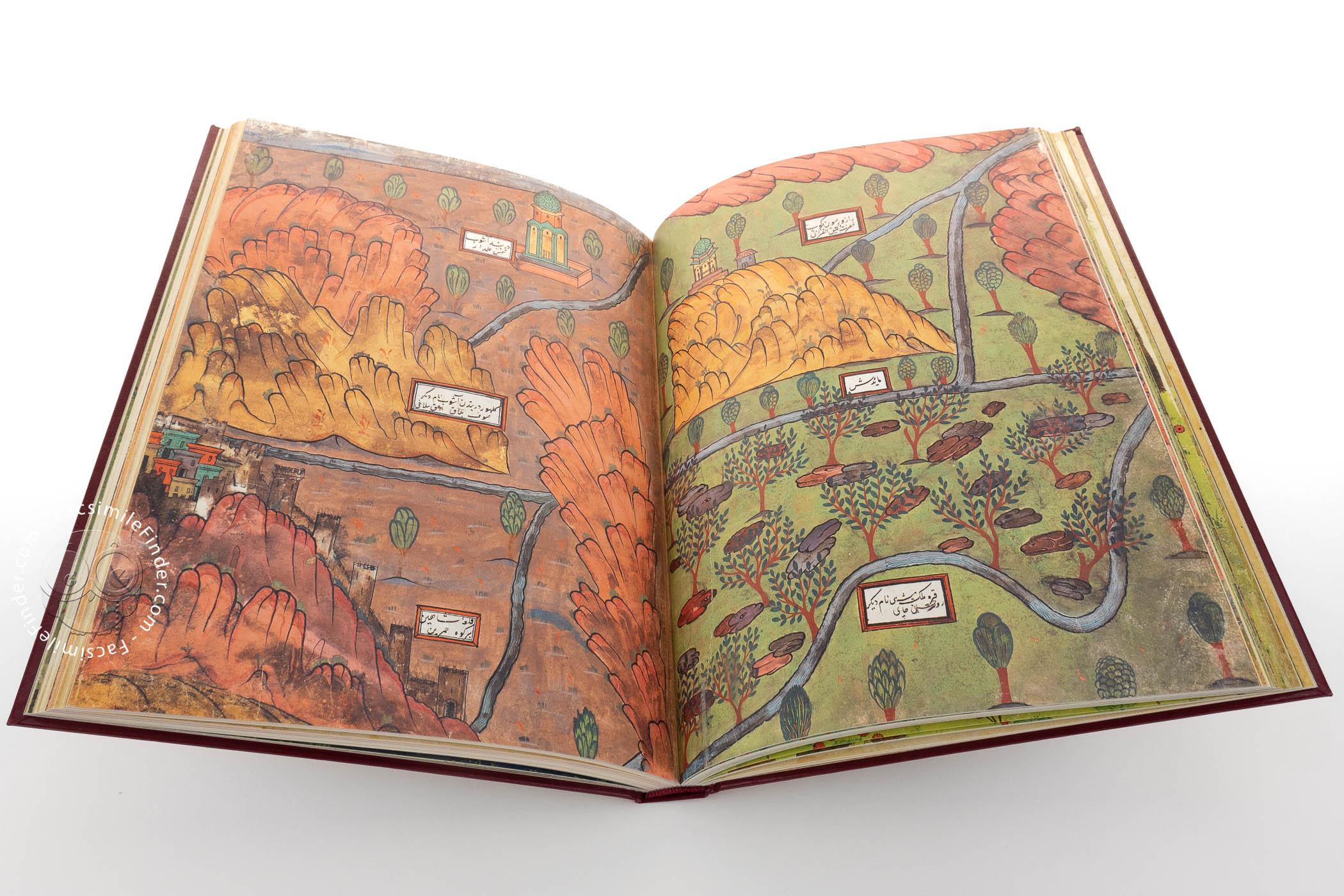
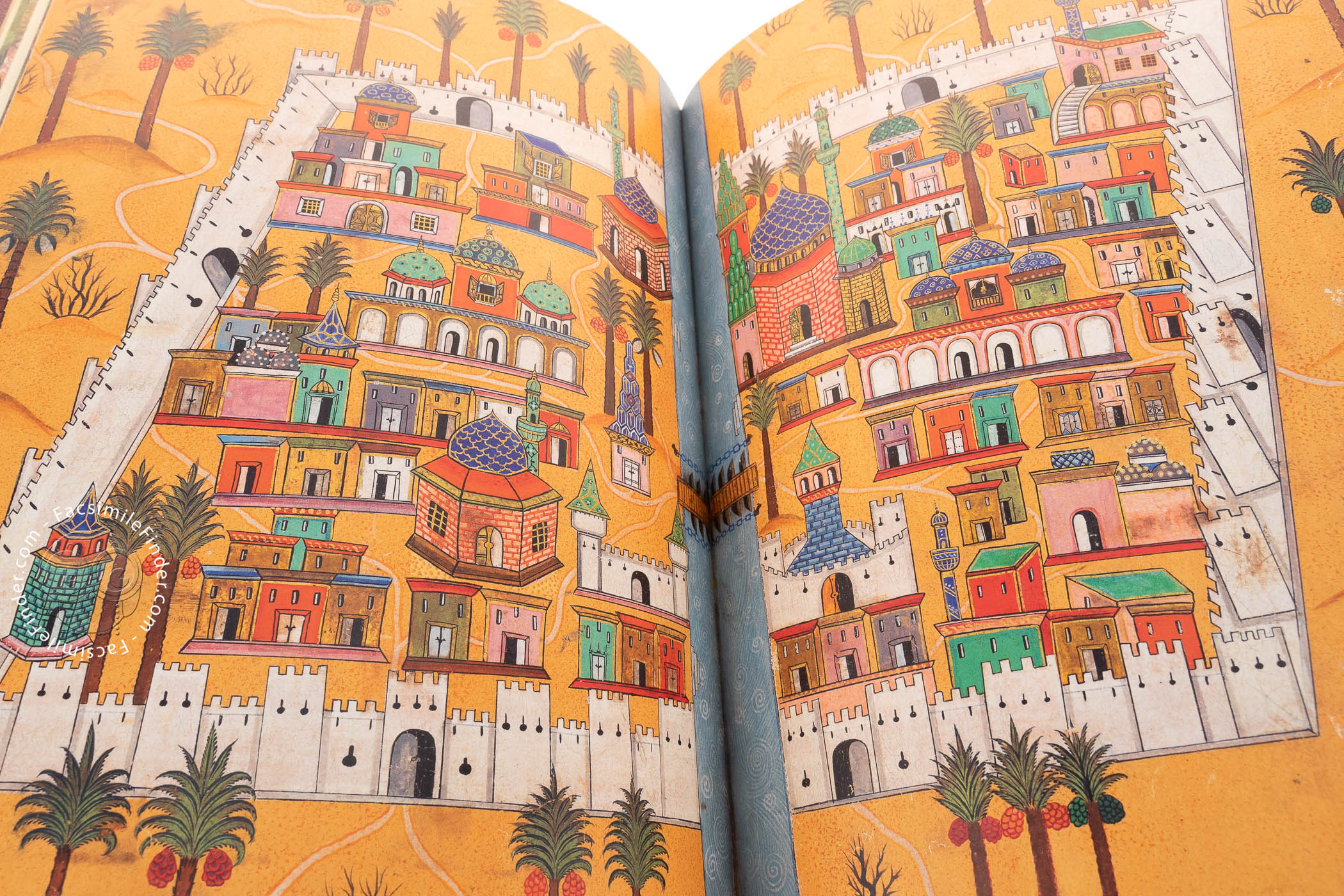
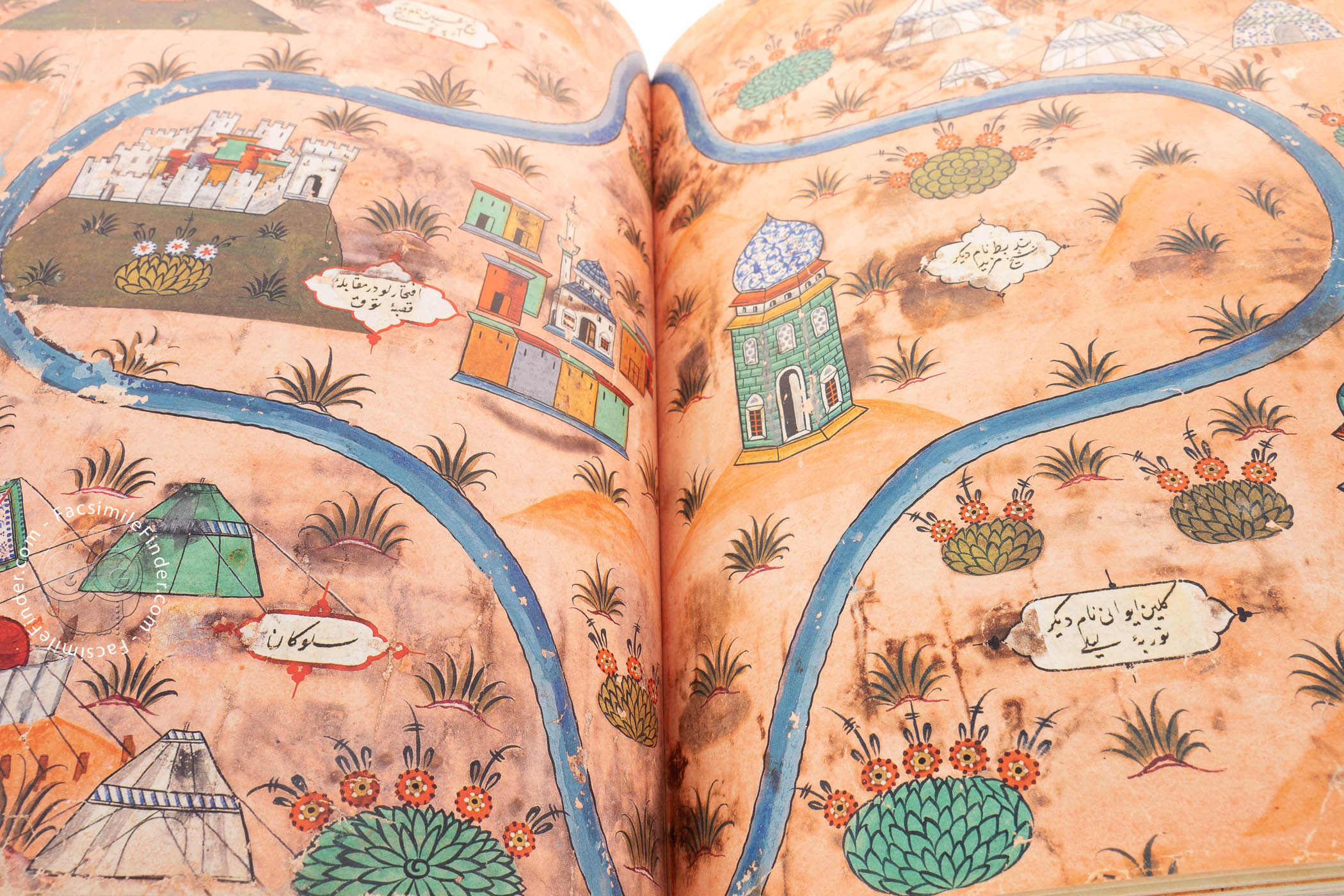
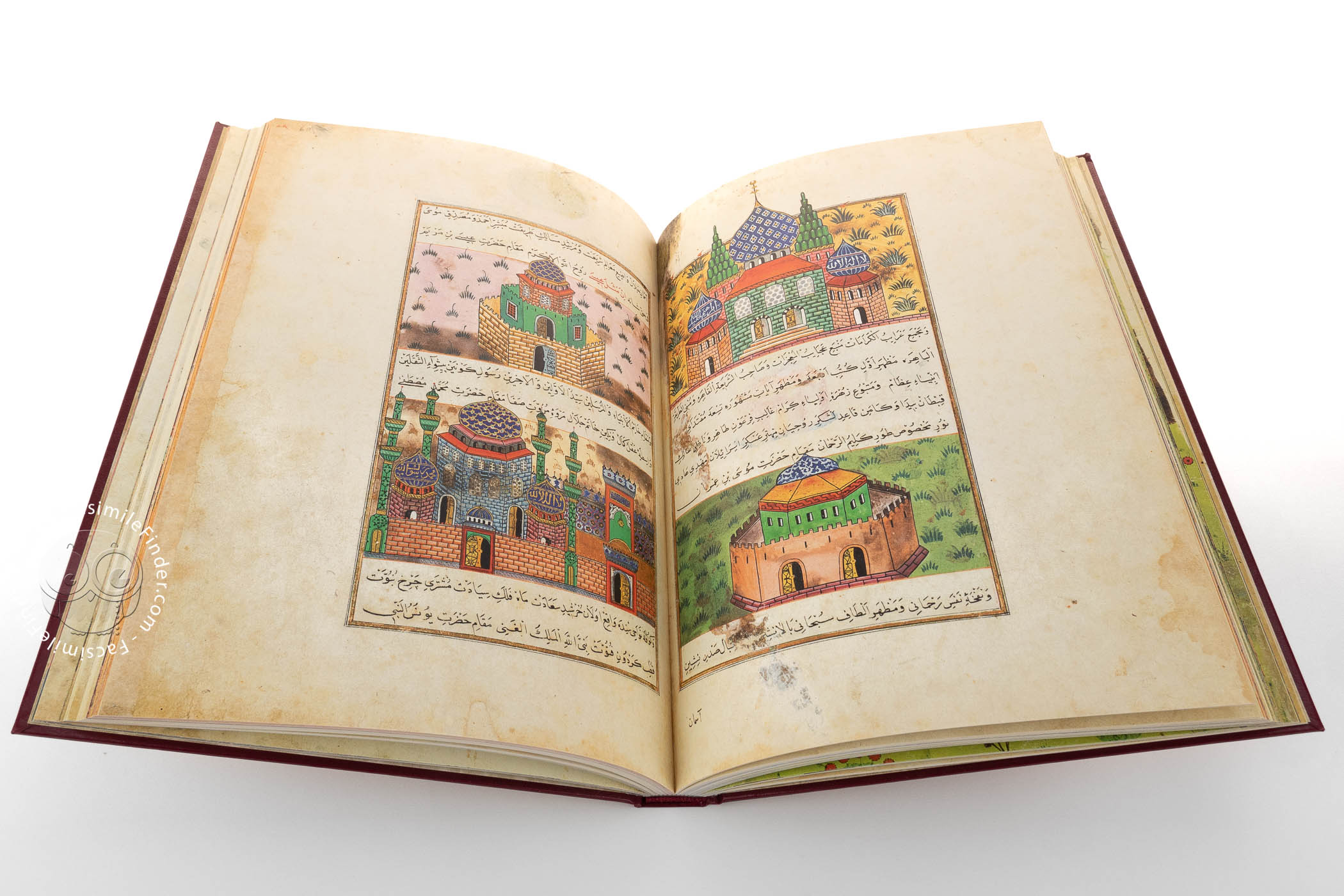

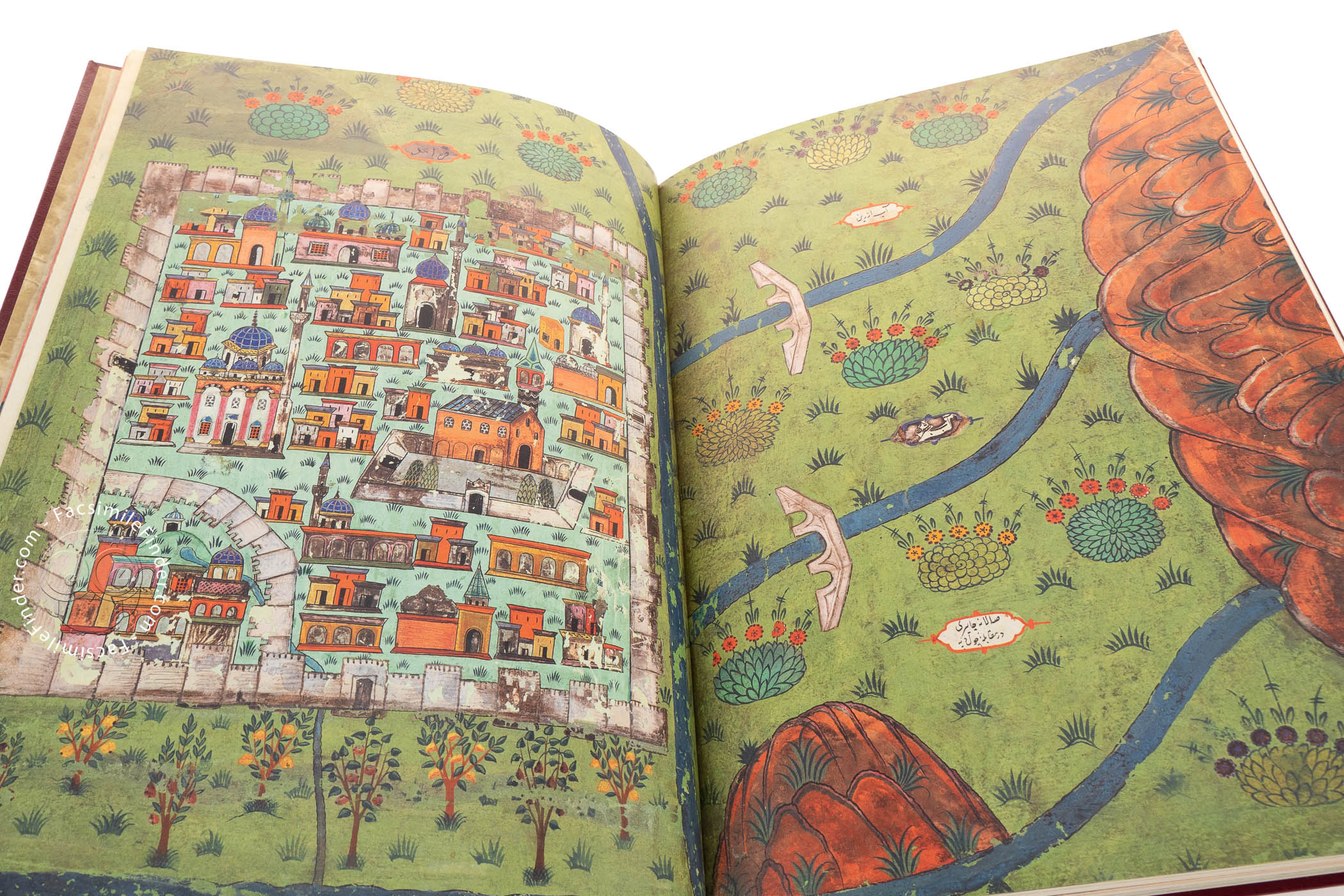

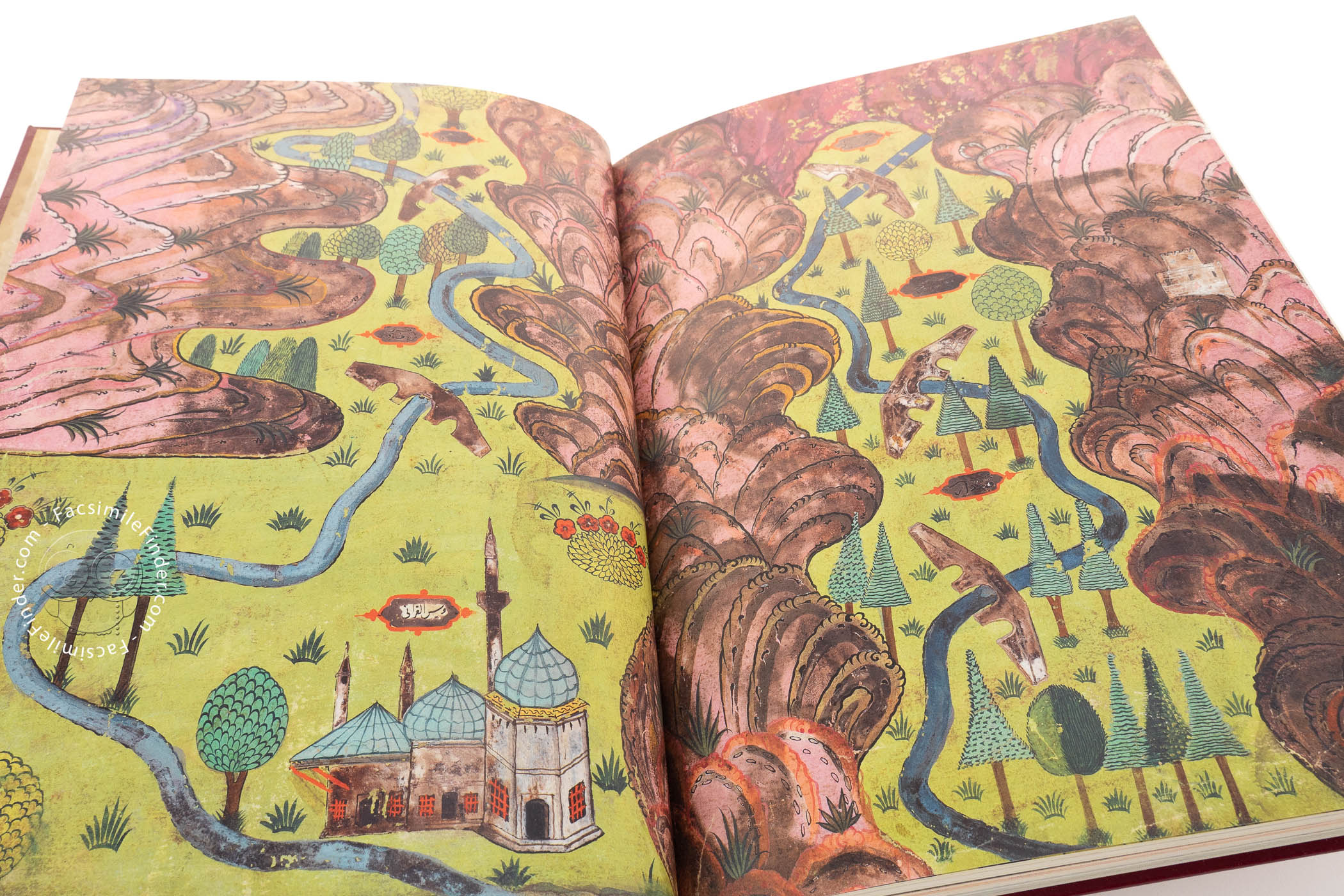

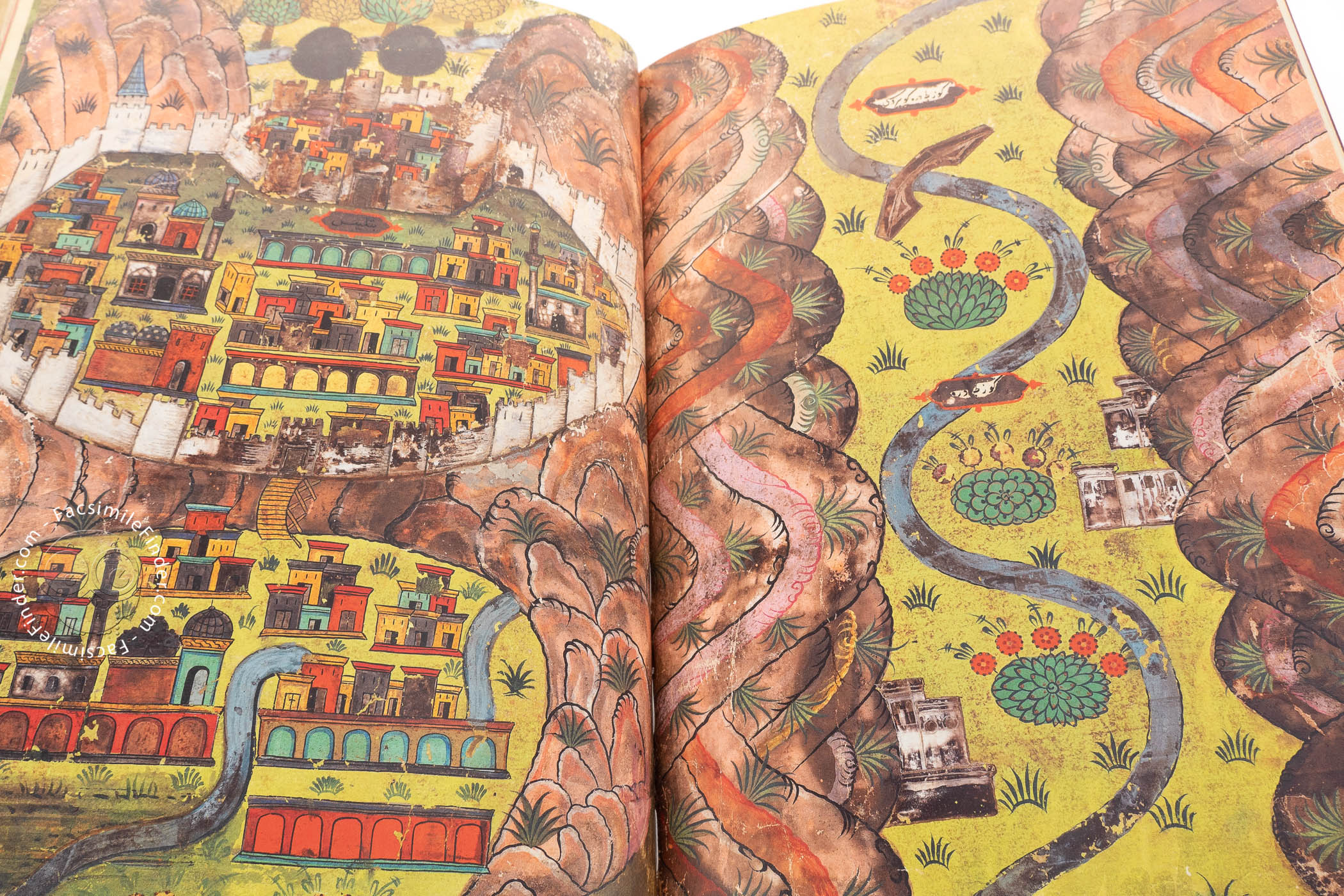

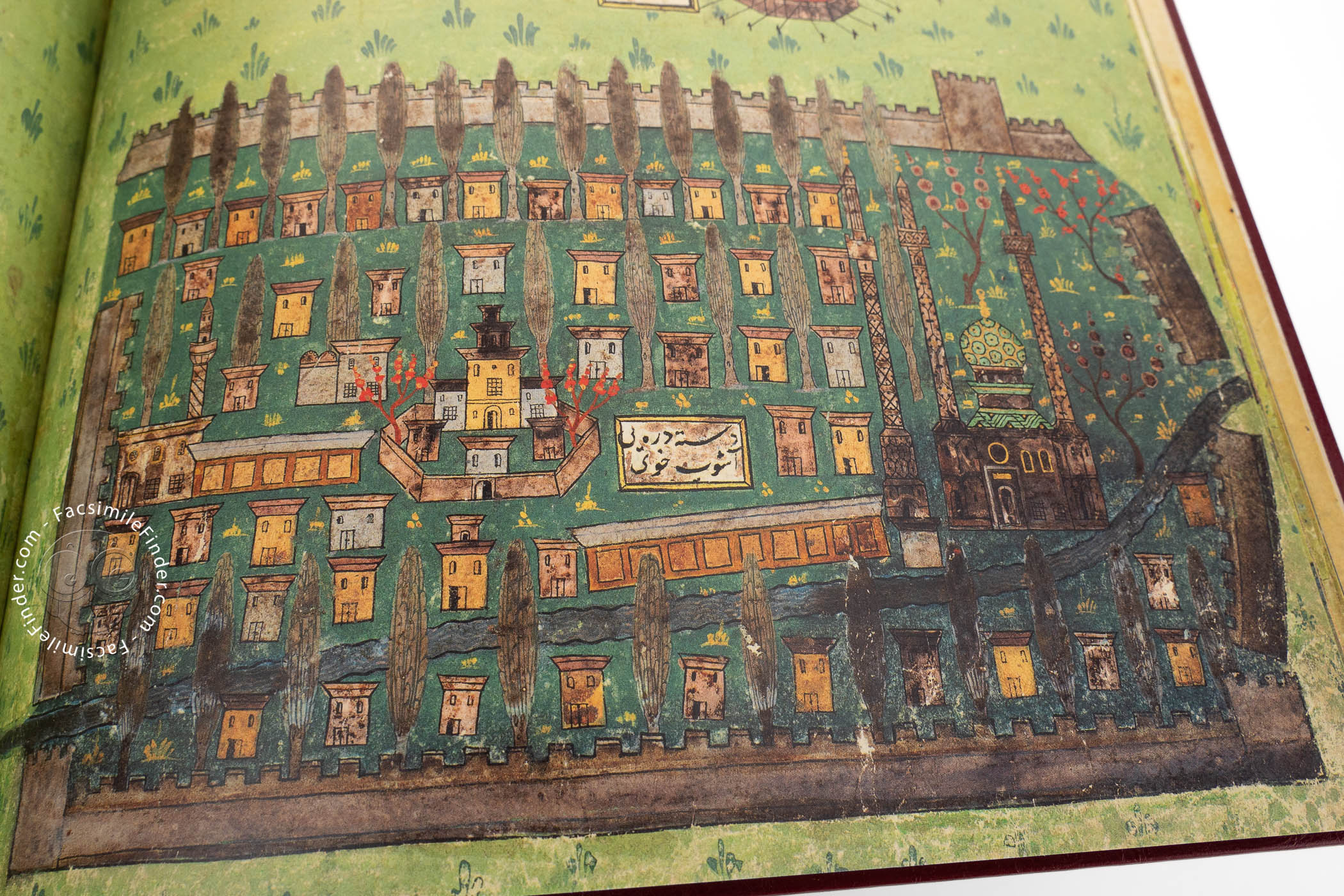
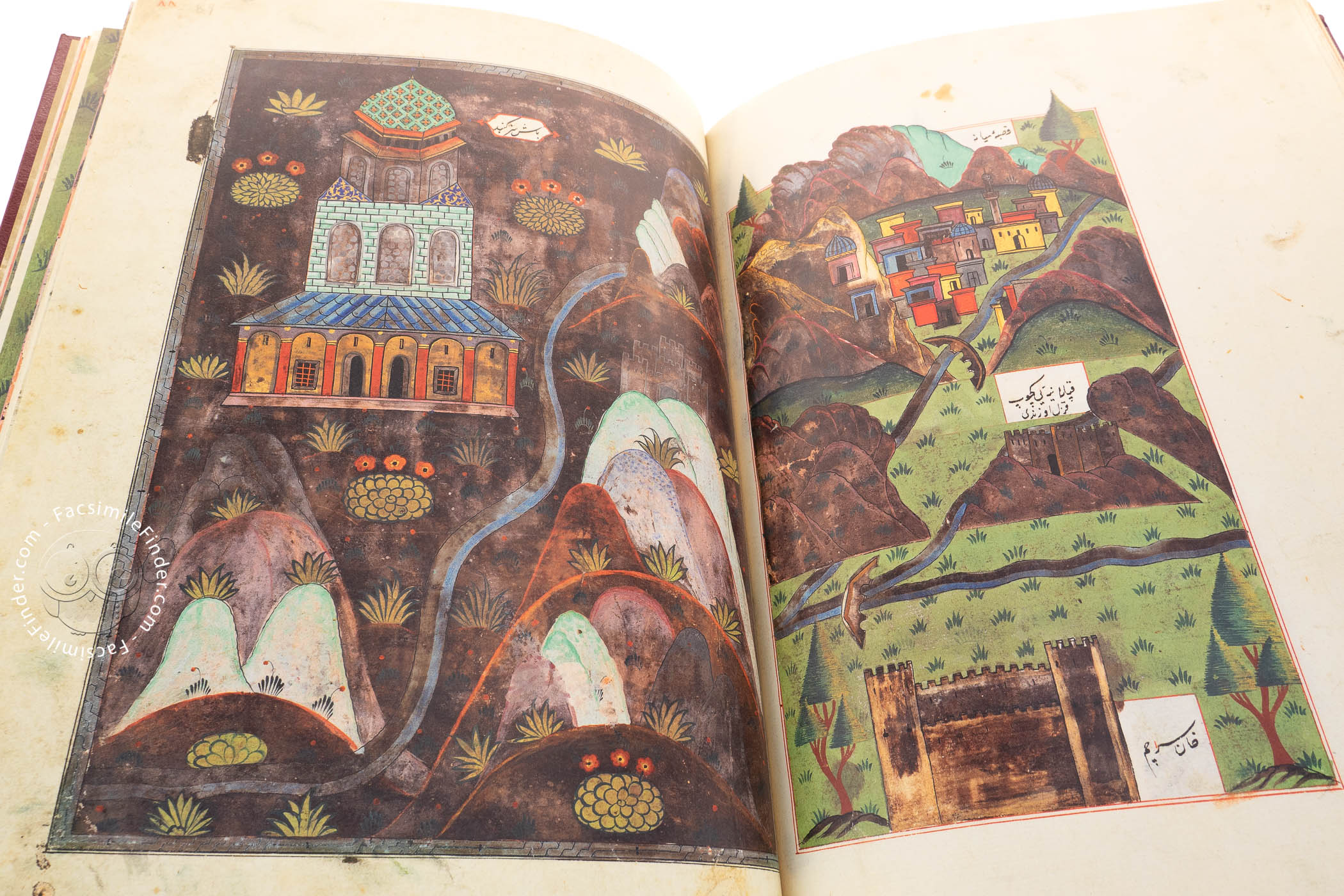

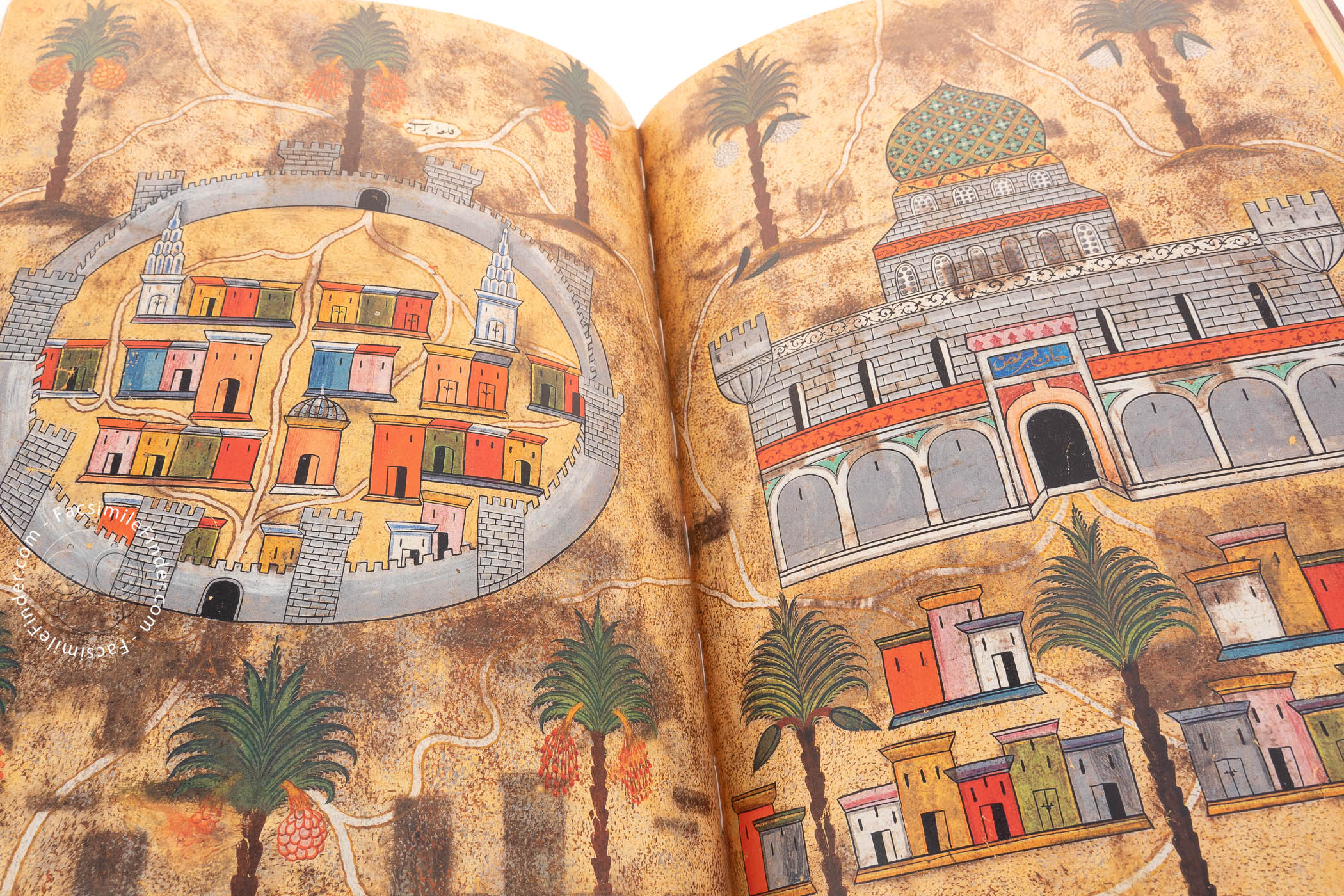
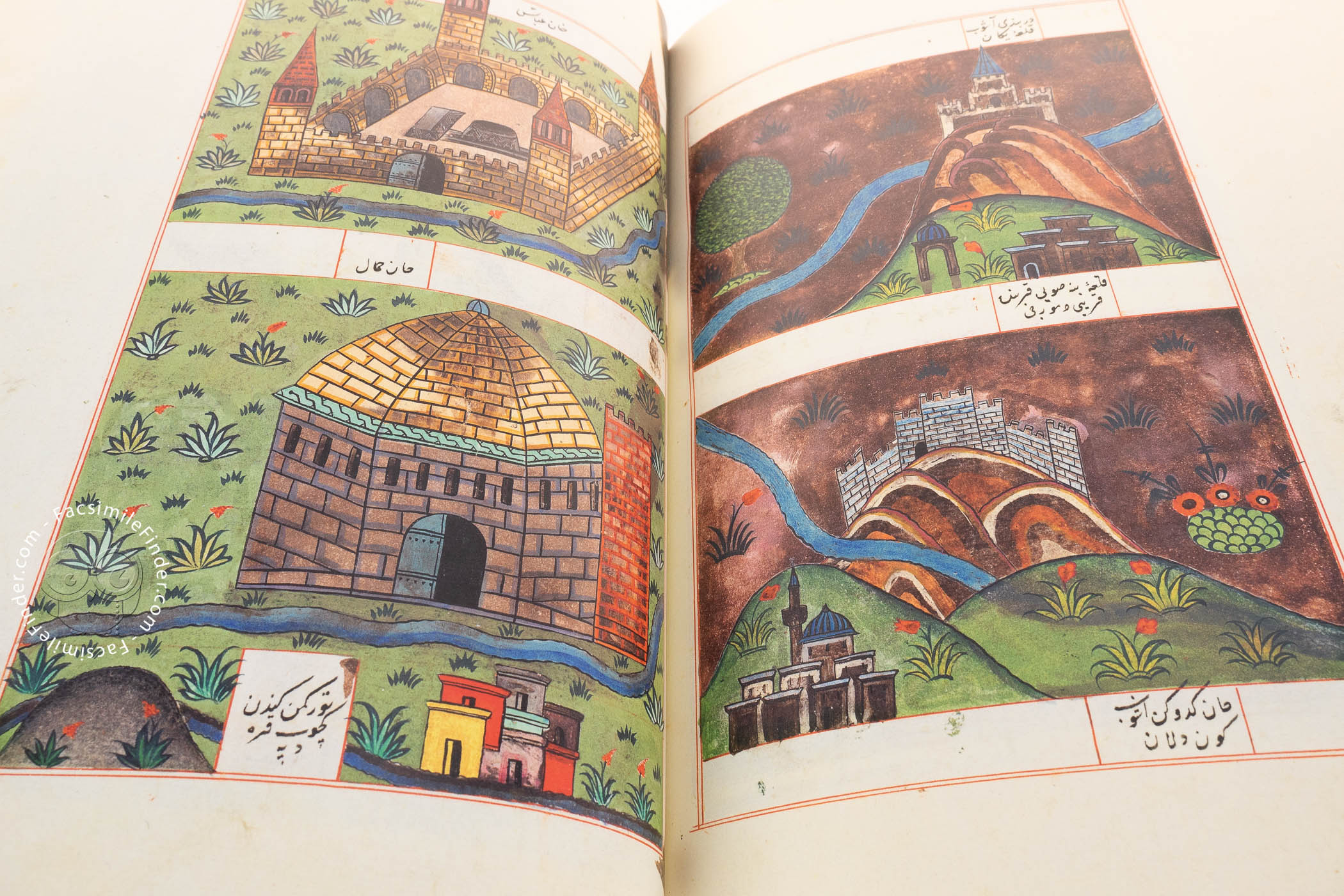
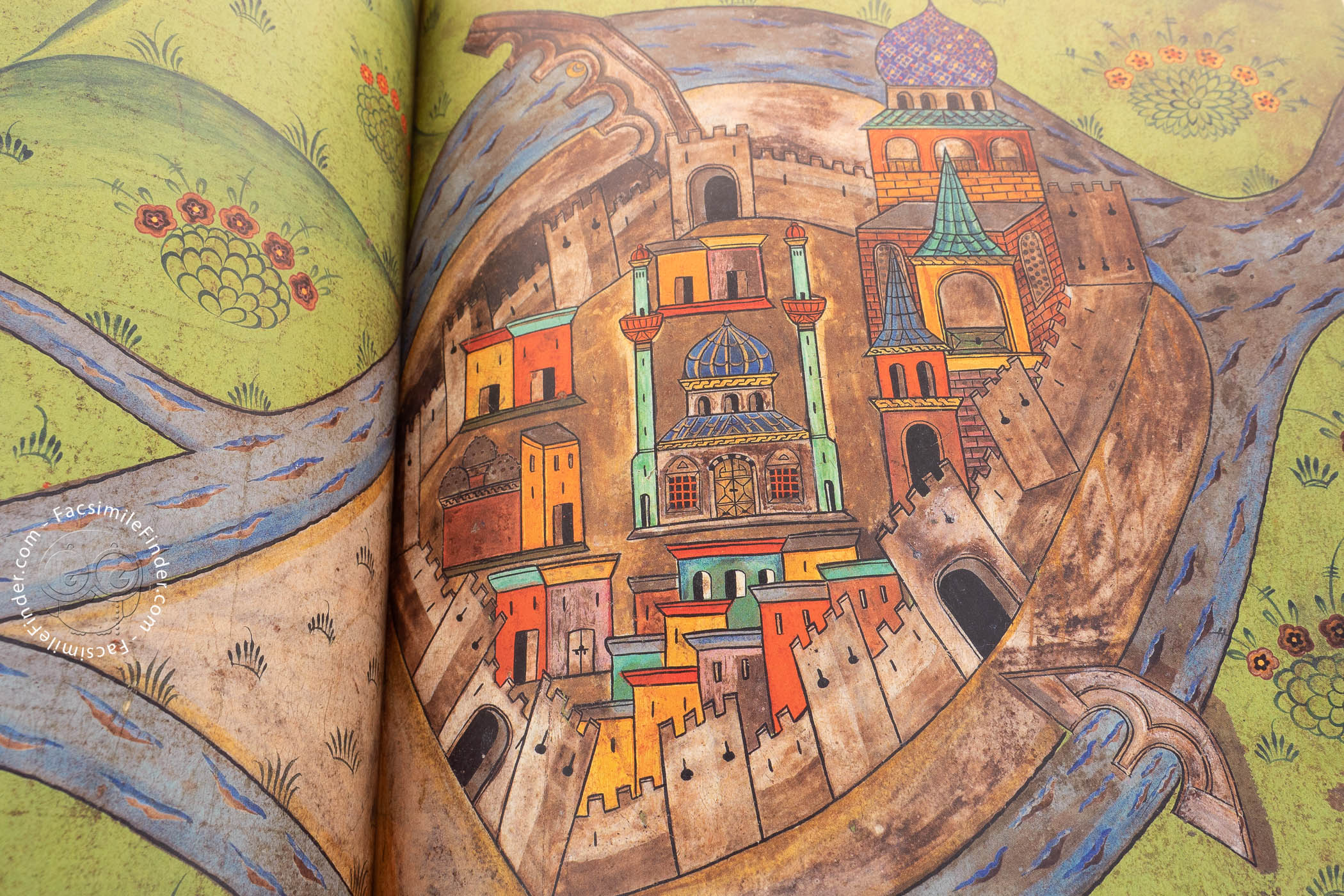
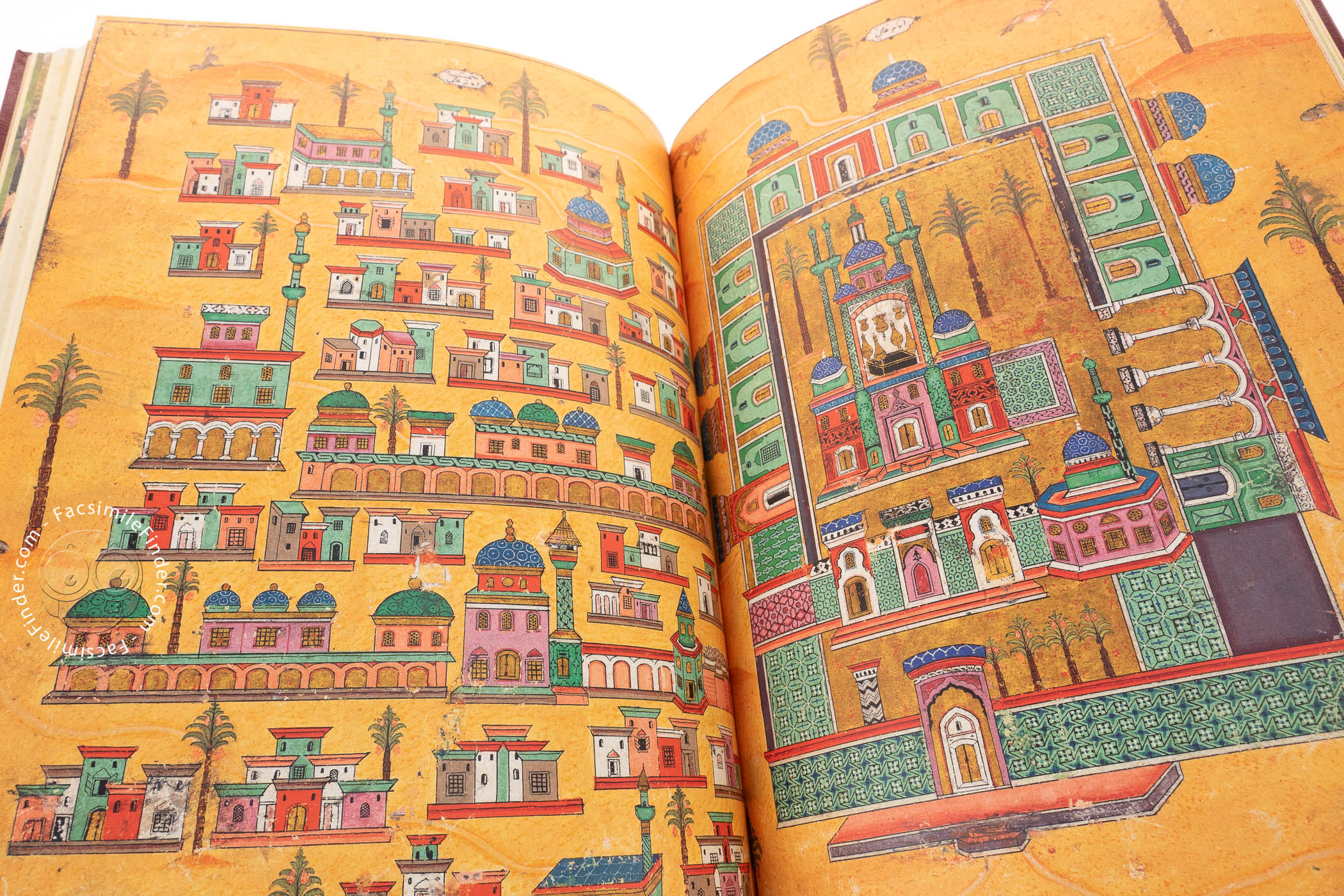


The Menazilname is the manuscript of a chronicle by Matrakçı Nasuh of a military campaign of Süleyman "the magnificent," Sultan of the Turks, which took him and his army into Iraq and western Iran, where they captured the cities of Baghdad and Tabriz. Nasuh, who was present on the campaign and may have made sketches of the sites along the way, supervised the production of the manuscript in Istanbul in 1537, the year after the army's return to the city. The manuscript boasts 107 miniatures, mostly bird's-eye views of landscapes and populated areas and portraits of shrines, many to Muslim prophets.
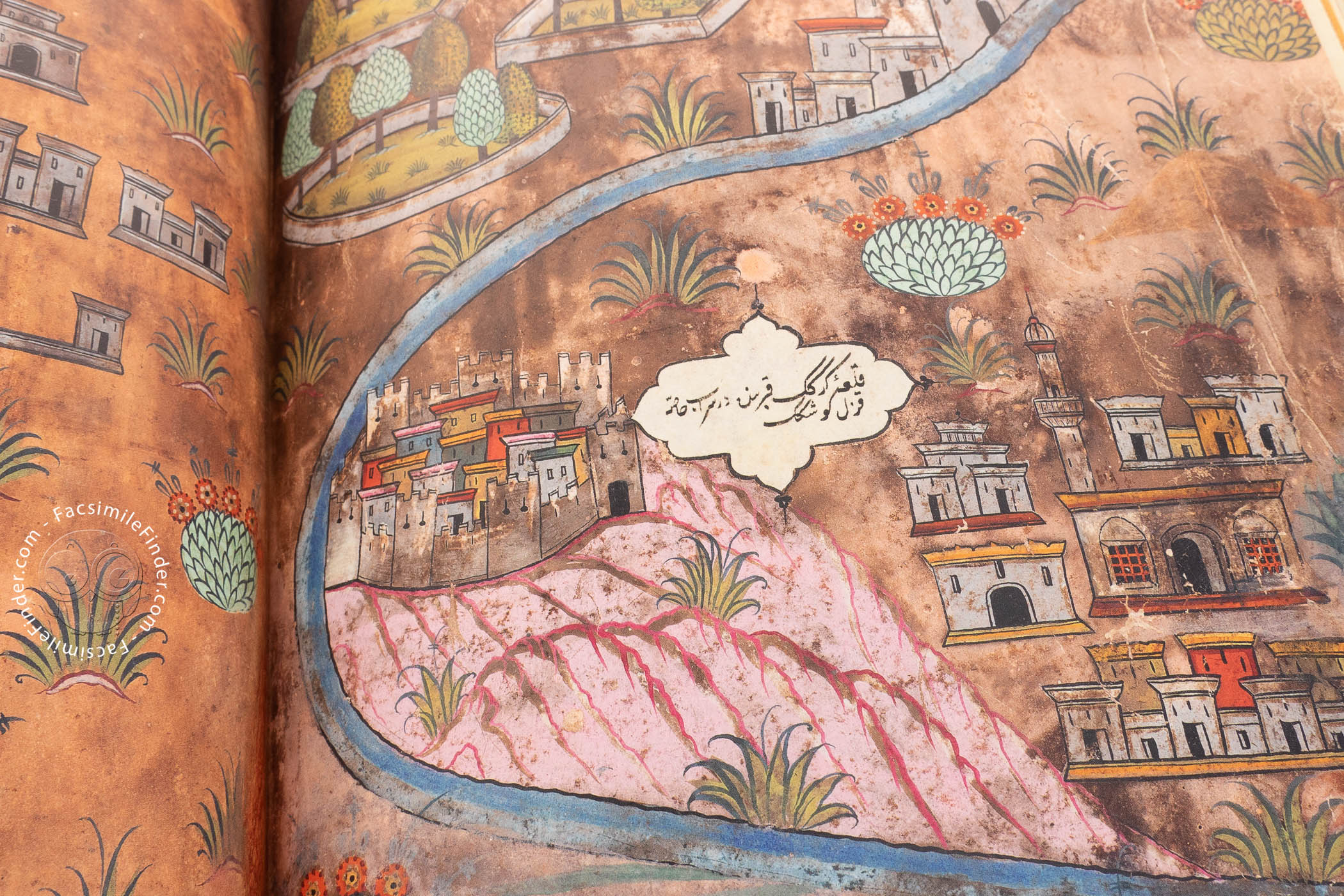
The miniatures are famous for their depictions of local flora and fauna, which are stylized but also specific enough that the species can be identified. The city views feature identifiable buildings. Their relative positions are true-to-life, but their exact locations are sometimes adjusted to allow for the inclusion of important architectural details.
A Polymath at Court
The mastermind behind the Menazilname was Matrakçı Nasuh (d. 1564), a mathematician, historian, geographer, translator, painter, and calligrapher. He arrived at the Ottoman court around 1500, where he eventually received a monthly stipend. Süleyman I, "the magnificent," Sultan of the Turks (d. 1566) engaged him to write histories and to organize court celebrations.
Although Nasuh is not the manuscript's scribe, he is the author of its text and supervised the painting of the miniatures, the work of several artists. Whether he was one of the painters, we do not know.
A Depopulated Landscape
Nasuh pioneered the Ottoman tradition of topographical paintings devoid of human figures. This lends a peaceful quality to the views of the many locales visited by the Ottoman forces. The tranquility of the landscapes is enhanced by the inclusion of animals and birds, many specifically appropriate to the locale in which they are pictured. These range from rabbits to lions and from ducks to pheasants.
Cities across Pages
Twelve of the miniatures extend across two facing pages. The two most important sites, Tabriz and Baghdad, are given two-page miniatures. Tabriz is shown as a city in the desert surrounded by an oval stone wall. The bird's-eye view is modified for the city wall, so that the city gates can be clearly seen; cypress trees line the long sides of the wall. Rabbits and deer occupy the surrounding desert (fols. 27v-28r).
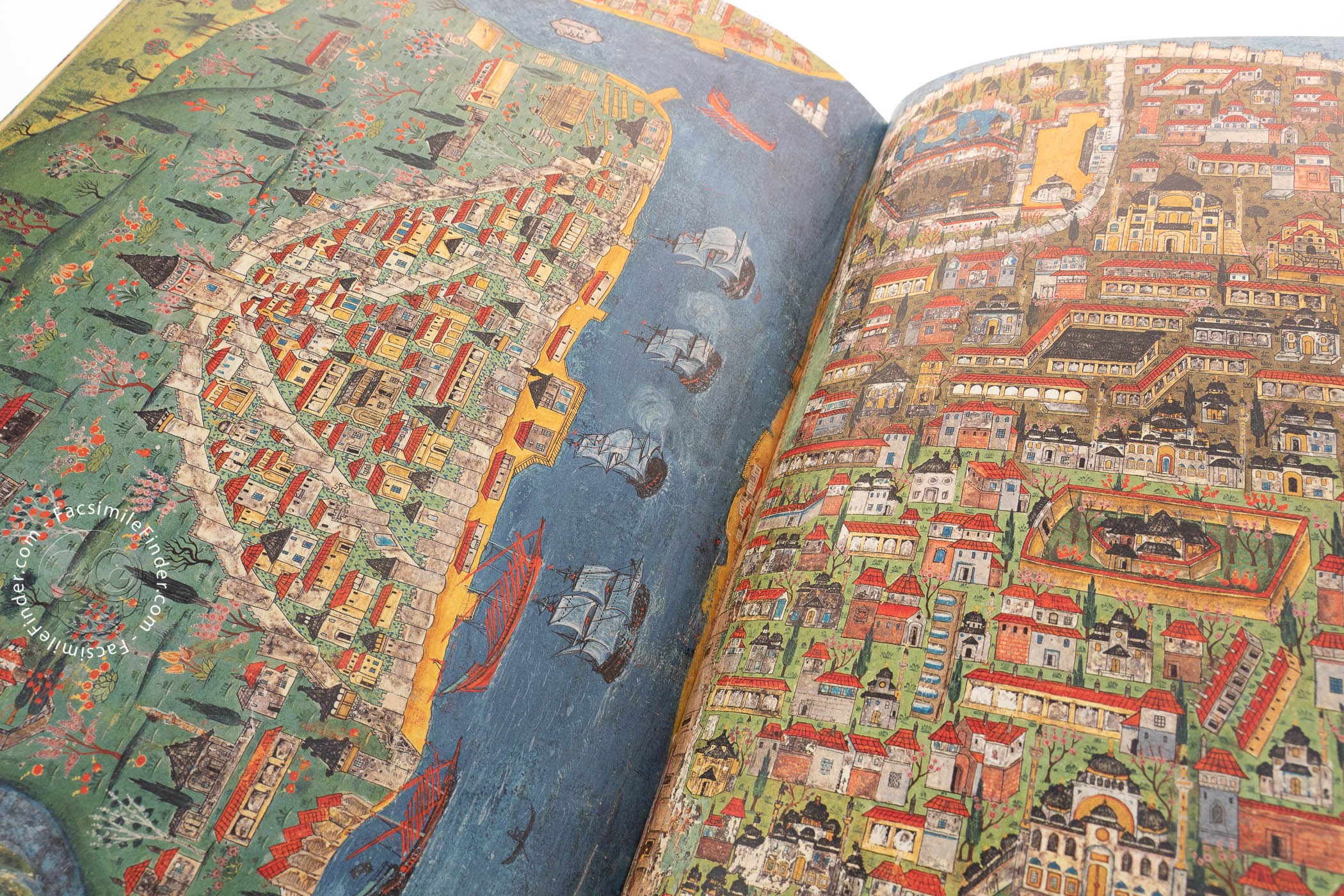
The most famous miniature shows the point of departure, Istanbul. The bird's-eye view is from the west looking east, with old Istanbul on the right-hand page and the neighborhood of Galata on the left. Many of the city's monuments, including the churches of Hagia Sophia and Hagia Irene (converted into mosques) and the ancient hippodrome, are carefully and clearly rendered (fols. 7v-8r).
Focus on Muslim Shrines
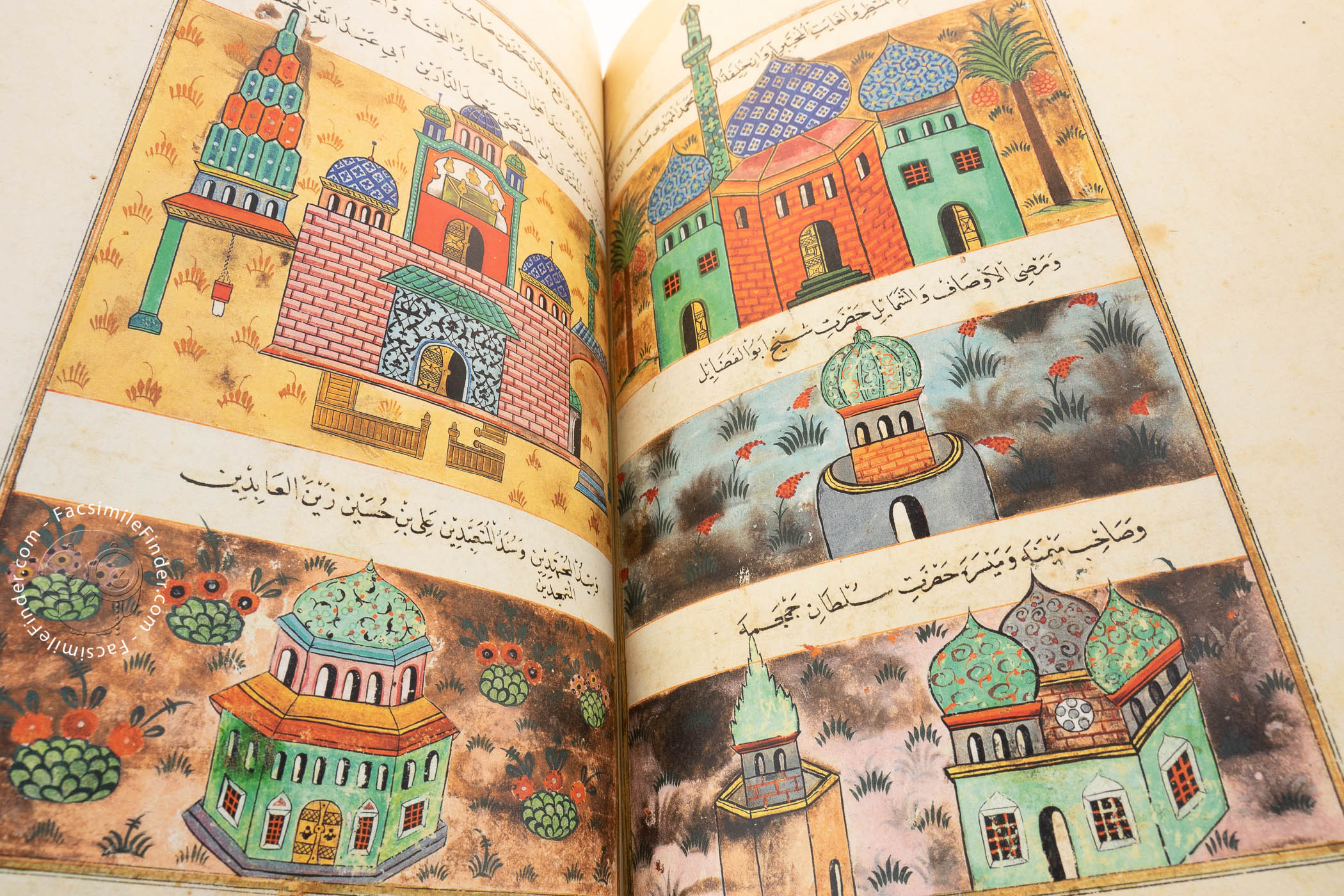
The text presents the progress of the army in more than 250 "stages," each associated with a natural landmark, structure, or human settlement. These include bodies of water, meadows, bridges, castles, archaeological sites, villages, towns, and cities. A particular emphasis is placed on Muslim shrines.
Seventy-seven shrines mark stages in the campaign, concentrated near Baghdad (fols. 49-66), so many that the manuscript has been characterized as an illustrated shrine book, perhaps meant to demonstrate Süleyman's piety and to justify his military campaign against the fellow Muslim Safavids.
A Turkish Text in Arabic Script
The Turkish-language text is written in the Arabic Naskh script in black and red inks in ruled boxes. There are many labels included in the miniatures: most are written on unpainted paper with painted frames to form cartouches, and others were added after the paintings were made.
A Treasure of the Ottoman Palace Library
The manuscript was presumably created for Süleyman himself. Its production was probably directed from the Ottoman imperial palace, but not all of the participating painters were necessarily court artists. The manuscript was among those of the Yıldiz Palace Library transferred to the university library in 1924 after the fall of the Ottoman Empire.
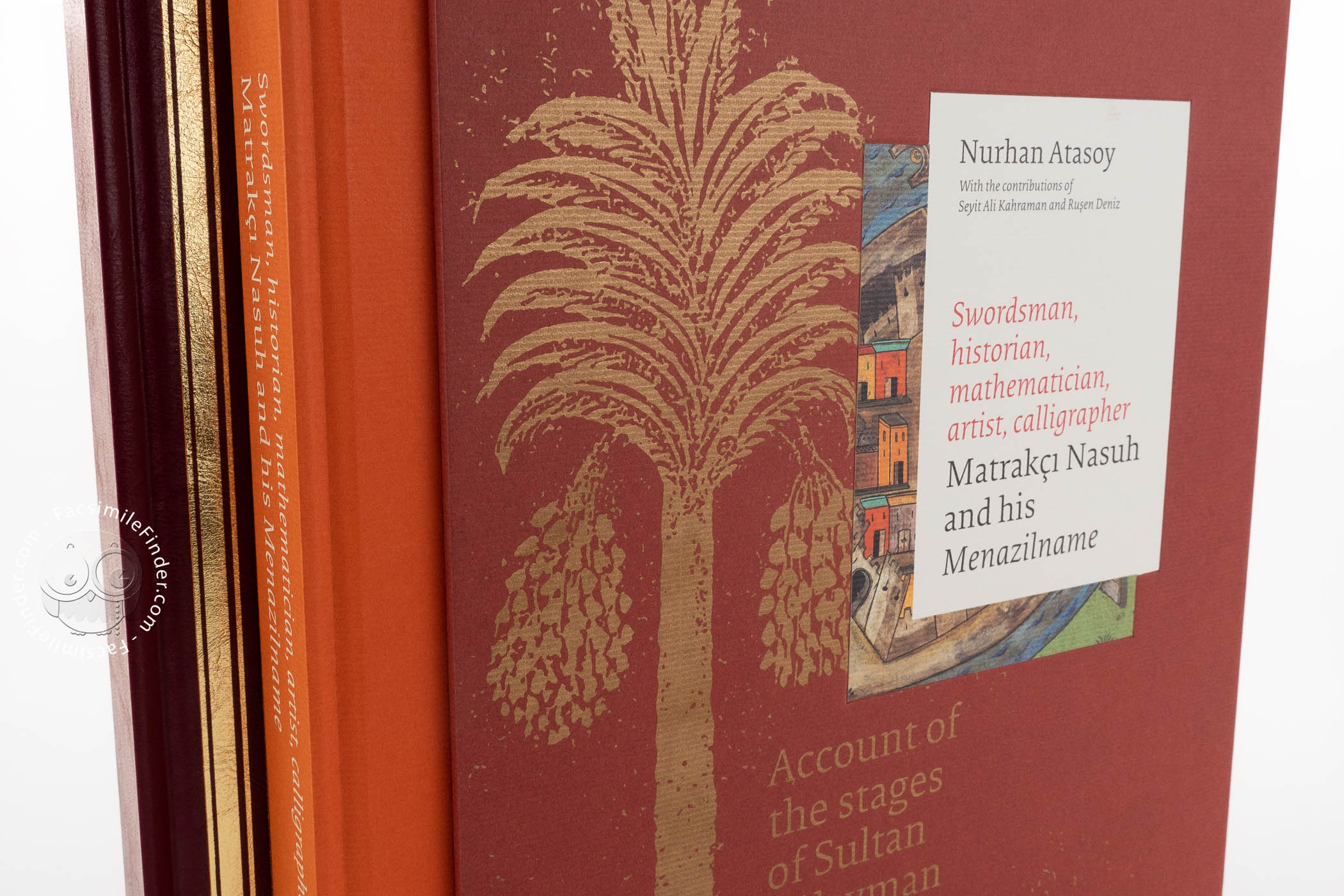
We have 1 facsimile edition of the manuscript "Menazilname": Beyân-ı Menâzil-i Sefer-i Irâkeyn-i Sultân Süleymân Hân facsimile edition, published by MASA, 2015
Request Info / Price