


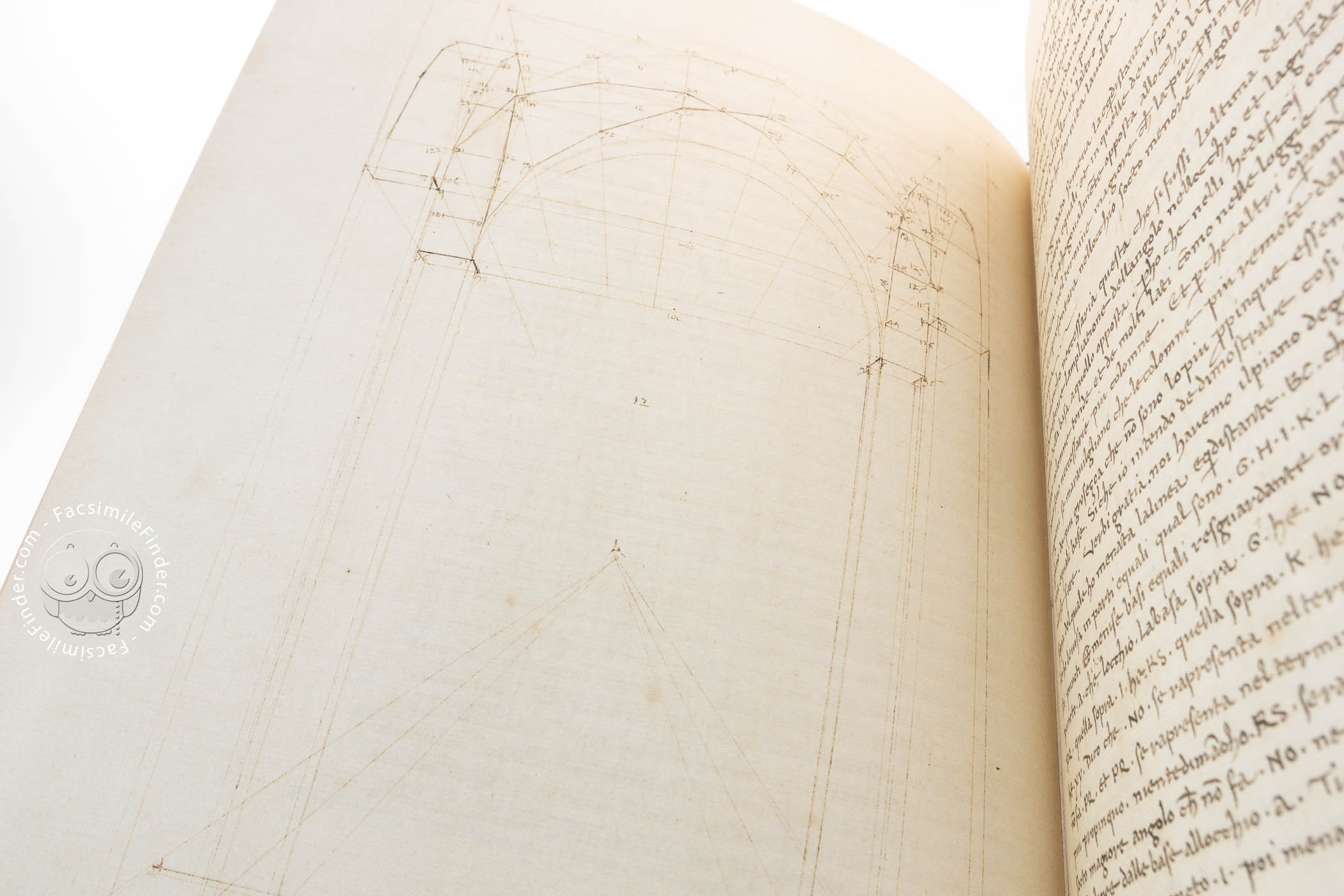


Among the seven surviving manuscripts of Piero della Francesca’s treatise on perspective, the copy kept in Reggio Emilia at the Biblioteca Panizzi, Mss. Regg. A 41/2 (formerly A 44), is one of only three to carry the painter’s own hand. Written on paper across 110 leaves and produced around 1472–1492, it transmits De prospectiva pingendi in Piero’s Italian vernacular.
A Drawing Manual for the Painter’s Workshop
Leon Battista Alberti had set out the theory of perspective a few decades earlier; Piero set out how to execute it. Composed probably around 1474–75, though its gestation may reach back to the middle of the 1460s, the treatise reached artists’ workshops through handwritten copies rather than print. Maestro Matteo di Ser Paolo d’Anghiari later rendered the text into Latin.
Autograph Corrections and More Than a Hundred Pen Diagrams
The text was copied by a fifteenth-century scribe, whose hand appears to recur in the Latin codices at Bordeaux and Milan. There is no illumination. The figures — over a hundred — were traced by Piero himself in brown ink with a pen cut so fine that it left only the thinnest line. Folios 66v–67r are entirely in his hand, as are more than sixty marginal annotations and the corrections running through the volume.
Three Books, from Flat Surfaces to the Human Head
Each problem is posed, then resolved by construction, the difficulty rising from plane figures to solids and finally to capitals, column bases and heads. It is the first systematic treatise on perspective to be wholly illustrated, and the first to justify its procedures mathematically.
Read without its later additions, the Reggio text stands among the versions closest to the archetype: a book caught in the act of being revised.
We have 2 facsimiles of the manuscript "De Prospectiva Pingendi":
- De Prospectiva Pingendi (Circulating Stacks Edition) facsimile edition published by Aboca Museum, 2008
- De Prospectiva Pingendi (Special Collections Edition) facsimile edition published by Aboca Museum, 2008
-facsimile-edition-01.jpg)
-facsimile-edition-02.jpg)
-facsimile-edition-03.jpg)
-facsimile-edition-04.jpg)
-facsimile-edition-05.jpg)
-facsimile-edition-06.jpg)
-facsimile-edition-07.jpg)
-facsimile-edition-08.jpg)
-facsimile-edition-09.jpg)
-facsimile-edition-10.jpg)
-facsimile-edition-11.jpg)
-facsimile-edition-12.jpg)
-facsimile-edition-13.jpg)
-facsimile-edition-14.jpg)
-facsimile-edition-15.jpg)
-facsimile-edition-16.jpg)
-facsimile-edition-17.jpg)
-facsimile-edition-18.jpg)
-facsimile-edition-19.jpg)
-facsimile-edition-20.jpg)
-facsimile-edition-21.jpg)
-facsimile-edition-22.jpg)
-facsimile-edition-23.jpg)
-facsimile-edition-24.jpg)
-facsimile-edition-25.jpg)


