

From Harvard and Stanford to the International Congress on Medieval Studies, Giovanni Scorcioni opens the “black box” of facsimile production: how a reproduction is brought as close as possible to the original, what separates an excellent edition from a mediocre one, and how a niche publishing market operates behind the scenes.
Looking for a meaningful way to bring manuscript culture into your classroom or library?
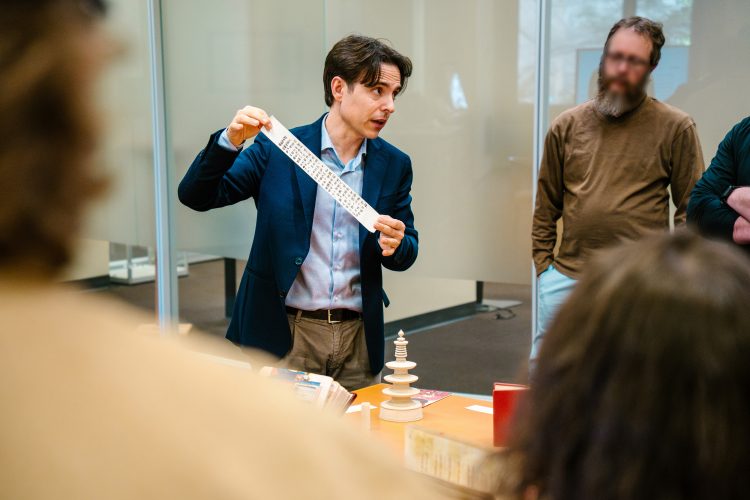
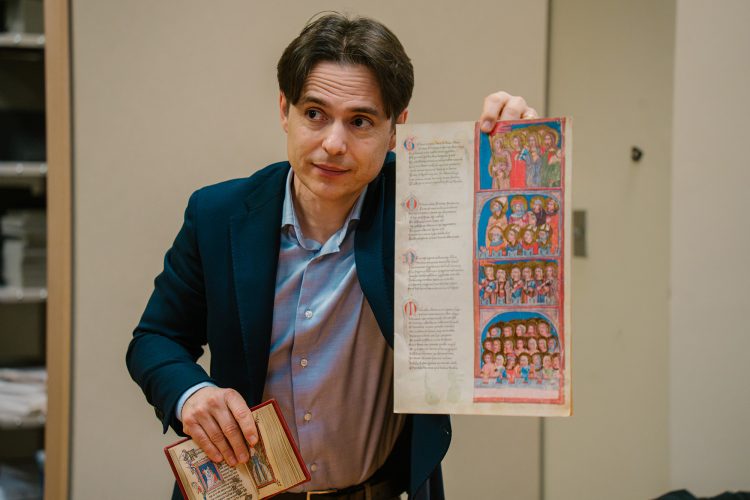
For more than a decade, Giovanni Scorcioni has been invited by universities, libraries, and academic conferences across North America and Europe to speak about manuscript facsimiles: how they are produced, how they differ from digital reproductions, and how they can enrich teaching, research, and public engagement. His sessions combine scholarly context with a down-to-earth, hands-on approach, making the world of fine facsimile editions accessible to students, faculty, librarians, and curators alike.
Plan a Talk or Workshop
What Giovanni Offers
Giovanni’s sessions are designed to be flexible, practical, and easy to integrate into existing academic programs. Here are the most common formats:
- Guest Lecture (50–75 minutes)
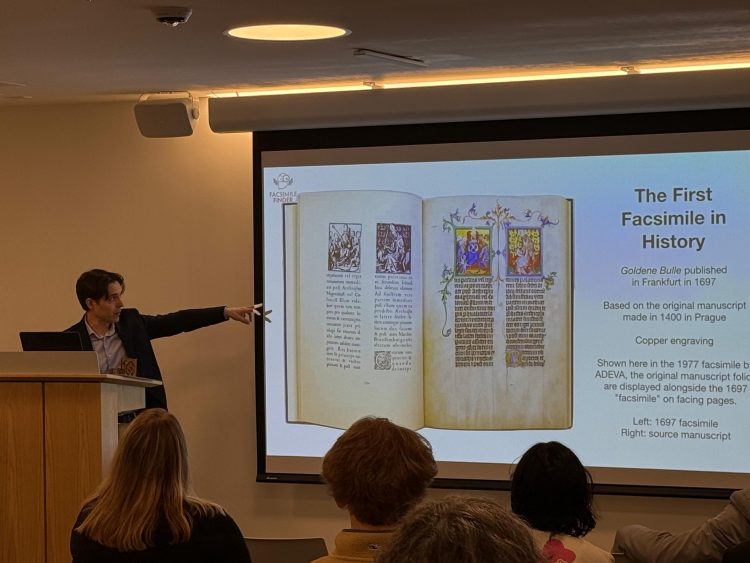
Drawing on years of work with publishers, artisans, libraries, and universities, Giovanni introduces students to the many decisions behind facsimile production: how the original is photographed, how colors are matched, how gold and parchment-like surfaces are recreated, and how binding choices affect the final object. Suited for survey courses, seminars, and library audiences.
- Hands-On Workshop (90–120 minutes)
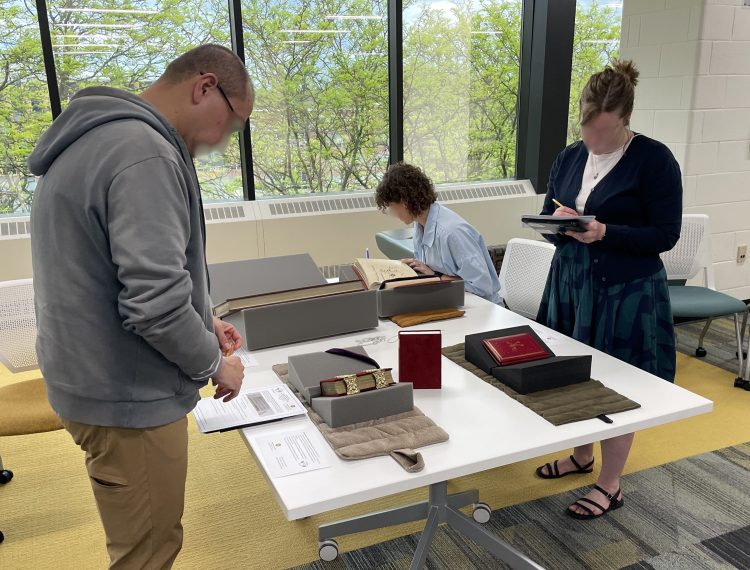
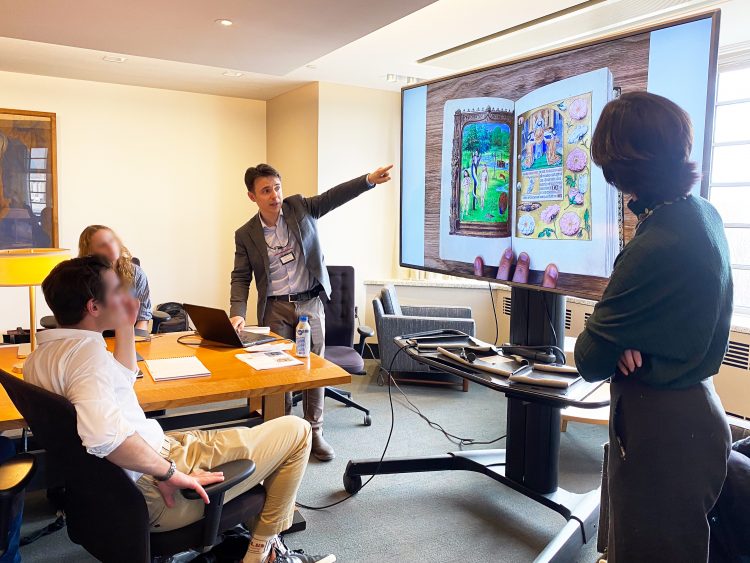
A more immersive session built around direct engagement with facsimile editions. Attendees examine high-quality facsimiles up close: turning pages, observing bindings, comparing materials, and discussing how gold, color, texture, and scale shape the experience of a medieval book. This format is especially effective for small to medium-sized classes.
- Class Visit or Roundtable
A conversational format shaped around your course needs. Students are encouraged to ask questions and engage directly with the issues raised by facsimile production. Depending on the course, the session can focus on how facsimiles are made, how they are used in classrooms and libraries, or what they can teach us about the material life of books.
How It Works
Planning a visit is simple. Once you share your course topic, audience size, preferred dates, and format, Giovanni will suggest the type of session that best fits your needs.
What Giovanni brings
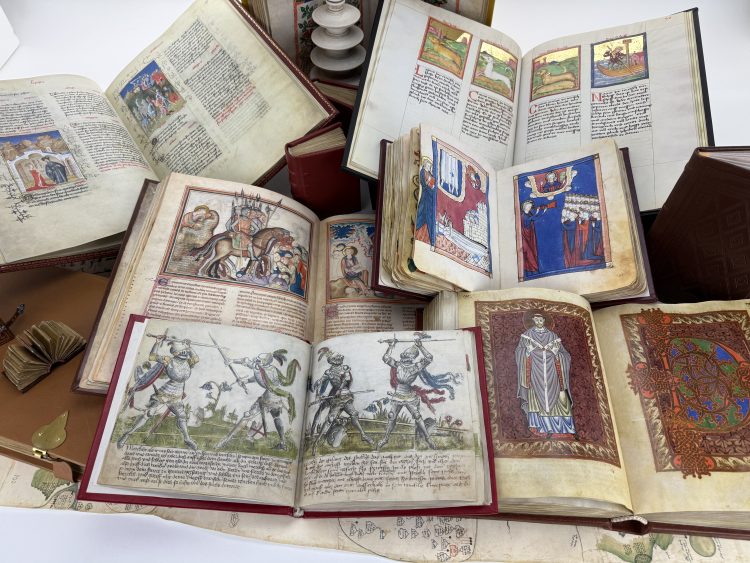
A selection of facsimile editions tailored to your class or institution, typically covering different periods, regions, formats, and production techniques. When possible, the selection can be adapted to your syllabus or collection focus.
What the institution provides
For workshops, a room with tables, a projector, and enough space for students to examine the books comfortably. For lectures, a standard classroom or event space with projection is usually enough.
Costs
Honoraria and travel arrangements are discussed case by case. Many institutions cover travel and lodging only, especially when Giovanni is already planning a trip to the United States or when several institutions in the same area coordinate their invitations.
Timing
Visits are usually planned 2–4 months in advance. Giovanni travels to the United States twice a year, typically in late winter (February–March) and late spring (May). For the next US tour, please get in touch early to find a slot.
Remote options
When an in-person visit is not possible, online sessions are available. Giovanni handles the facsimiles on camera, guiding students through the same kinds of visual and material details they would discuss in person.
What Faculty and Students Say
Giovanni delivered a compelling presentation to my class of graduate students, and his presence with us was a highlight in our course about late antique manuscripts…. The hands-on exercise he devised and led for us was highly engaging and stimulated careful thought about both ancient and modern techniques in the inclusion and presentation of images alongside text on a page.
Felicity Harley-McGowan
Lecturer in the History of Art
Yale University
The expertise of the facsimile creator, Giovanni Scorcioni, truly grounded my understanding of the importance of these treasures for best exposing us to medieval readings when originals are out of reach.
Linda Jones,
Chair of the Department of World Languages, Literatures and Cultures
University of Arkansas
Giovanni, infinite thanks for your generosity in preparing your class so thoughtfully and taking so much time for us – we all learned a great deal about facsimiles and had a wonderful time!
Beatrice Kitzinger
PhD, Department of Art & Archaeology
Princeton University
Dear Giovanni, thank you so much for visiting our class. Our workshop on facsimile production was one of my favorite moments of the semester.
Princeton University student
Class visit: Arts of the Medieval Book, Prof. Beatrice Kitzinger
From his warehouse of facsimiles in Italy, Giovanni delivered an interdisciplinary virtual presentation that introduced students to this valuable learning resource by handling and explaining the features of several facsimiles, in a personal approach that gave students a deeper appreciation of these codices than would be gained by just viewing digital images online. Students’ reactions were overwhelmingly positive. Several students expressed interest in developing curricula that utilize facsimiles as teaching resources to enrich their professional skill set.
Marie-Thérèse Champagne
PhD, Department of History
Justin Sturgeon
PhD, Department of Art and Design
University of West Florida
All participants in Giovanni’s workshop, from undergraduate and graduate students to faculty members and librarians, found the experience highly engaging and enriching… The display of a variety of artifacts, along with the various types of paper employed in facsimile reproductions, further enhanced the overall quality of the event.
Daniela D’Eugenio
Assistant Professor, World Languages, Literatures, & Cultures
University of Arkansas
Past Engagements
Index:
- International Congress on Medieval Studies (ICMS) – Workshop | May 16, 2026
- International Congress on Medieval Studies (ICMS) – Interview | May 14, 2026
- International Center of Medieval Art (ICMA) at Carleton College – Workshop | May 9, 2026
- University of Michigan Library – Talk | May 8, 2026
- University of Rochester – Workshop | May 7, 2026
- Medieval Academy of America (MAA) – Workshop | March 20, 2026
- Harvard University – Workshop | February 27, 2026
- Yale University – Talks | February 26, 2026
- Savannah College of Art and Design – Workshop | February 25, 2026
- University of Arkansas, Fayetteville – Workshop & Guest Talk | February 24, 2026
- University of Utah – Workshop | February 23, 2026
- Stanford University – Guest Talk | February 18, 2026
- University of Tennessee, Knoxville – Workshop | February 17, 2026
- Princeton University – Guest Talk (Remote) | October 22, 2025
- Arts Library Society of North America (ARLIS/NA) – Guest Talk (Remote) | May 15, 2025
- Princeton University – Workshop | March 18, 2025
- University of Cincinnati – Workshop | April 1, 2024
- University of Saskatchewan – Workshop | March 22, 2024
- University of Manitoba – Guest Talk | March 21, 2024
- Minnesota Twin Cities University – Guest Talk | March 20, 2024
- Fairfield University – Workshop | March 12, 2024
- University of Bergen – Roundtable (Remote) | September 8, 2023
- University of West Florida – Guest Talk (Remote) | October 28, 2021
- Florida State University – Guest Talk (Remote) | October 20, 2021
- Princeton University – Guest Talk | September 20, 2021
- International Congress on Medieval Studies (ICMS) – Guest Talks (Remote) | May 15, 2021
- Harvard University – Guest Talk (Remote) | April 2, 2021
- Stanford University – Roundtable | May 9, 2015
2026
International Congress on Medieval Studies (ICMS) – Workshop
May 16, 2026


The workshop From Hand to Mind: Integrating Facsimiles of Medieval Manuscripts into Undergraduate Teaching will explore how facsimiles of medieval manuscripts can be used as effective teaching tools in undergraduate courses. Led by Susan M. Steuer (Western Michigan University Libraries) together with Giovanni Scorcioni, and introduced by Mallory C. Heslinger.
International Congress on Medieval Studies (ICMS) – Interview
May 14, 2026
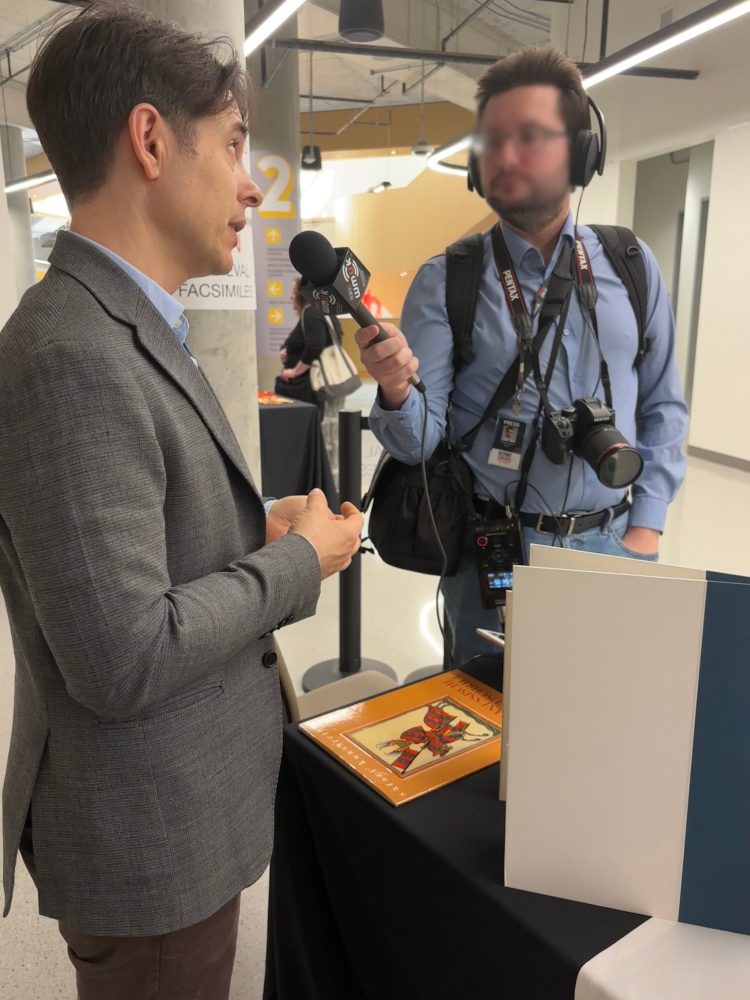
In his interview with Michael Symonds of WMUK, Giovanni Scorcioni brought listeners into the lively atmosphere of the International Congress on Medieval Studies in Kalamazoo, reflecting on Facsimile Finder’s long-standing presence at the event and on the role of manuscript facsimiles in today’s scholarly world. Through the conversation, Giovanni highlighted how high-quality facsimile editions make the material richness of medieval books more accessible, allowing students, scholars, librarians, and collectors to engage with scale, texture, craftsmanship, and visual detail in ways that digital images alone cannot fully convey.
International Center of Medieval Art (ICMA) at Carleton College – Workshop
May 9, 2026


Laboratories of the Senses: Medieval Manuscript Facsimiles From Production to Pedagogy invited participants to consider the role of high-quality manuscript facsimiles as bridges between medieval book culture and contemporary teaching. Organized by William North and featuring a presentation by Giovanni Scorcioni, the workshop highlighted how these objects can enrich undergraduate learning by making the materiality, artistry, and intellectual life of medieval manuscripts more accessible in the classroom.
University of Michigan Library – Talk
May 8, 2026
During the presentation The Production of High Quality Facsimiles, Giovanni Scorcioni offered an inside look at the craftsmanship behind fine manuscript facsimiles, from the reproduction of medieval books to the delicate use of gold leaf. The lecture showed how facsimiles of manuscripts dating from roughly 700 to 1600 CE make richly decorated works accessible for study, teaching, and close visual appreciation. The event also included time to view examples from Giovanni’s work and the Clark Library collection.
University of Rochester – Workshop
May 7, 2026


At the University of Rochester, Giovanni led a hands-on workshop introducing students to the history, materiality, and production of manuscript facsimiles. Through examples and discussion, the session explored how fine facsimile editions are conceived, photographed, printed, and bound, showing how they can bring the physical presence of medieval manuscripts into teaching and close study.
Medieval Academy of America (MAA) – Workshop
March 20, 2026
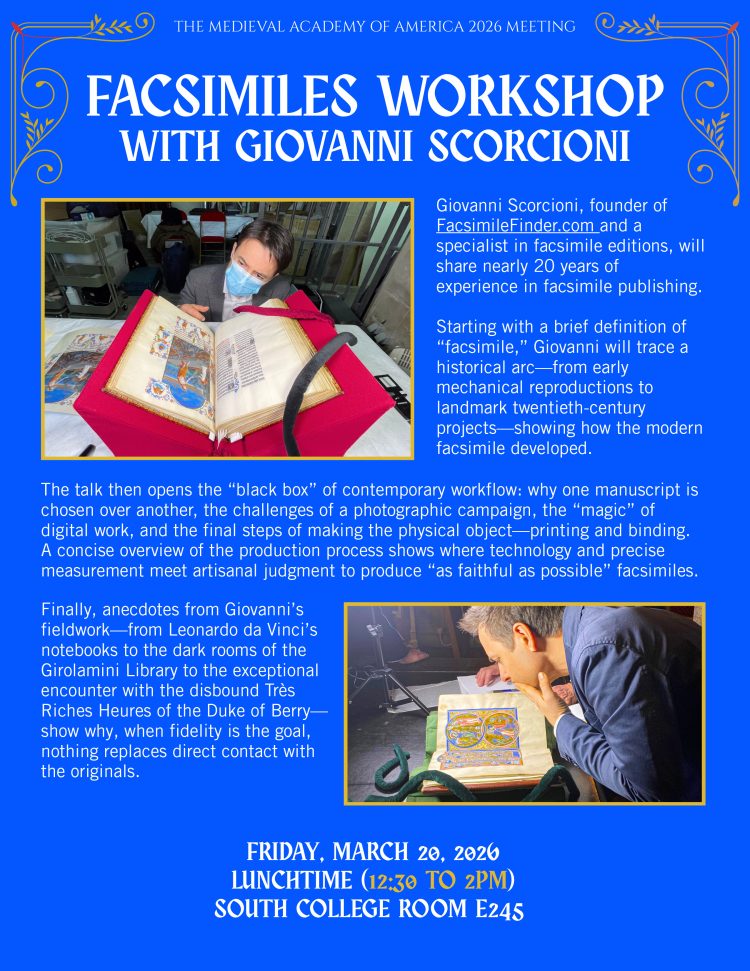
In this workshop, Giovanni opened the “black box” of contemporary facsimile production, guiding attendees through the full process — from selecting a manuscript and organizing a photographic campaign to printing and binding. Blending technical precision with artisanal judgment, he explored how modern facsimiles strive to be as faithful as possible to their originals, while sharing fieldwork stories from major European libraries.
Harvard University – Workshop
February 27, 2026


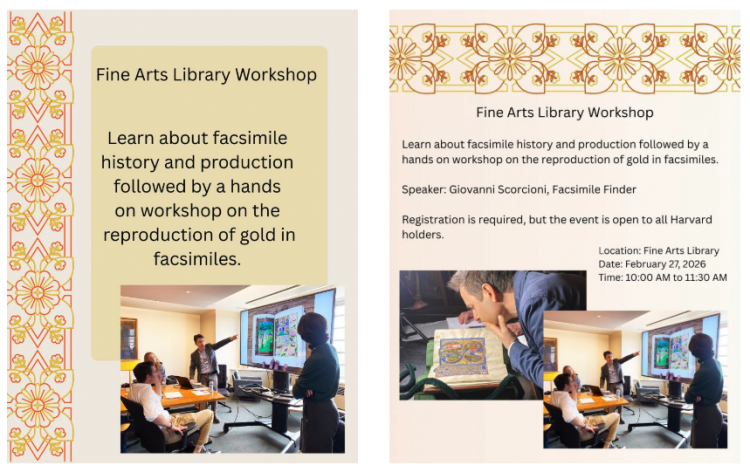
This hands-on workshop introduced participants to the history and production of facsimiles, followed by a practical demonstration on the reproduction of gold in manuscript facsimiles. Designed for students and faculty, the session combined historical context with material experimentation, highlighting the craftsmanship behind fine press editions.
Yale University – Talks
February 26, 2026


On the same day, Giovanni gave a public talk at Yale University and a talk for the class of Professor Felicity Harley-McGowan, Lecturer in the History of Art at Yale Divinity School and a specialist in late antique and early Christian art. Through illustrated examples and discussion, Giovanni explained how manuscript reproductions are conceived, photographed, printed, and bound, highlighting the importance of material accuracy in the study and teaching of medieval manuscripts.
Savannah College of Art and Design – Workshop
February 25, 2026


Giovanni led an interactive workshop centered on the material presence of manuscript facsimiles. Students were invited to examine reproductions up close, considering texture, scale, binding, color, and decorative details as essential parts of the manuscript experience.
University of Arkansas, Fayetteville – Workshop & Guest Talk
February 24, 2026


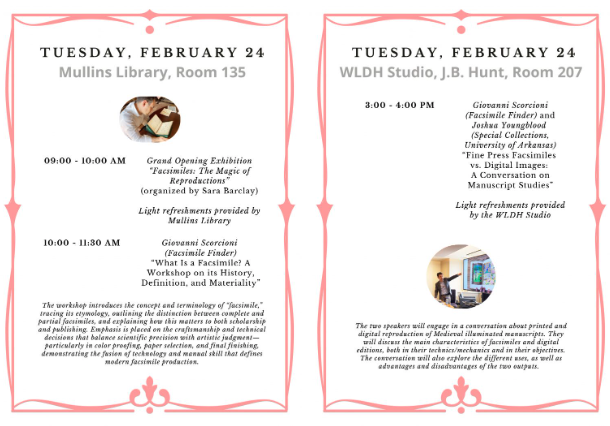
At the University of Arkansas, Giovanni participated in two events: What Is a Facsimile? A Workshop on Its History, Definition, and Materiality, in which he explored the conceptual and material foundations of facsimile production; and the talk Fine Press Facsimiles vs. Digital Images: A Conversation on Manuscript Studies, held alongside Joshua Youngblood, Associate Dean for Special Collections.
- Two-Day Symposium on Medieval Literature and Illuminated Manuscripts Begins Today
- U of A to Host Symposium on Medieval Literature and Illuminated Manuscripts
- Four U of A Undergraduates Present Research Among Top Boccaccio Scholars in U.S.
University of Utah – Workshop
February 23, 2026


This workshop offered students a close look at how manuscript facsimiles can support teaching and object-based learning. Using concrete examples from the world of fine press reproduction, Giovanni discussed how facsimiles help bring the physical features of medieval books into the classroom, making questions of format, decoration, and use more tangible for students.
Stanford University – Guest Talk
February 18, 2026


Hosted by Stanford Libraries, this talk examined the history, production, and market of illuminated manuscript facsimiles. Giovanni also addressed how facsimiles are used in libraries and classrooms, emphasizing their unique ability to create meaningful engagement with medieval art and material culture.
University of Tennessee, Knoxville – Workshop
February 17, 2026


This session explored the pedagogical differences between digital images and physical facsimiles. Giovanni discussed how materiality, scale, texture, and craftsmanship shape the learning experience, offering practical insights into how facsimiles can enrich art history and manuscript studies curricula.
2025 – 2024 – 2023
Princeton University – Guest Talk (Remote)
October 22, 2025


In this virtual guest lecture for Princeton University, Giovanni introduced students to the world of manuscript facsimiles and the complex process behind their production. The talk explored how facsimiles are created, how they differ from digital reproductions, and how they can serve as powerful tools for teaching, research, and public engagement with medieval manuscripts.
Arts Library Society of North America (ARLIS/NA) – Guest Talk (Remote)
May 15, 2025


Presented via Zoom at the Art Libraries Society of North America conference, the talk Touching the Past: The Power of Medieval Manuscript Facsimiles focused on the role of facsimiles in library collections and scholarly engagement. Giovanni highlighted how facsimiles expand access to rare objects while preserving the tactile and visual richness essential to art historical study.
Princeton University – Workshop
March 18, 2025


In this workshop, Giovanni examined the production process behind high-quality facsimiles, offering students an inside look at how historical manuscripts are transformed into faithful reproductions. The session emphasized the balance between technology and craftsmanship in contemporary facsimile publishing.
University of Cincinnati – Workshop
April 1, 2024


Giovanni offered attendees an inside look at the world of manuscript facsimiles, focusing on the choices and craftsmanship that allow these editions to echo the presence of their medieval originals. The workshop encouraged close observation of materials, decoration, and production techniques, showing how facsimiles can deepen engagement with rare books beyond the limits of digital images.
University of Saskatchewan – Workshop
March 22, 2024


At Murray Library, Giovanni led a hands-on workshop introducing attendees to the history, materiality, and production of manuscript facsimiles. Through examples and discussion, the session explored how facsimile editions are conceived, photographed, printed, and bound, highlighting their value for teaching, research, and close engagement with medieval manuscripts.
University of Manitoba – Guest Talk
March 21, 2024


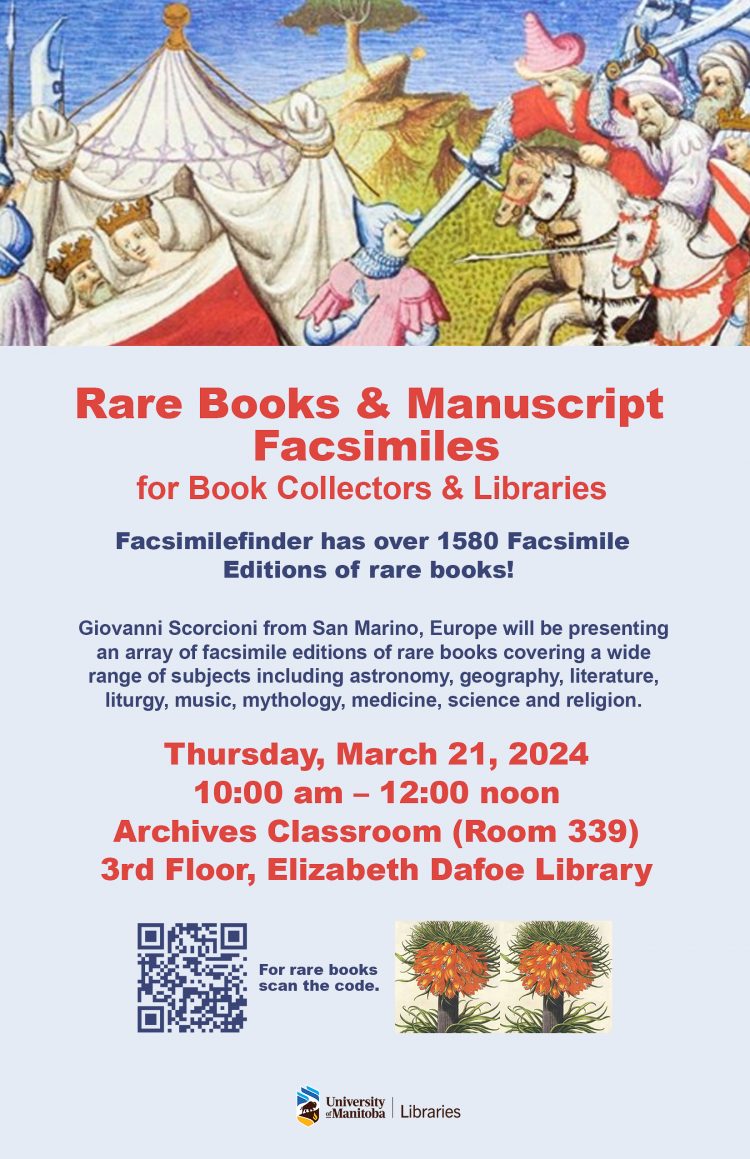
Held at the University of Manitoba Libraries, this presentation introduced audiences to a wide range of rare book and manuscript facsimiles across subjects such as literature, science, religion, and medicine. By showcasing the breadth of the field, Giovanni highlighted how facsimile editions can open new paths for discovery in both library settings and classroom contexts.
Minnesota Twin Cities University – Guest Talk
March 20, 2024
This presentation explored the evolving role of facsimiles in academic and curatorial contexts. Giovanni discussed how faithful reproductions can bridge the gap between preservation and accessibility, supporting both scholarship and experiential learning.
Fairfield University – Workshop
March 12, 2024


Hosted by University Archives & Special Collections at Fairfield’s DiMenna-Nyselius Library, this workshop took the form of an informal facsimile showcase. Participants were able to encounter medieval manuscript reproductions up close while learning how facsimiles can support hands-on teaching, visual analysis, and broader access to rare materials.
University of Bergen – Roundtable (Remote)
September 8, 2023


This roundtable event centered on the facsimile of the Munkeliv Psalter, examining its historical significance and the production choices behind its reproduction. The discussion highlighted how facsimiles can revitalize scholarly attention and public interest in medieval manuscripts.
And many, many more!
Here’s just a few examples:
University of West Florida – Guest Talk (Remote)
October 28, 2021


Hosted by Justin Sturgeon and Marie-Thérèse Champagne, Associate Professors of Art History, this guest lecture introduced students to the history and purpose of manuscript facsimiles. Giovanni discussed the role of facsimile editions in preserving and disseminating medieval cultural heritage, highlighting how these reproductions allow scholars and students to study manuscripts that would otherwise remain inaccessible.
Florida State University – Guest Talk (Remote)
October 20, 2021


Invited by Lynn Jones, Associate Professor in the Department of Art History, Giovanni presented an overview of the production and scholarly value of manuscript facsimiles. The talk explored the relationship between original manuscripts and their reproductions, and how facsimiles can support both academic research and classroom teaching.
Princeton University – Guest Talk
September 20, 2021


In this guest lecture, Giovanni introduced students to the history and contemporary production of manuscript facsimiles. The session highlighted the technical challenges of reproducing medieval manuscripts and discussed how high-quality facsimiles enable close study of objects that are otherwise too fragile or rare to be widely handled.
International Congress on Medieval Studies (ICMS) Conference – Guest Talks (Remote)
May 15, 2021
Giovanni participated in two virtual events: a self-hosted unboxing of the new facsimile of the Psalter of Blanche of Castile, and a discussion titled Reproductive Cultures: New Approaches to the Facsimile. These sessions examined how facsimiles shape the teaching of art history and open new pathways for scholarly interaction with medieval manuscripts.

Harvard University – Guest Talk (Remote)
April 2, 2021
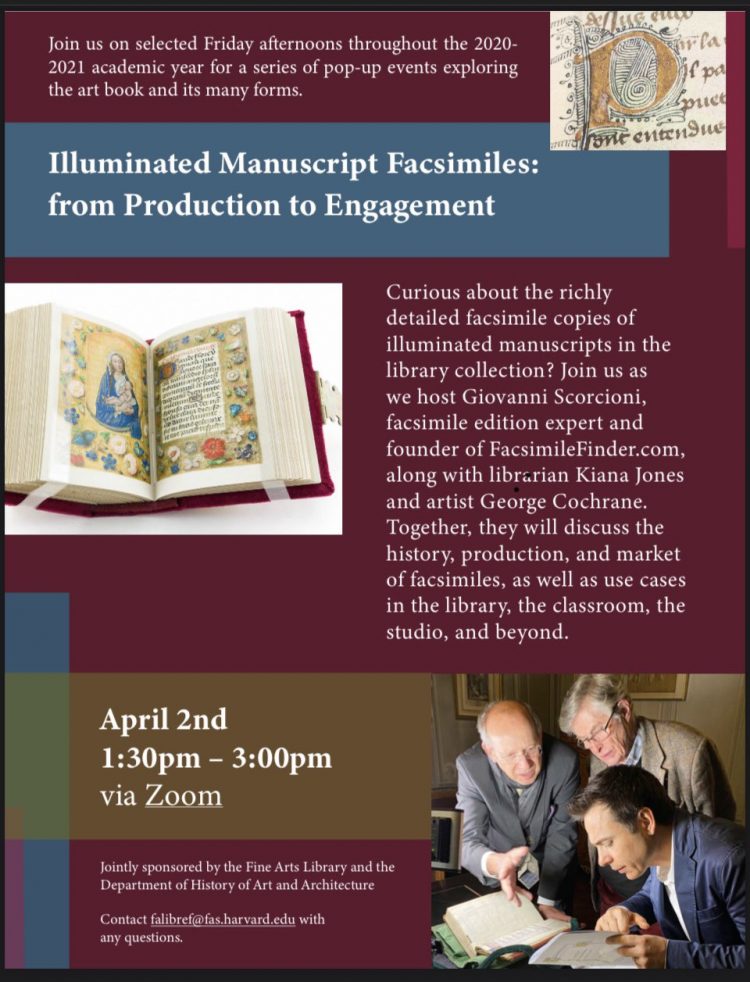
In this virtual event, Giovanni explored the lifecycle of a facsimile edition — from concept and research to printing and distribution. The talk emphasized how facsimiles function not only as scholarly tools but also as bridges between past and present audiences.
Stanford University – Roundtable
May 9, 2015
In this early roundtable discussion, Giovanni addressed broader questions surrounding the value and perception of facsimiles in academic environments, contributing to ongoing conversations about authenticity, reproduction, and access.
Some photos featured in this article were taken by Megan Cunningham, College of Arts and Sciences, University of Tennessee.