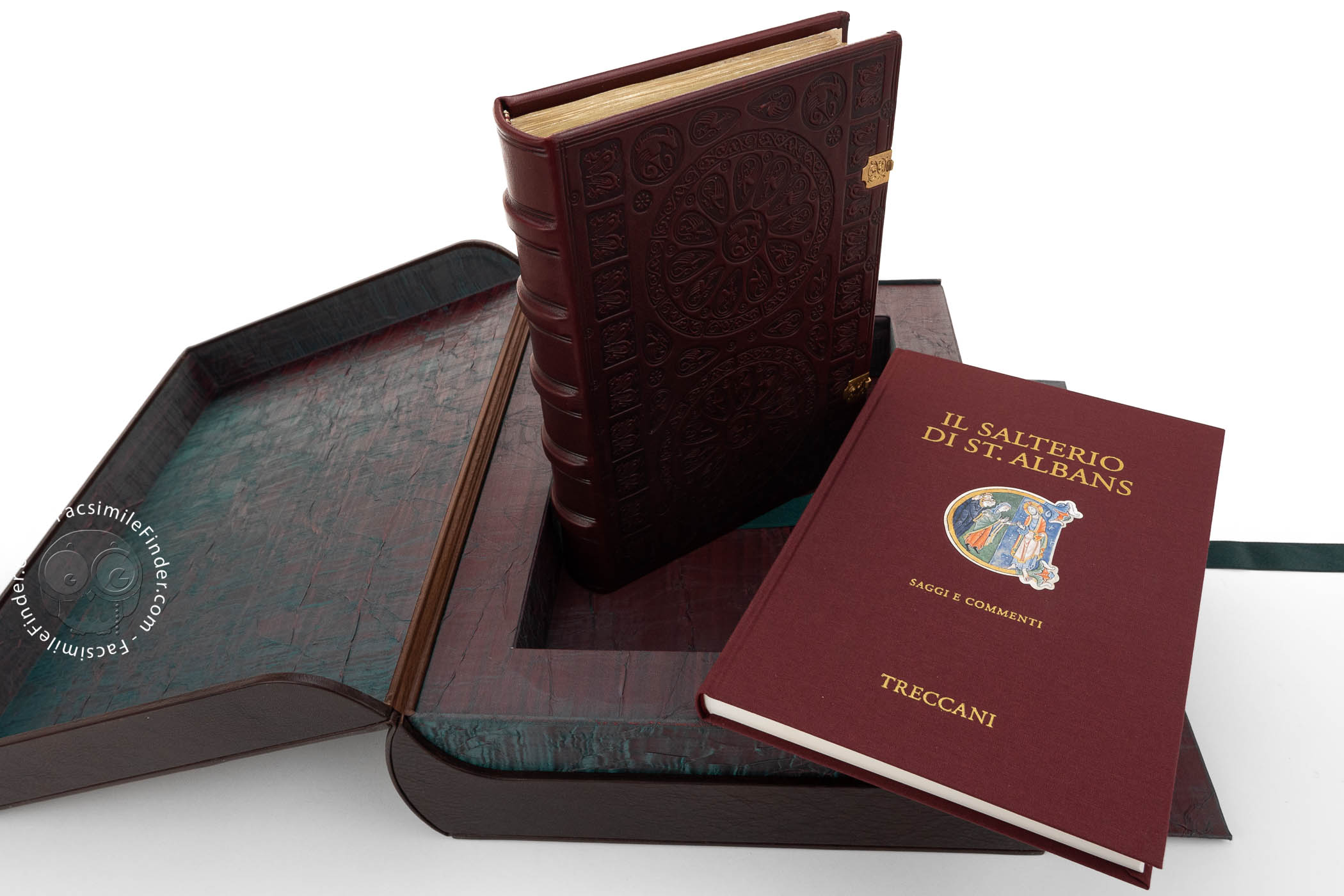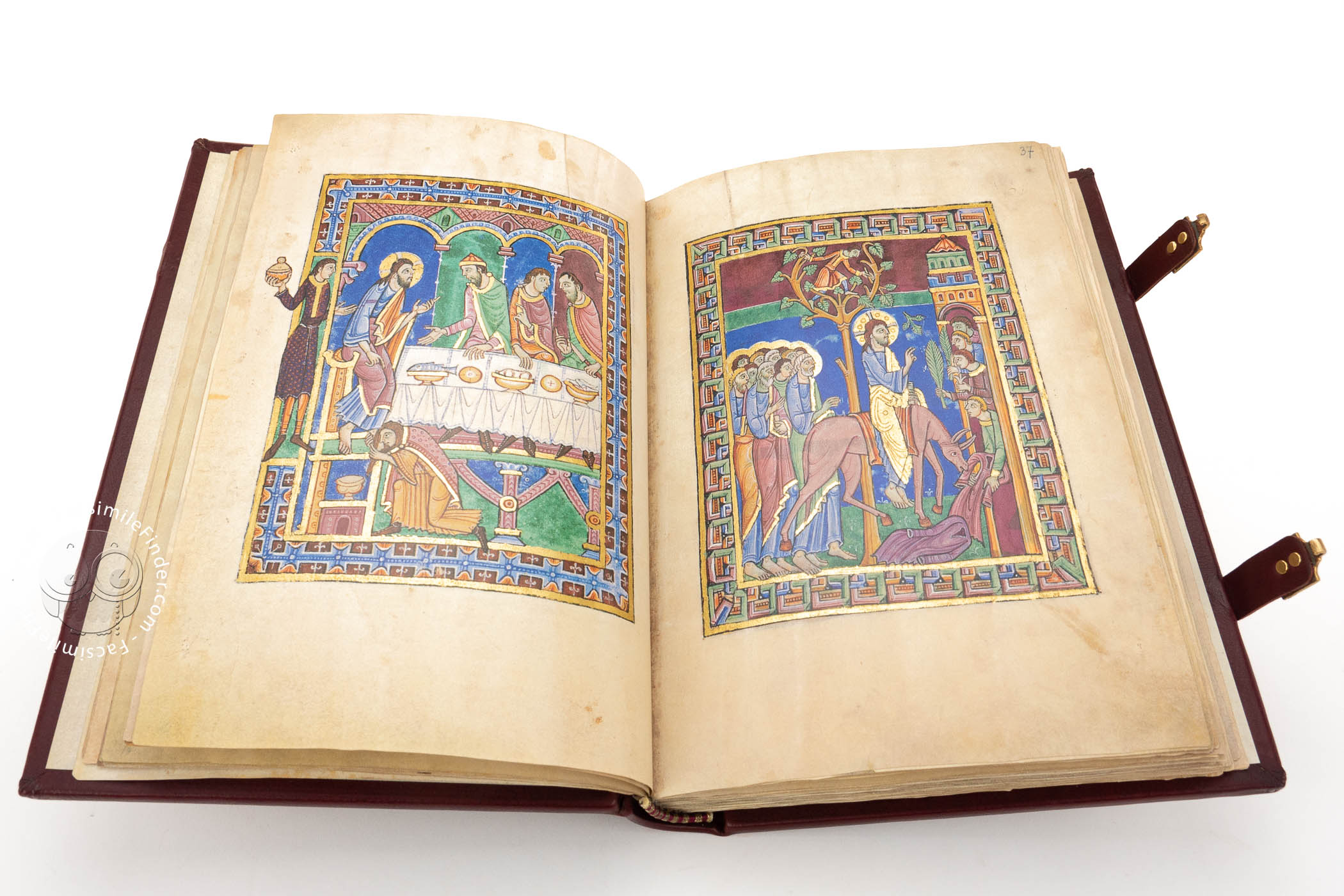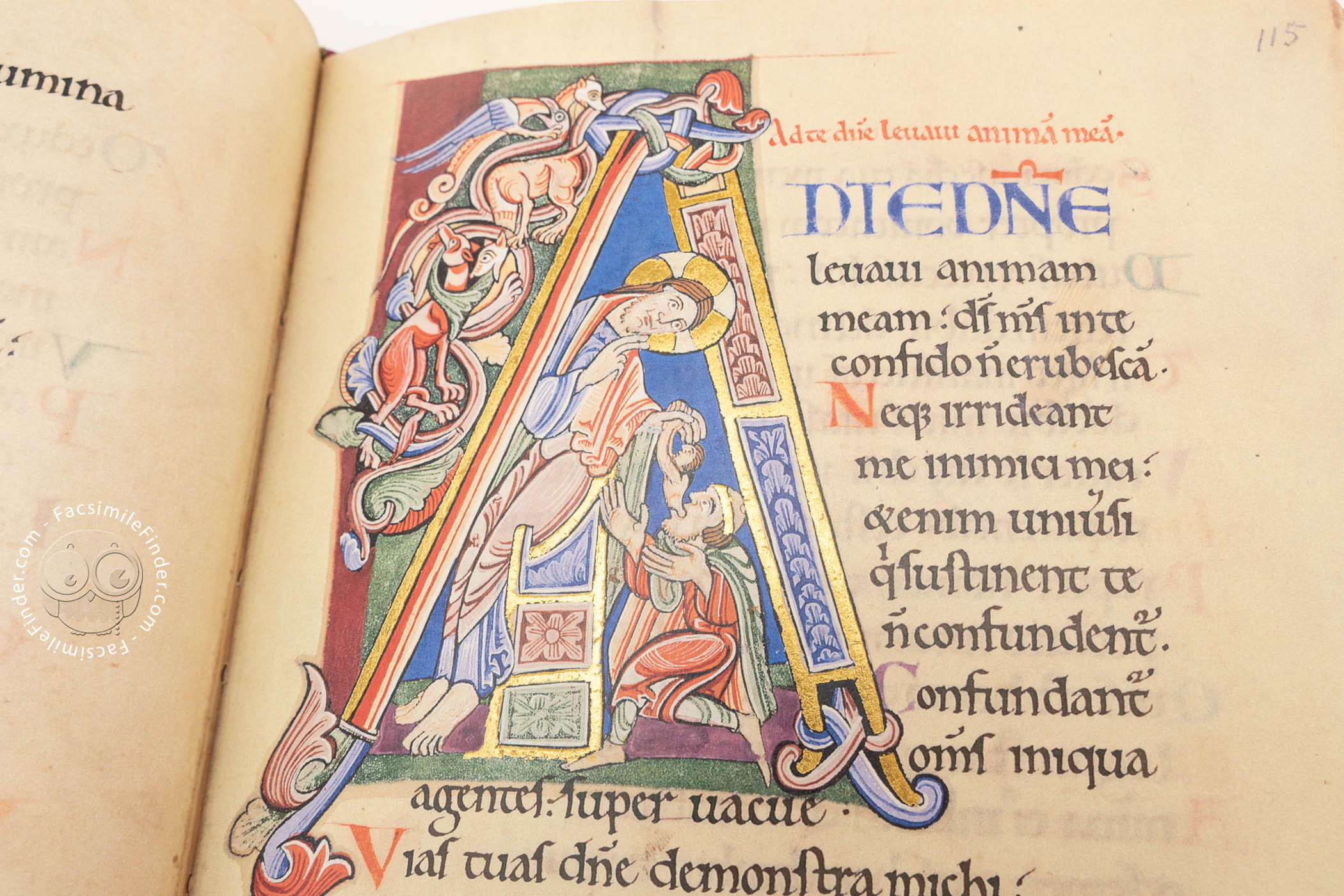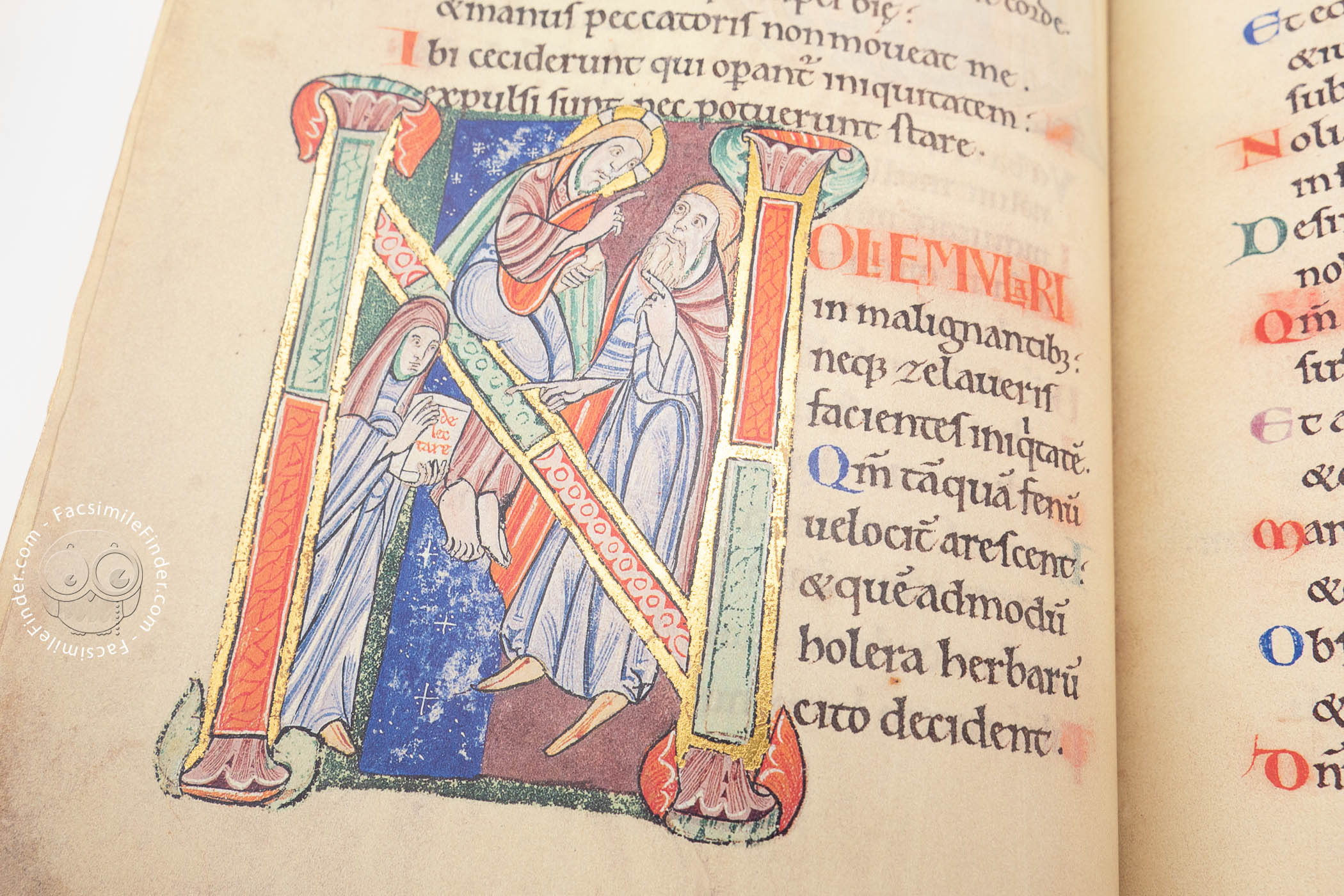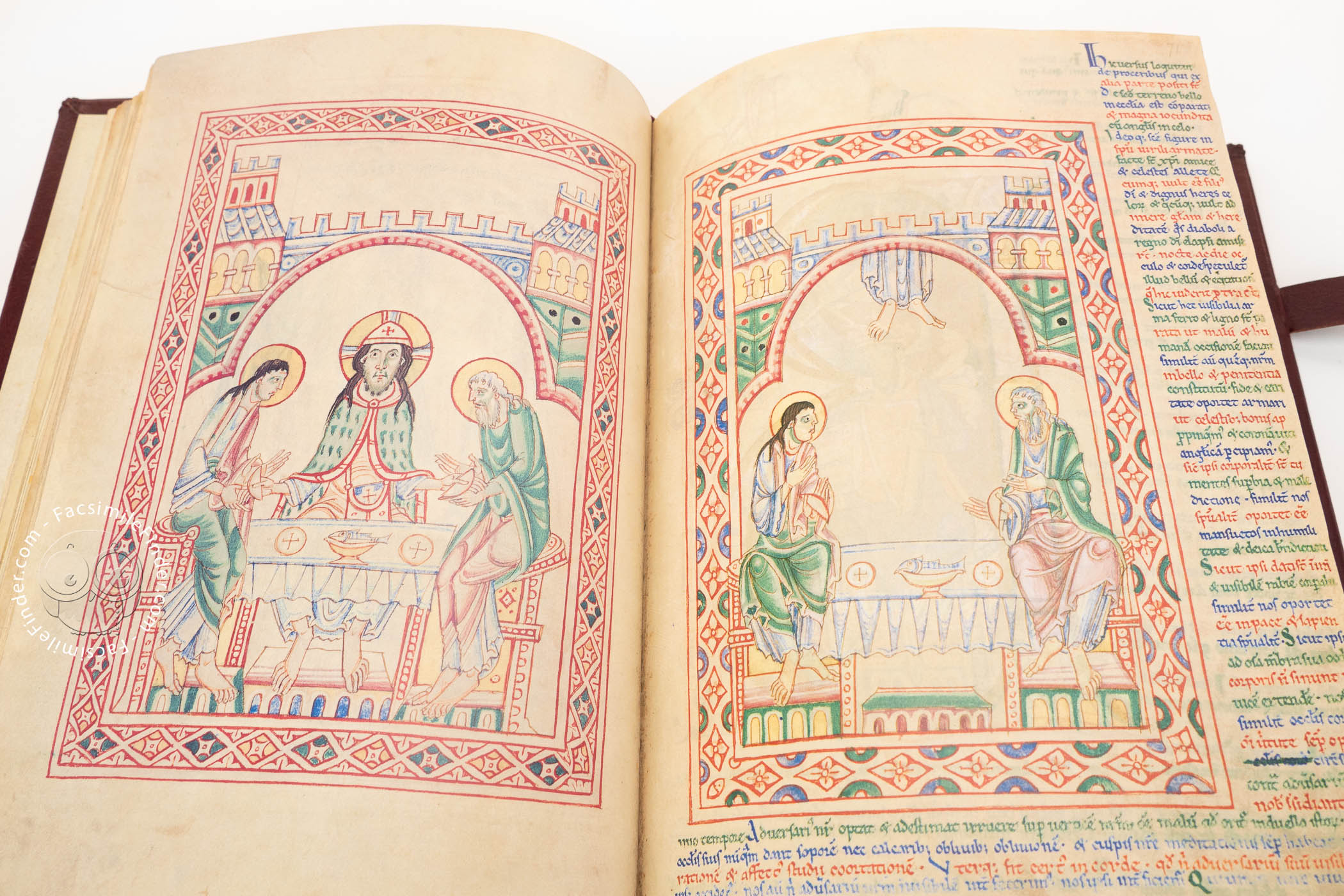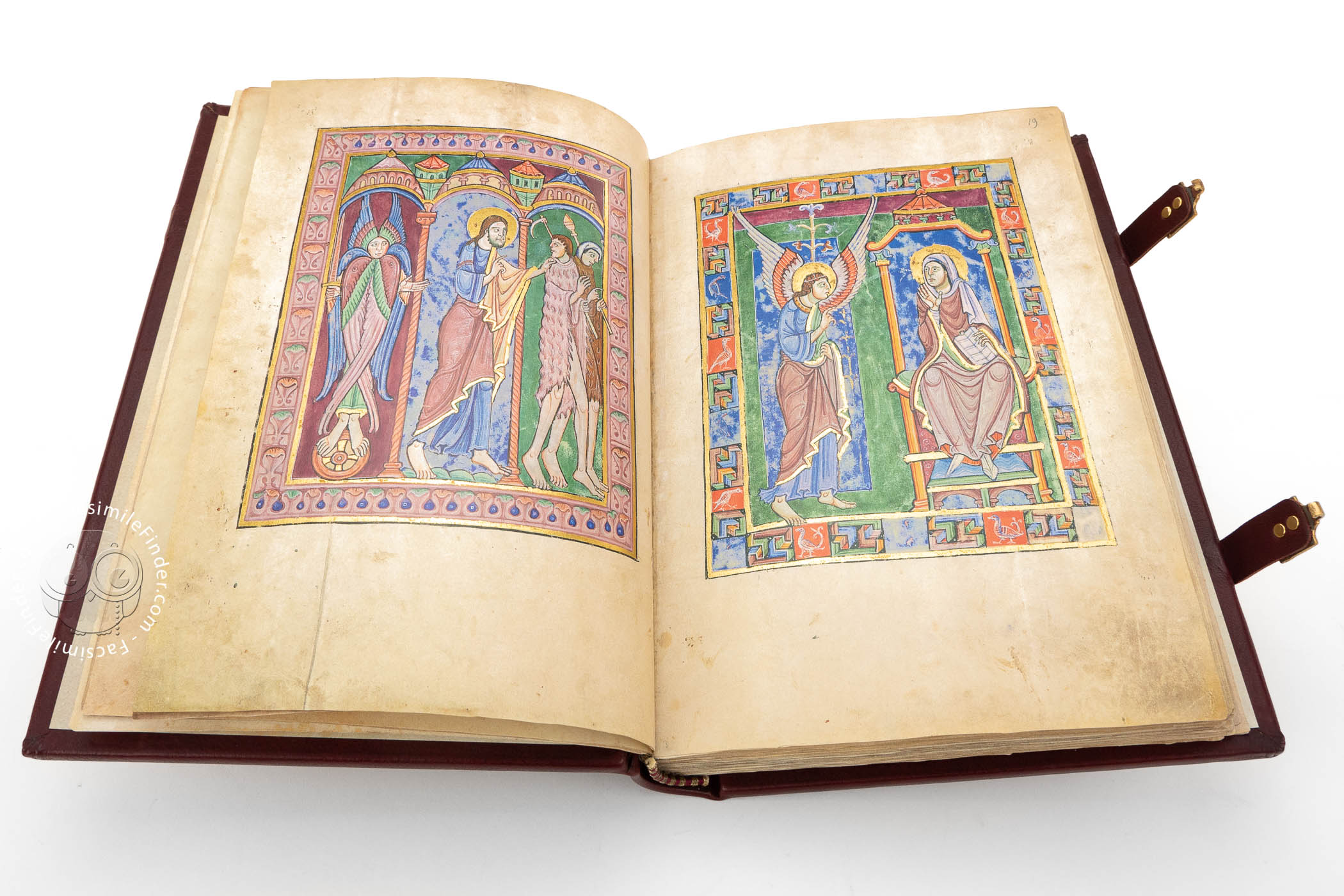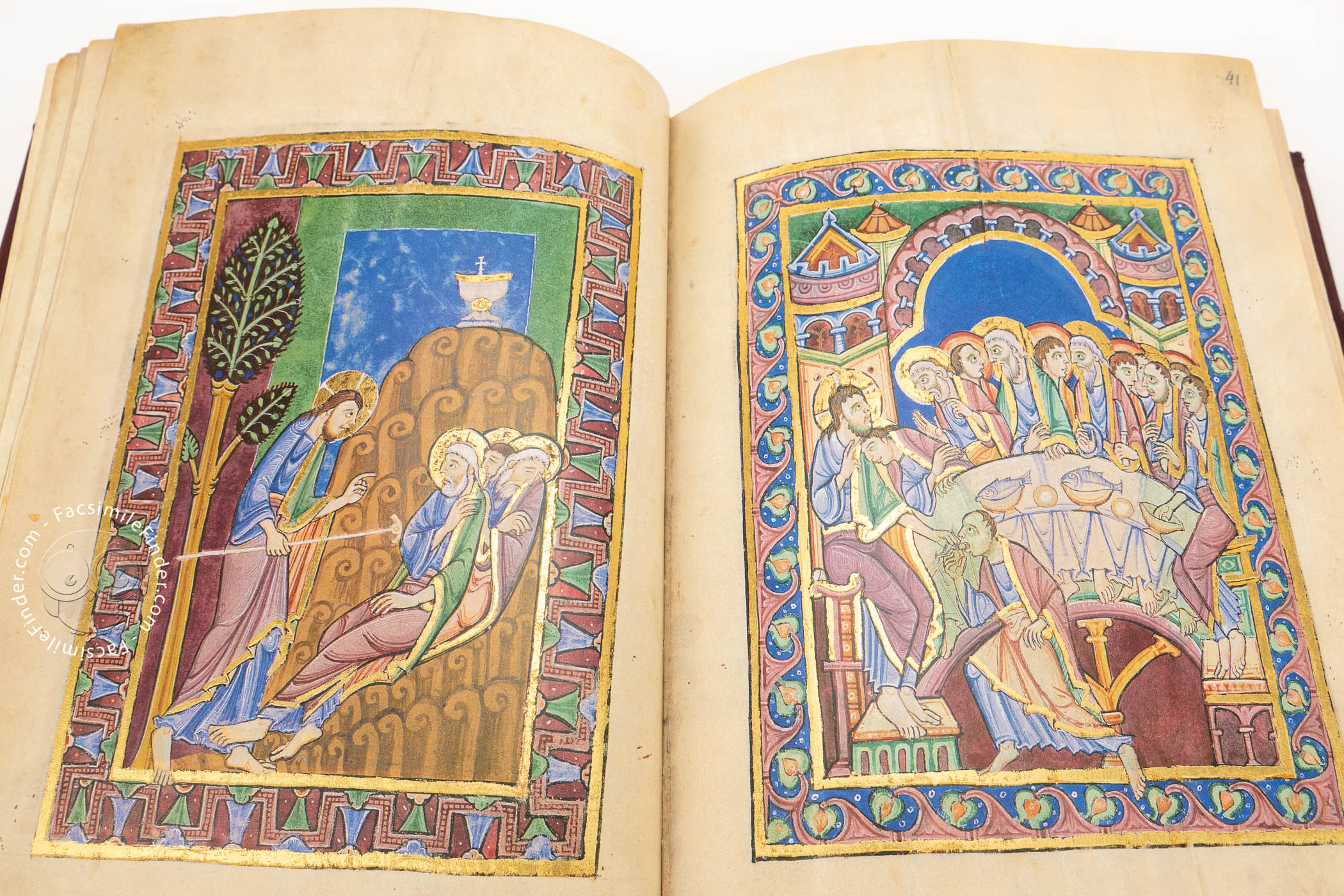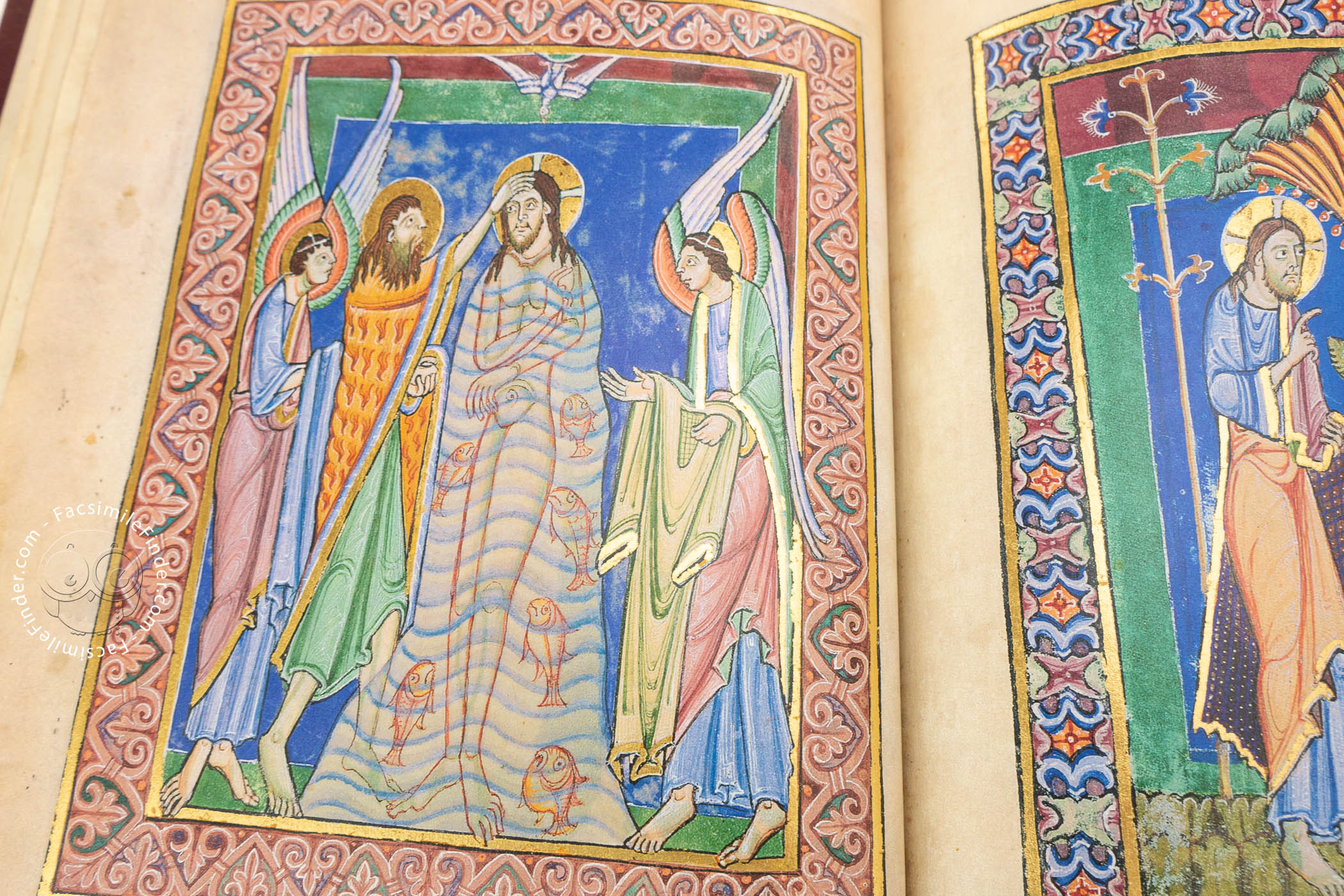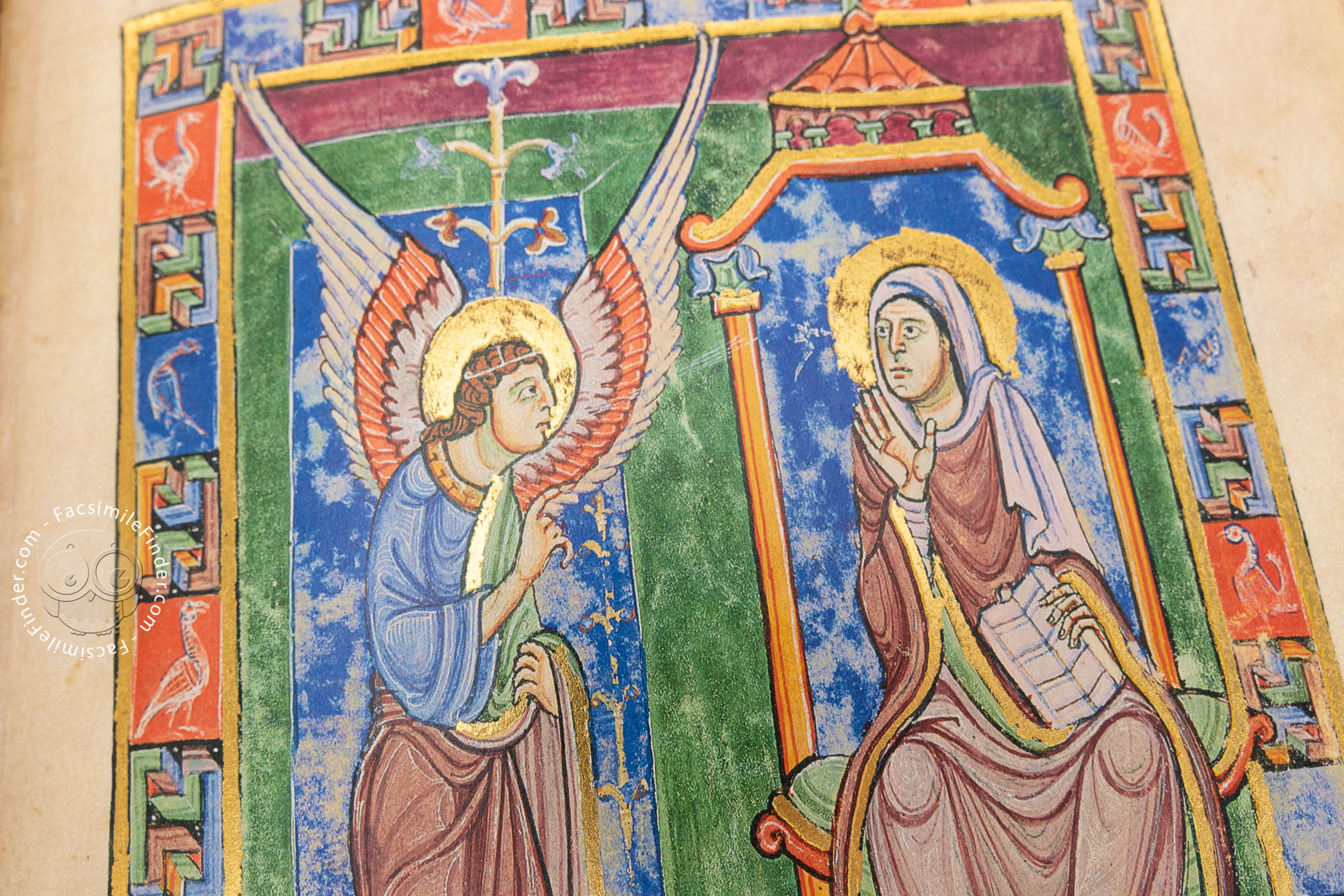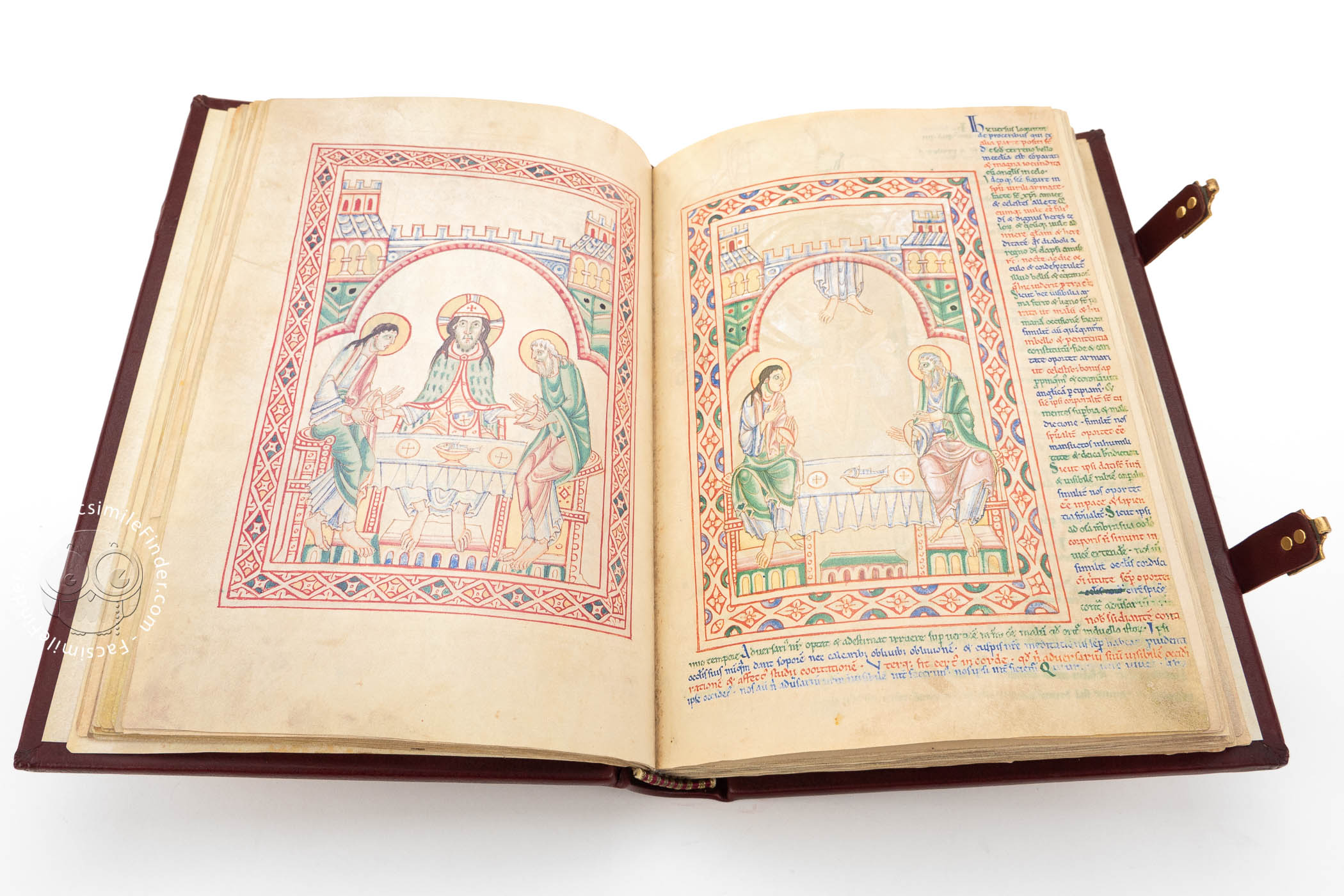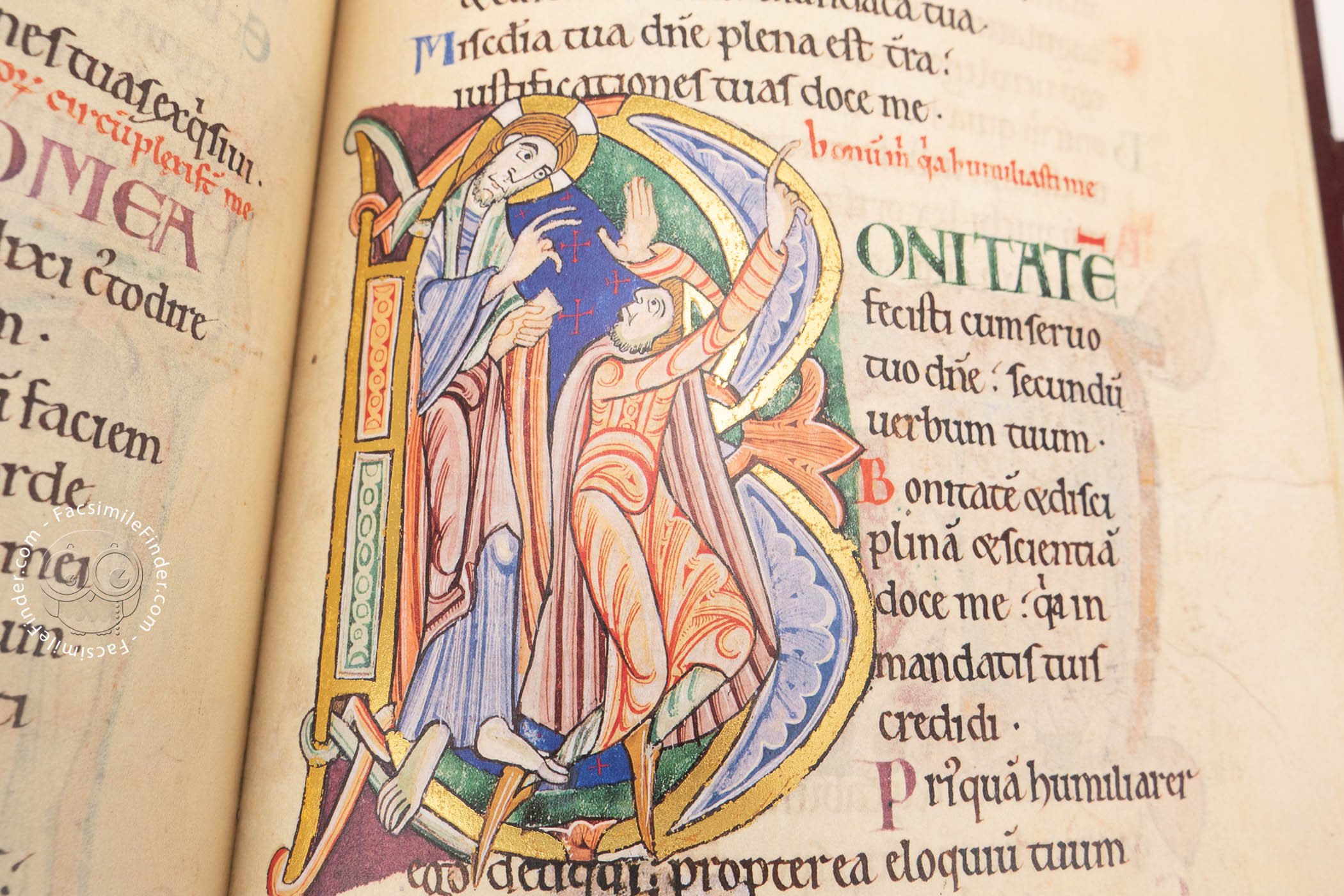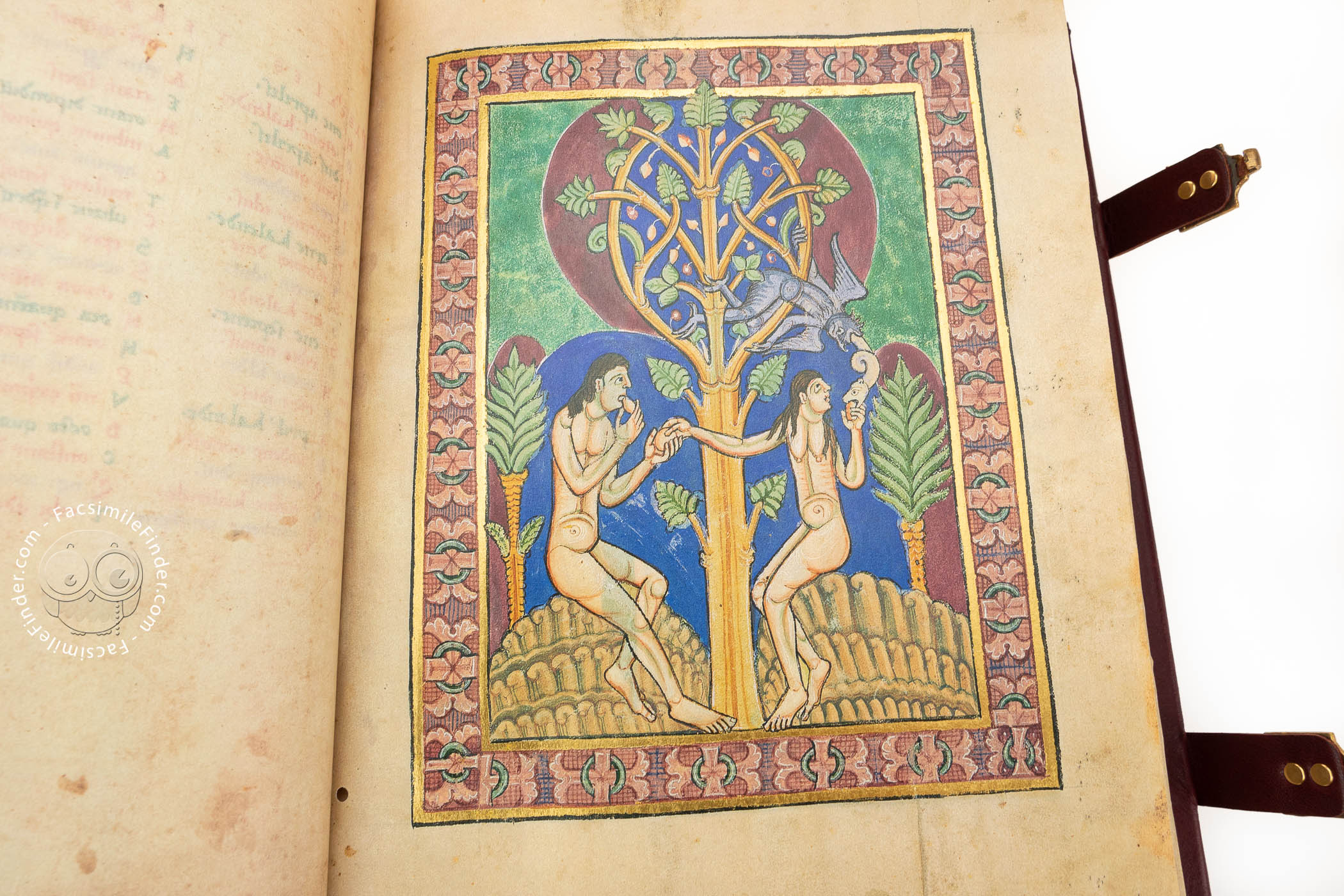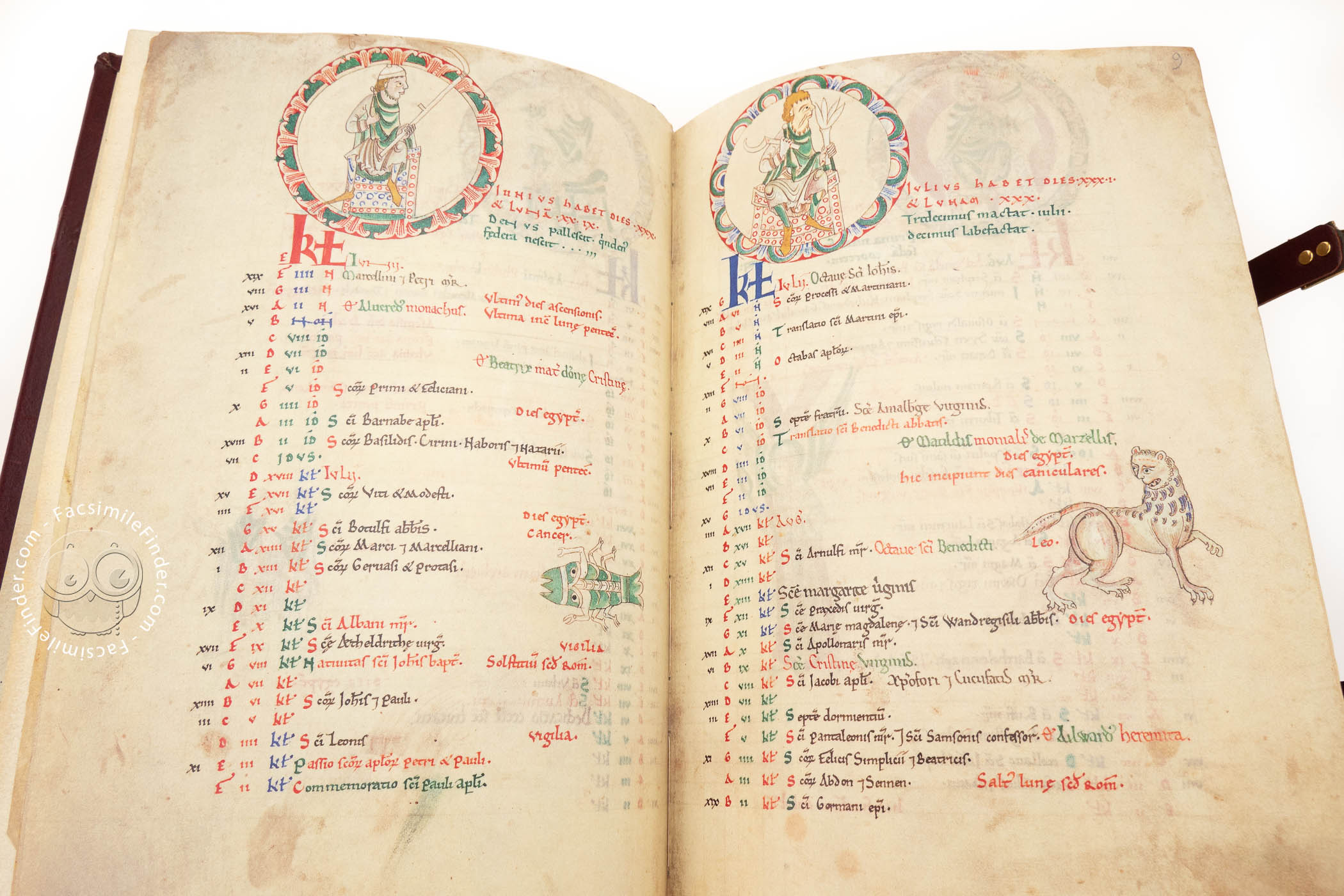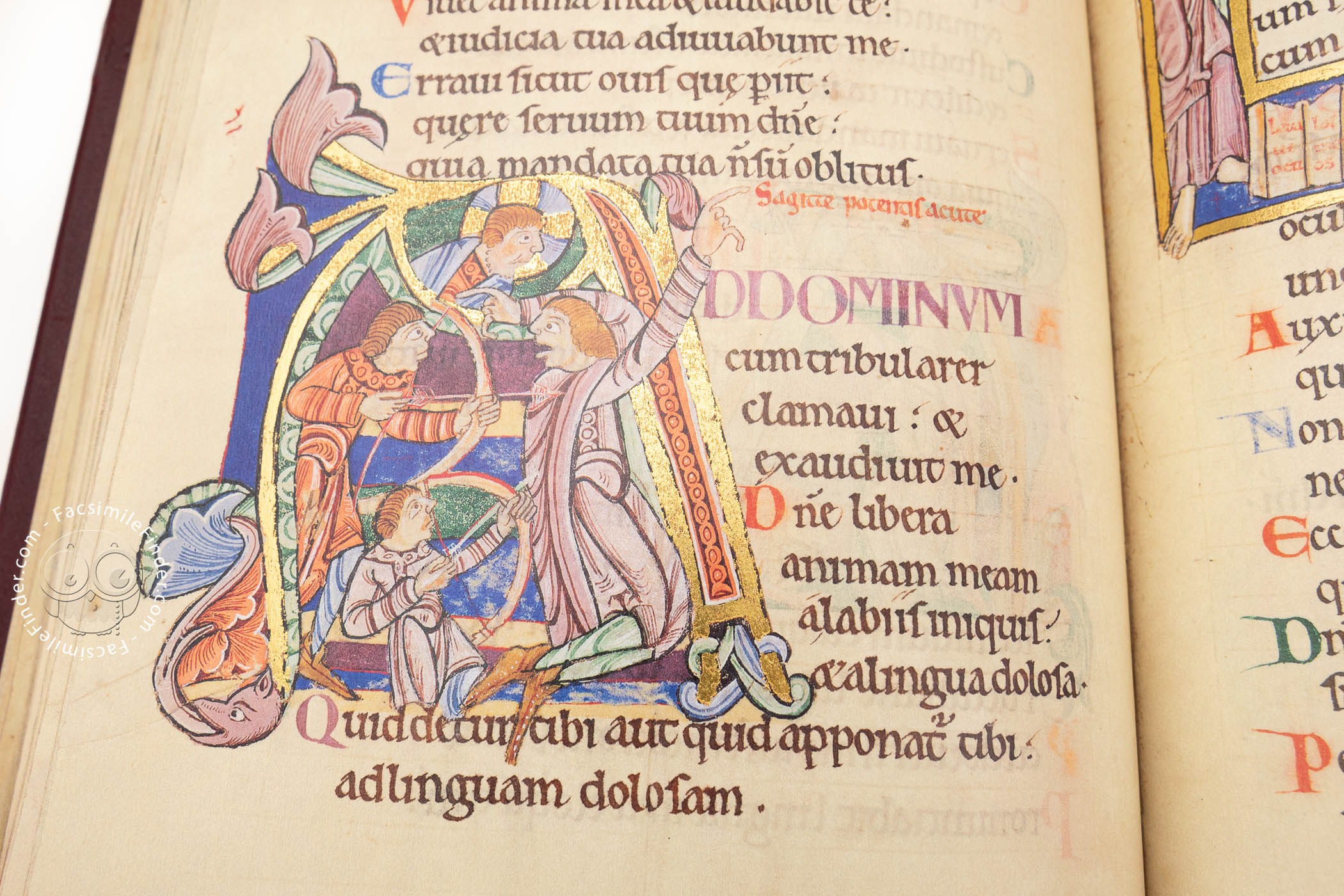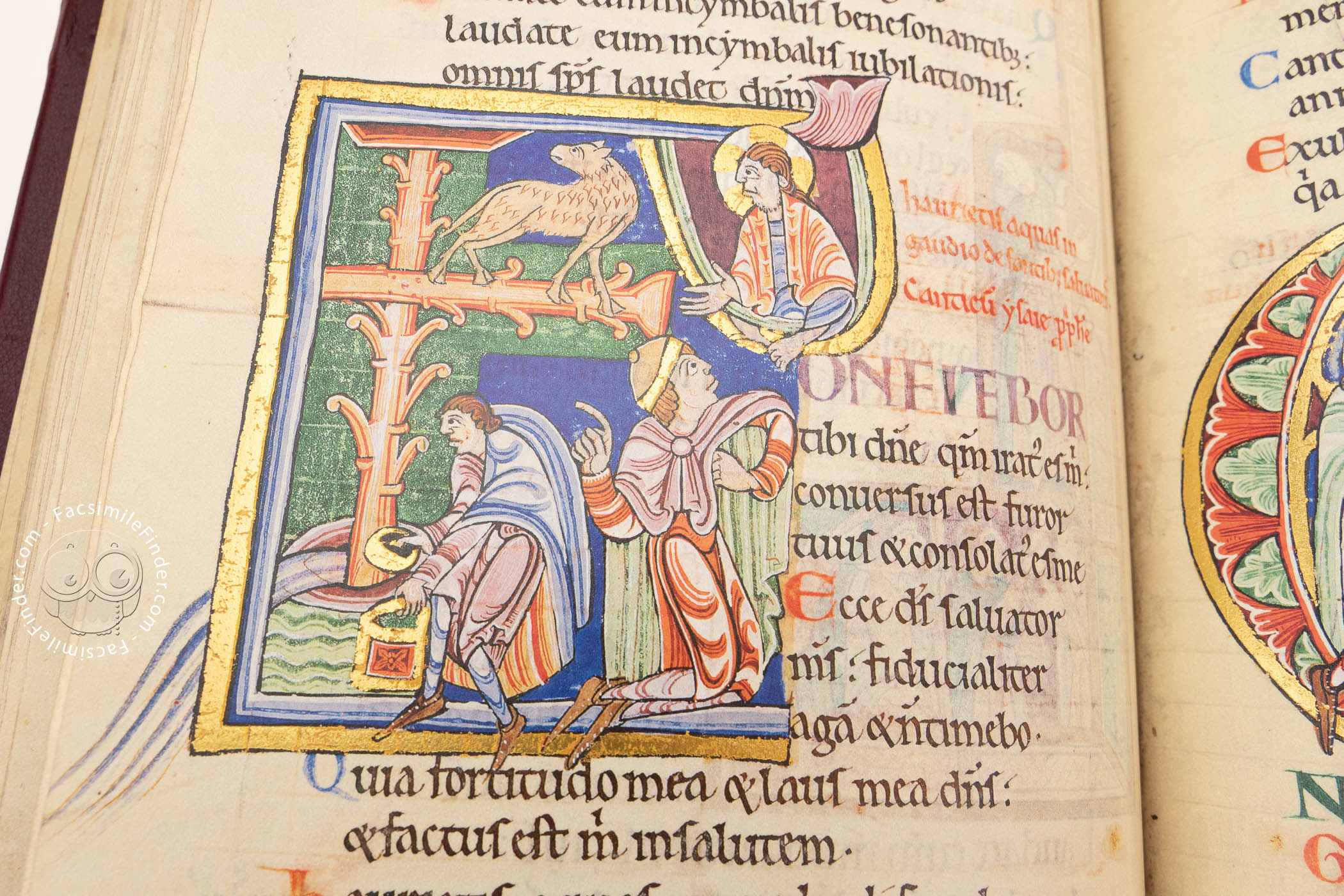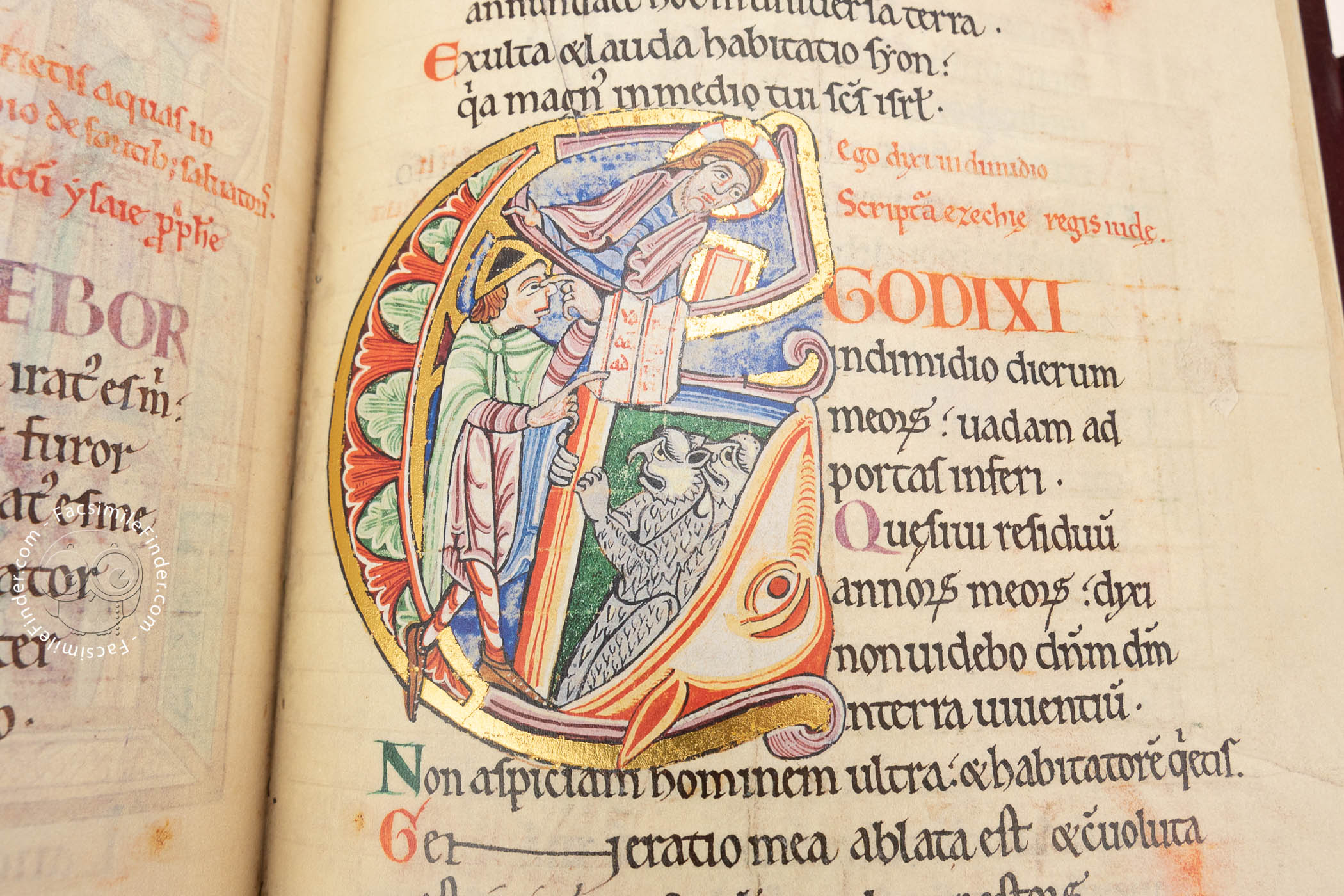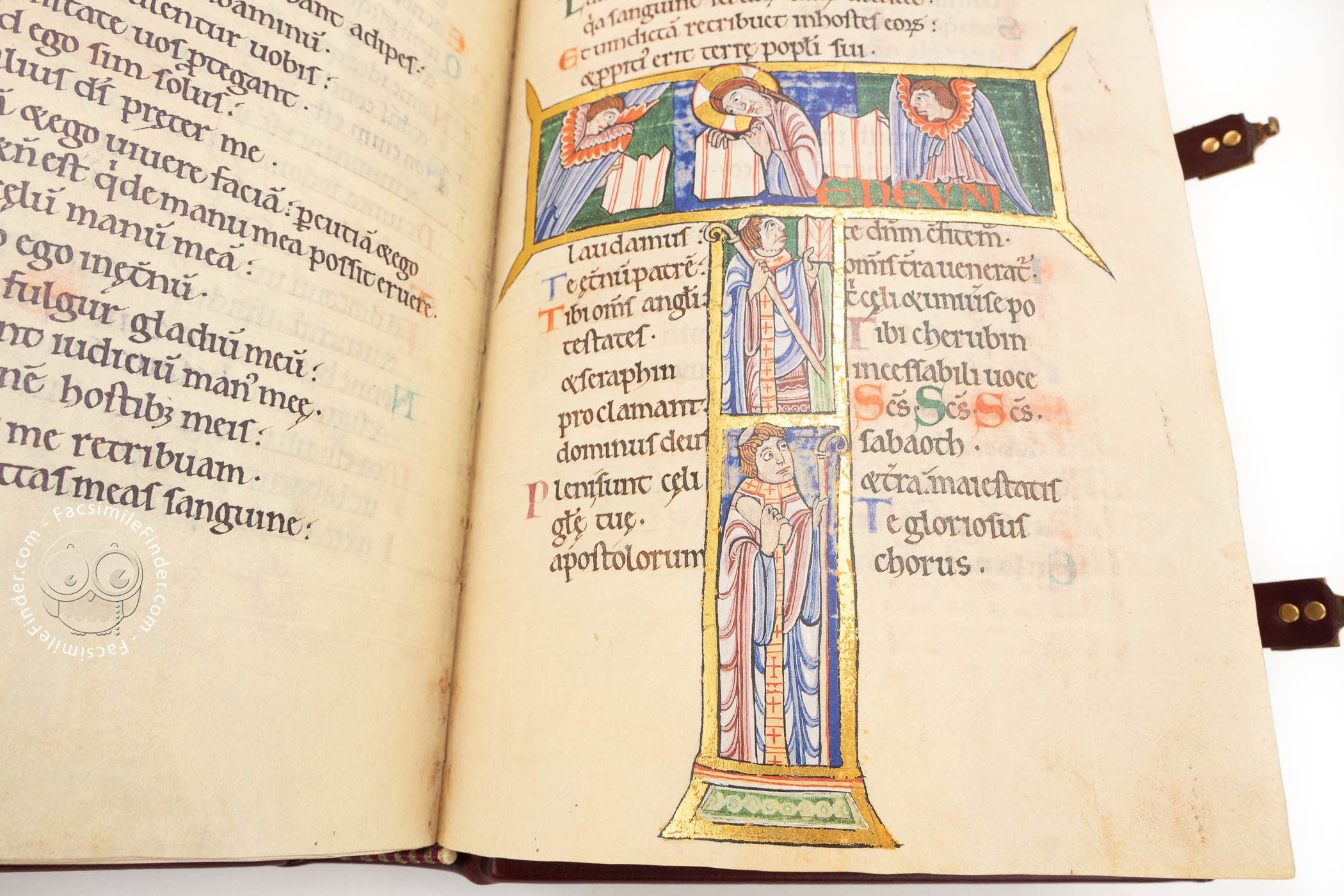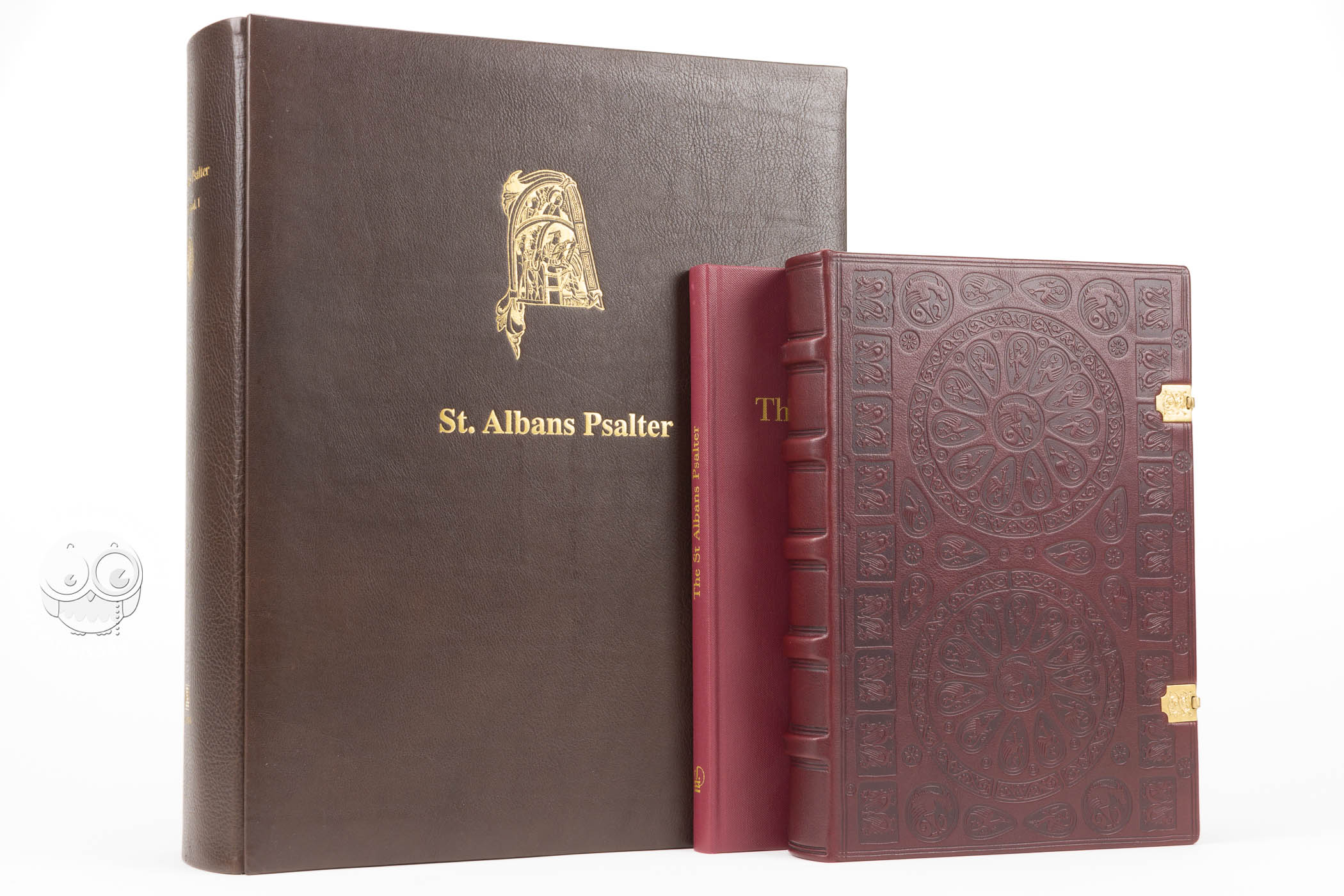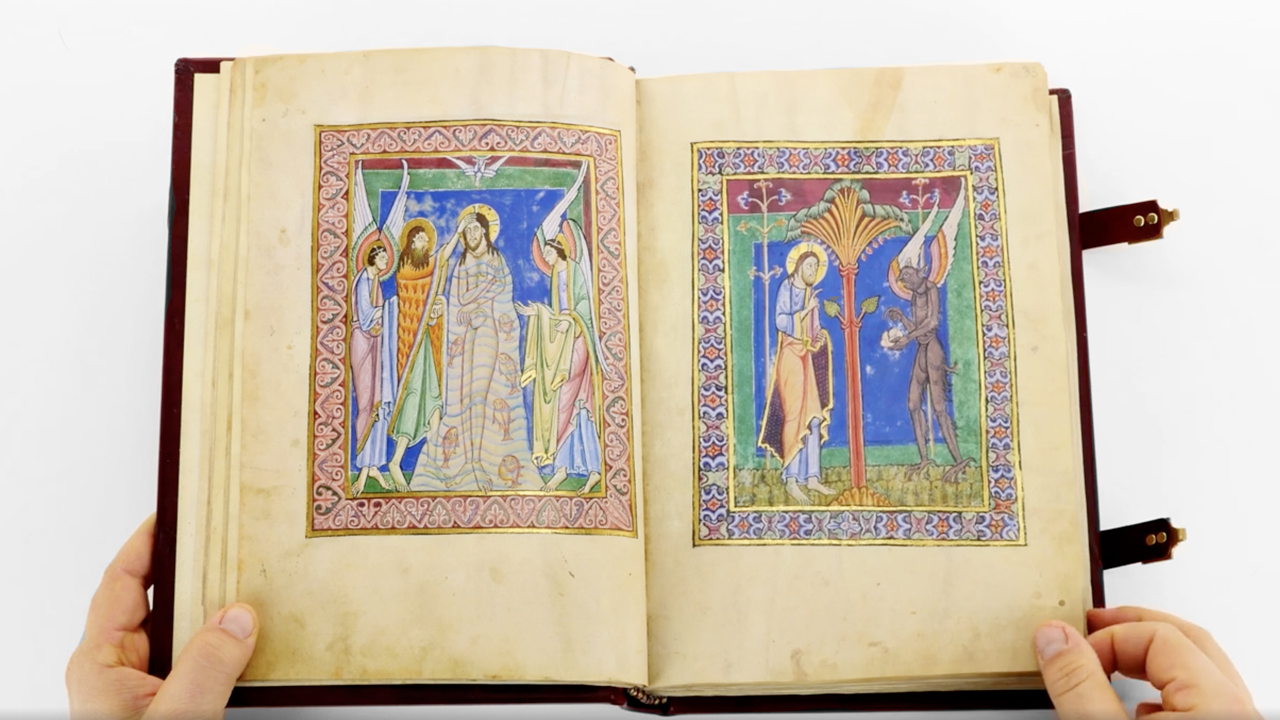
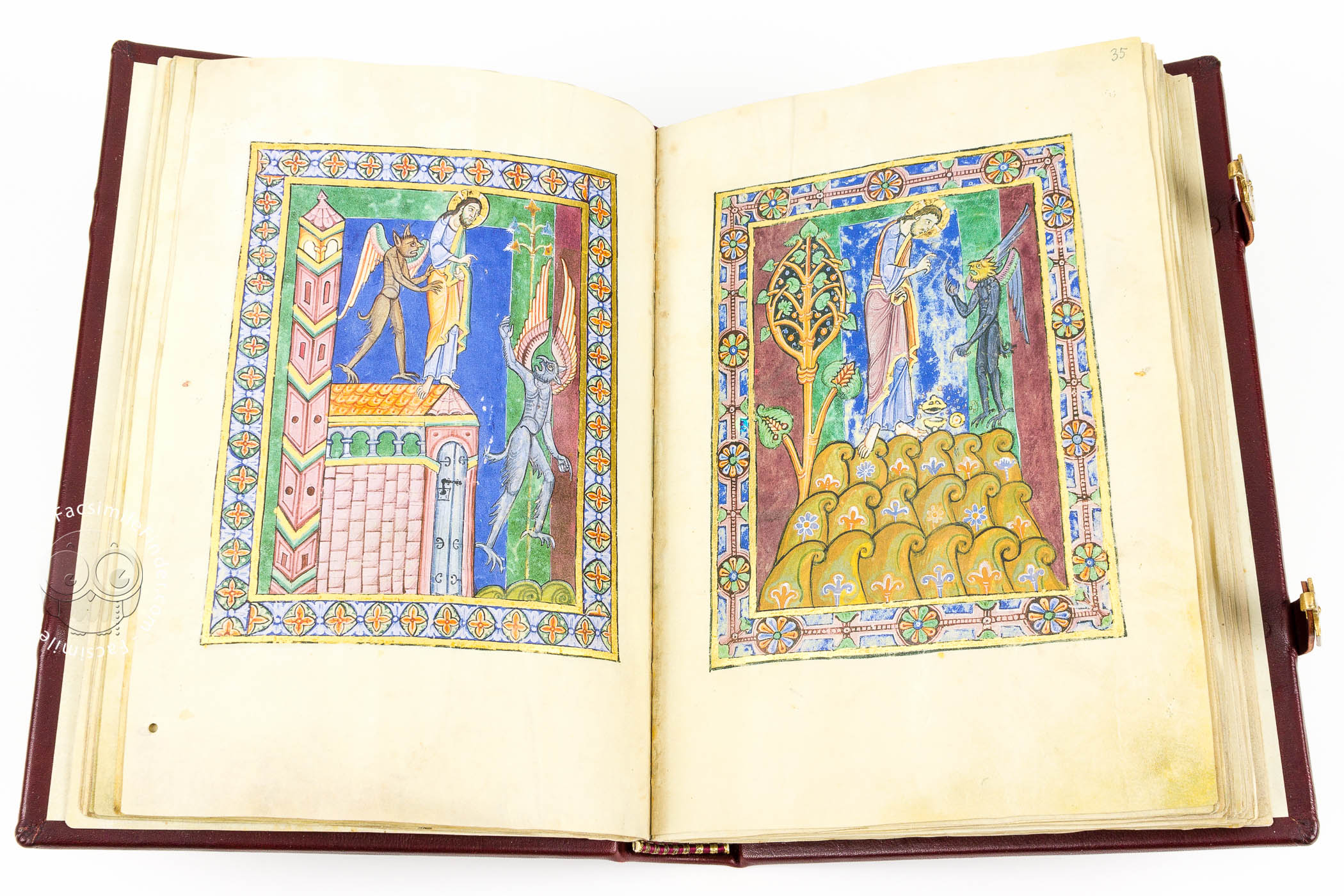
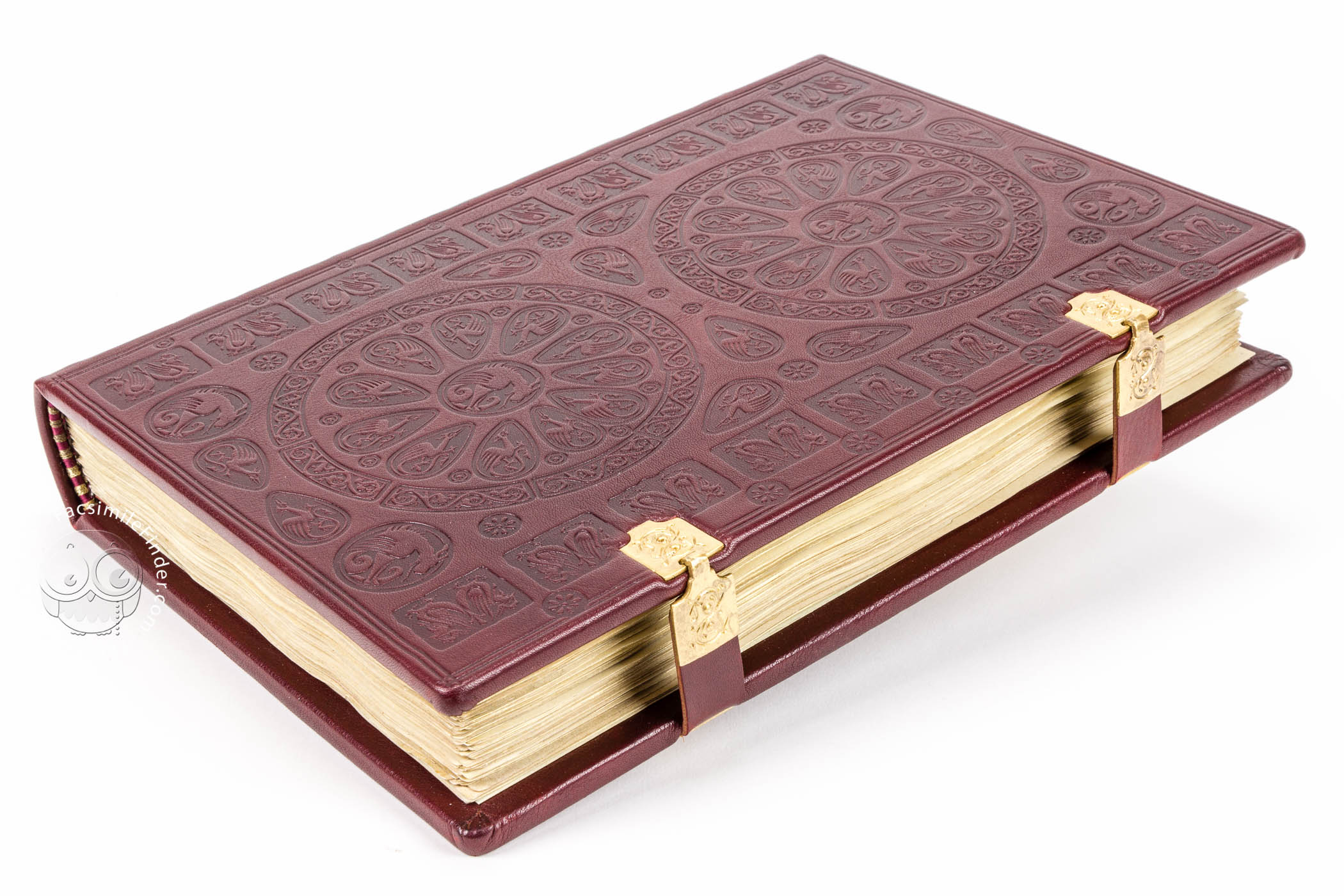
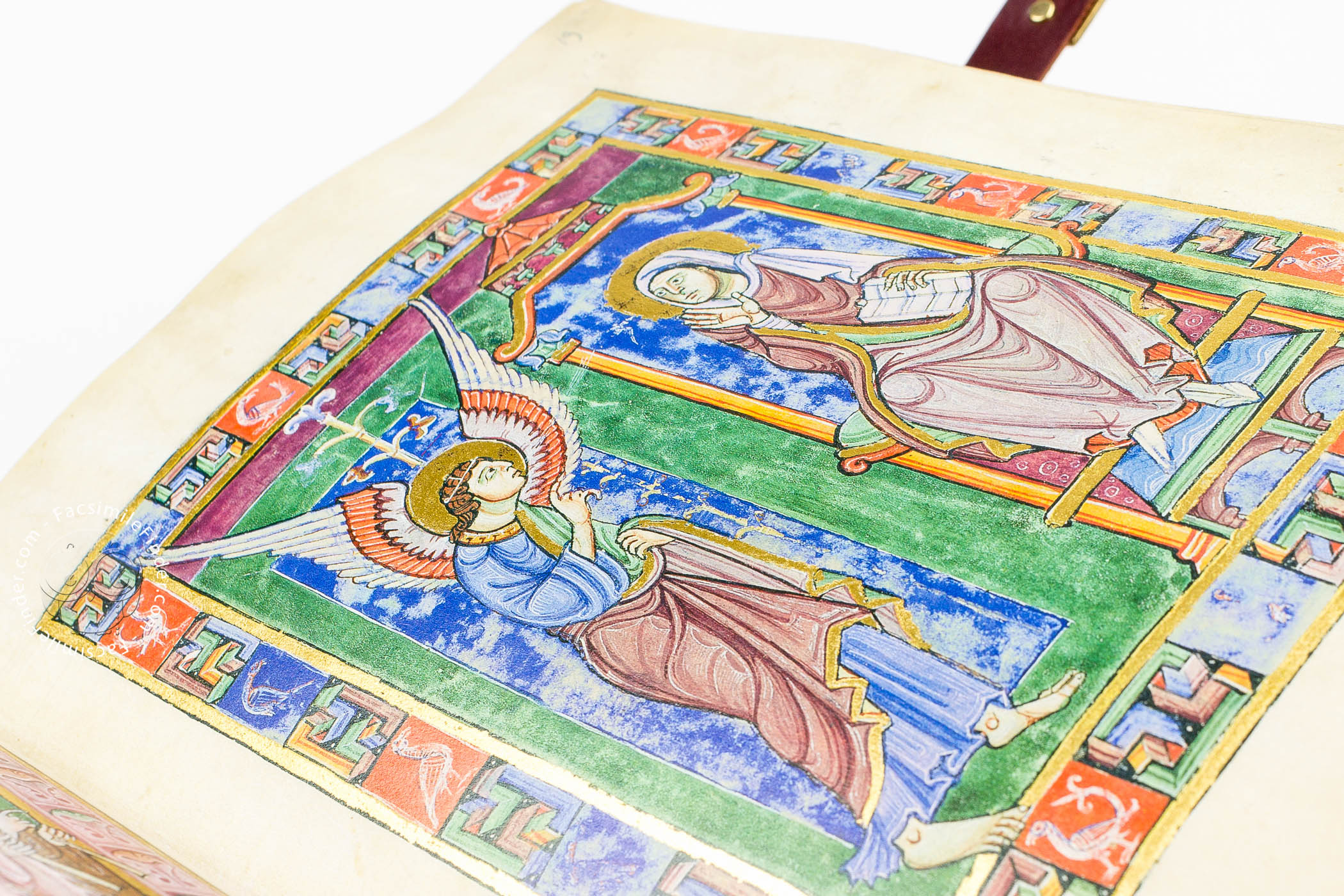
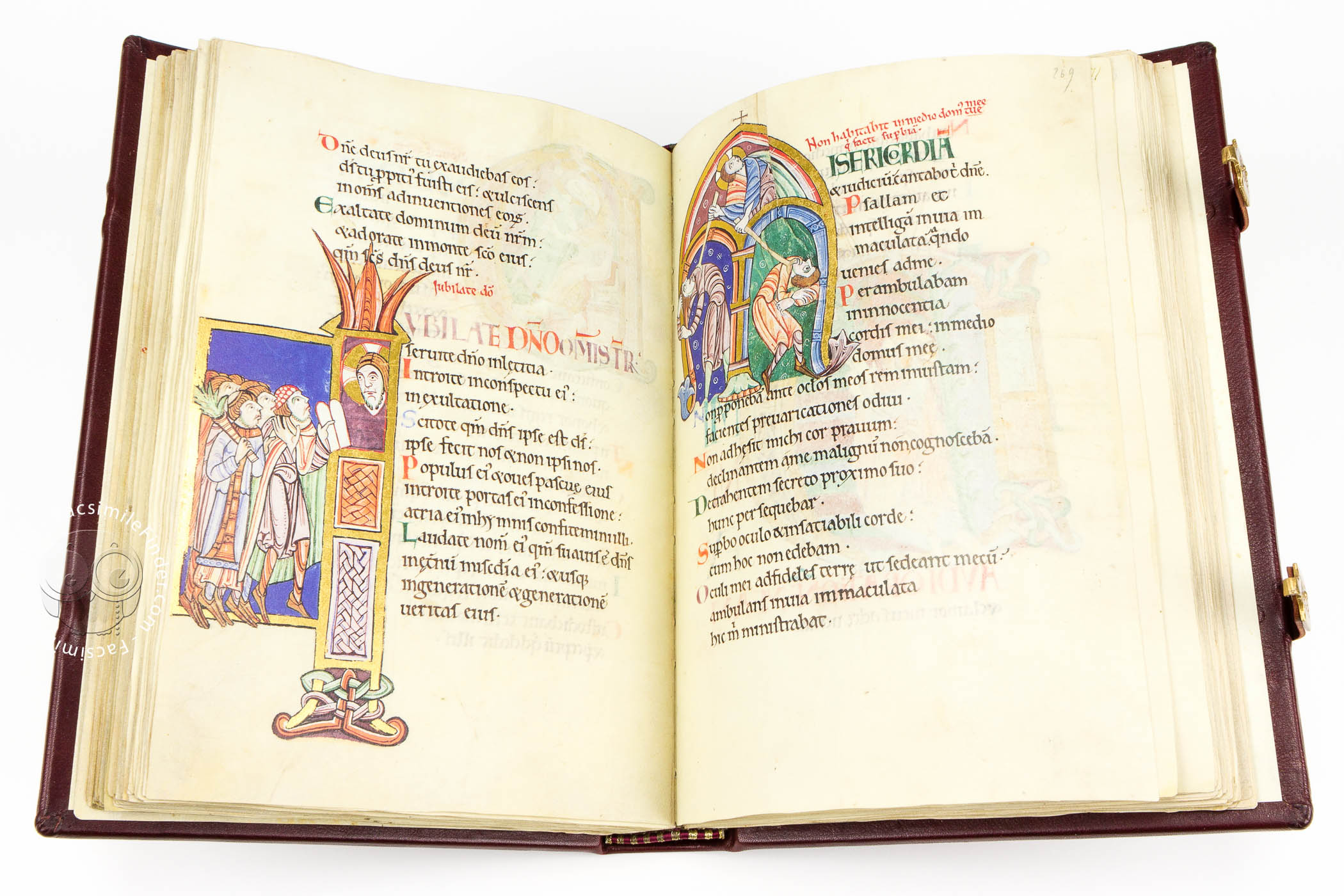
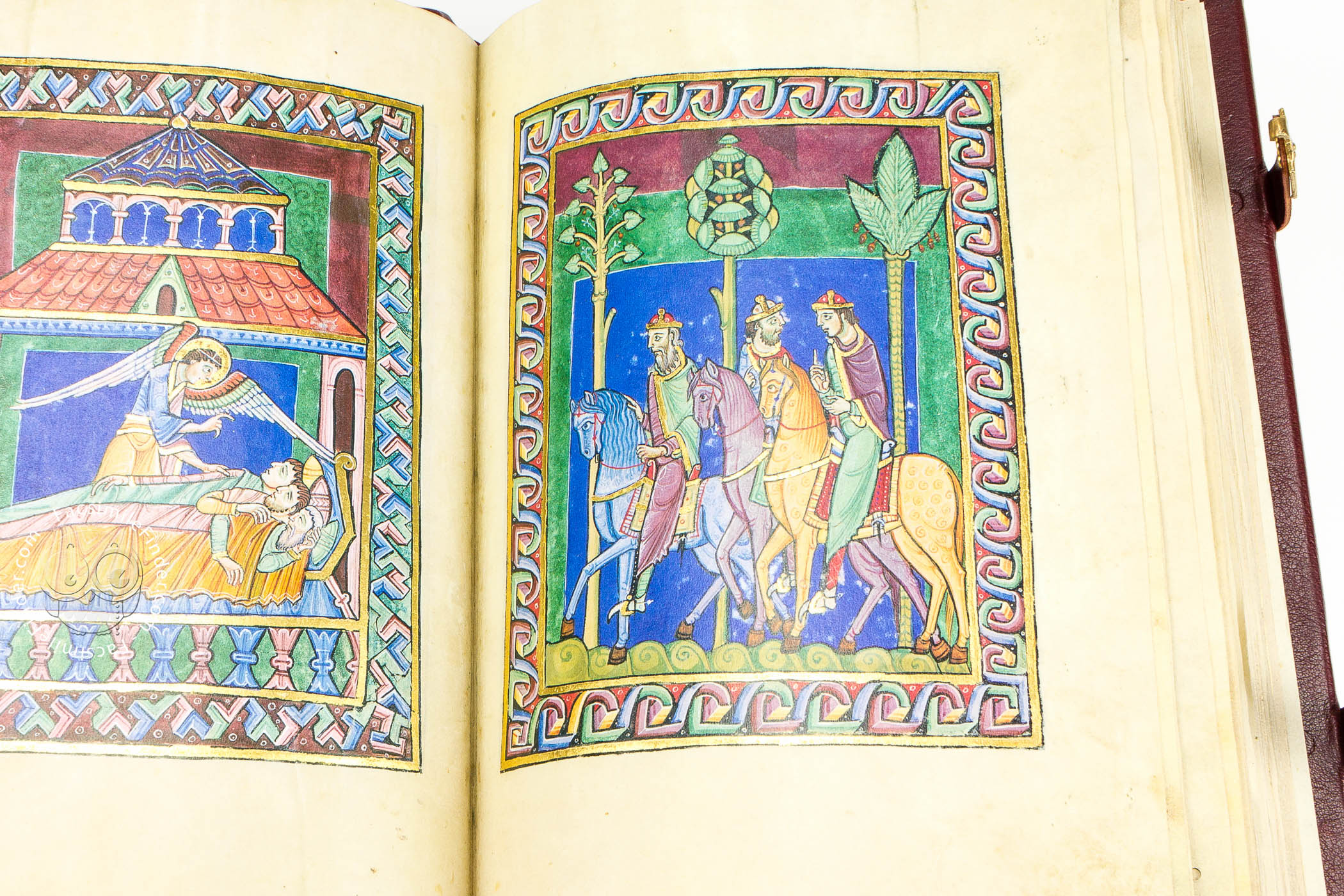
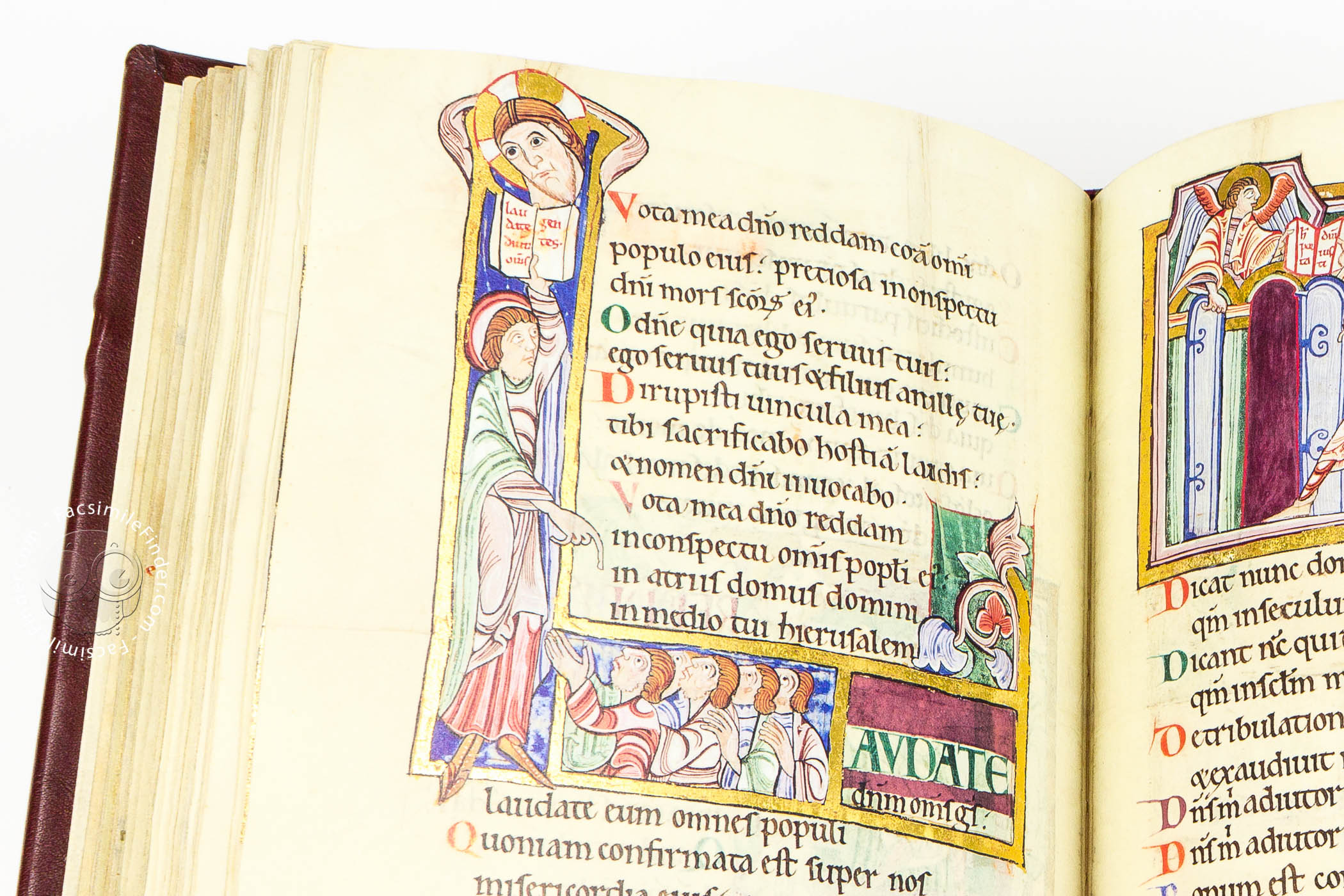
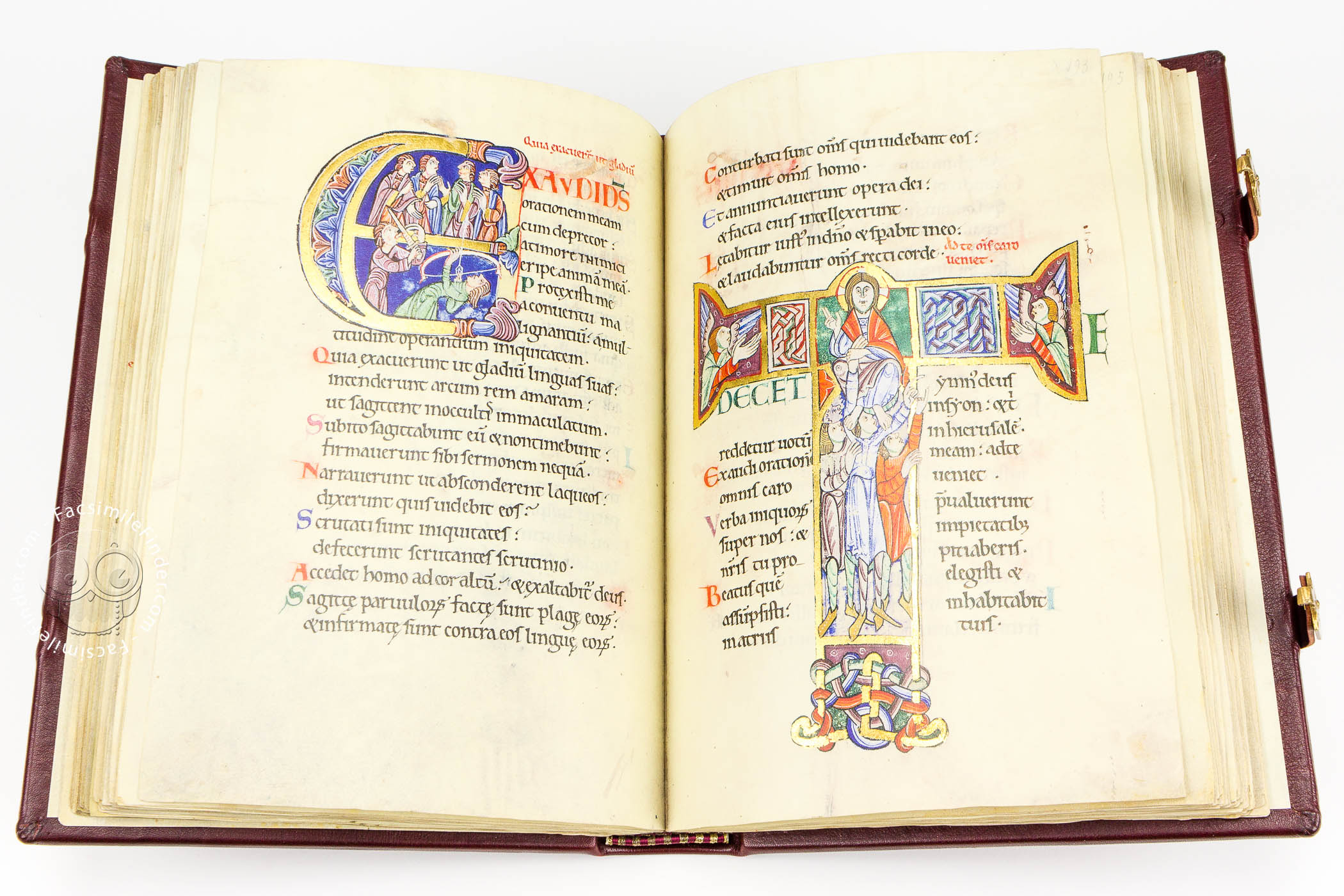
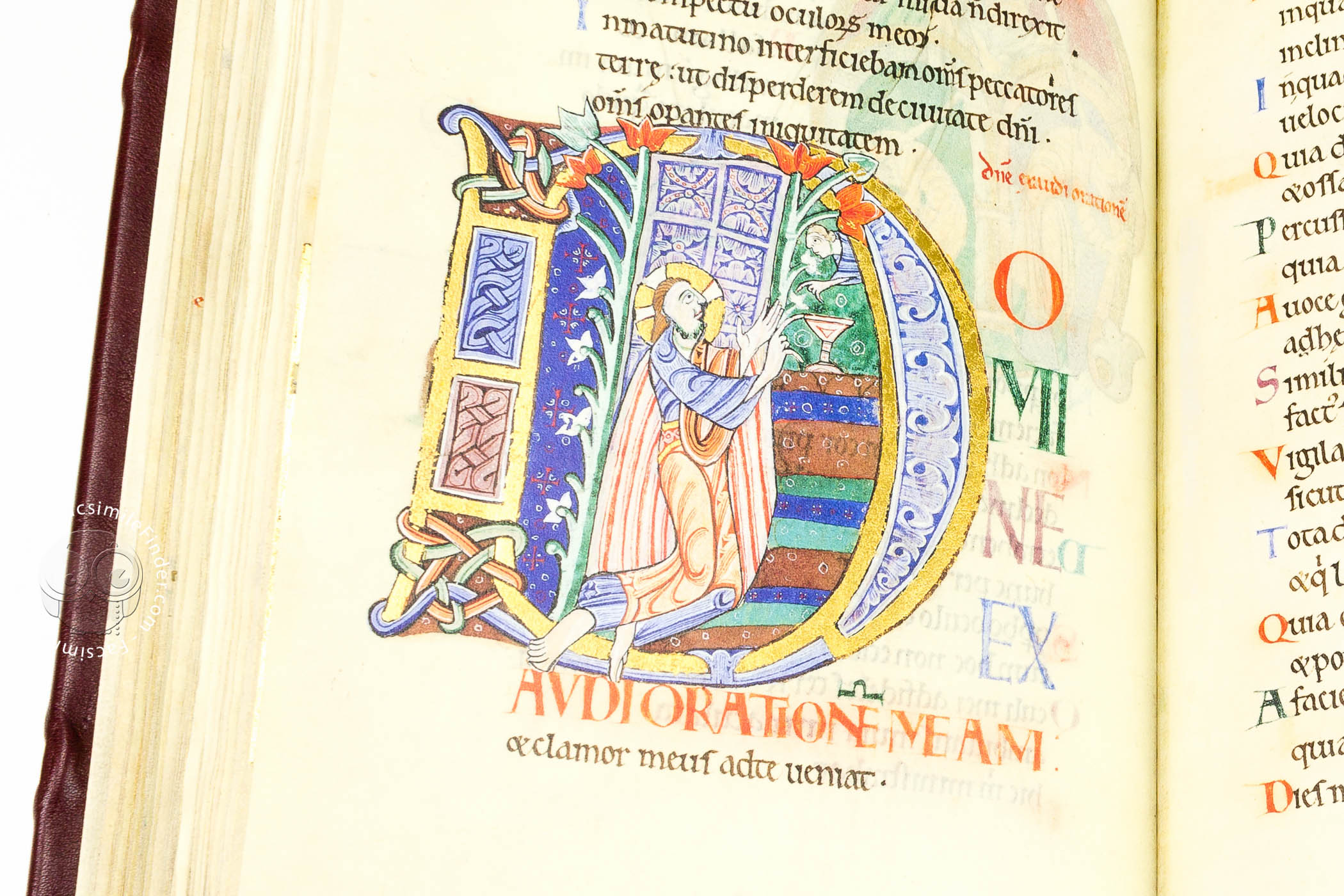
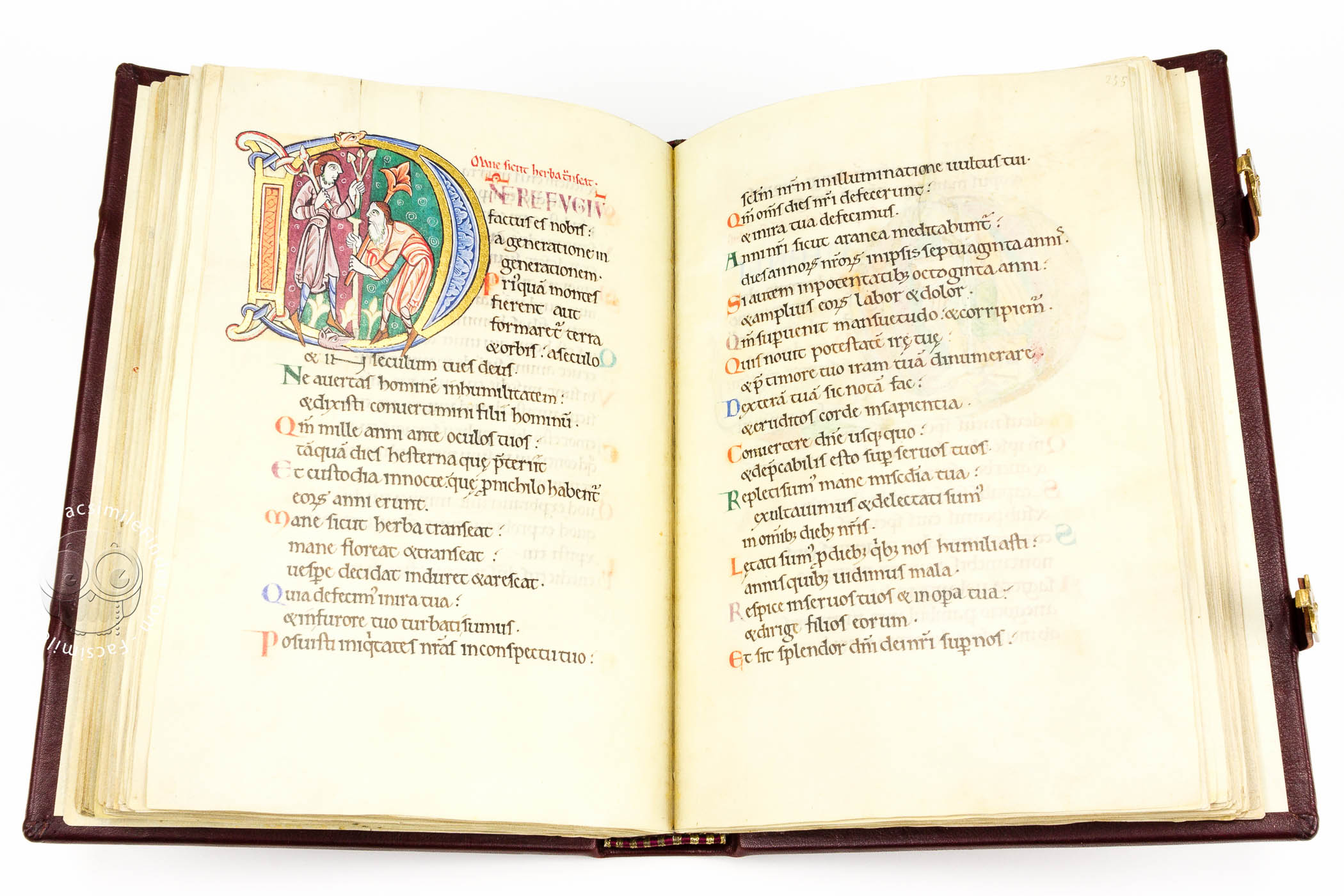
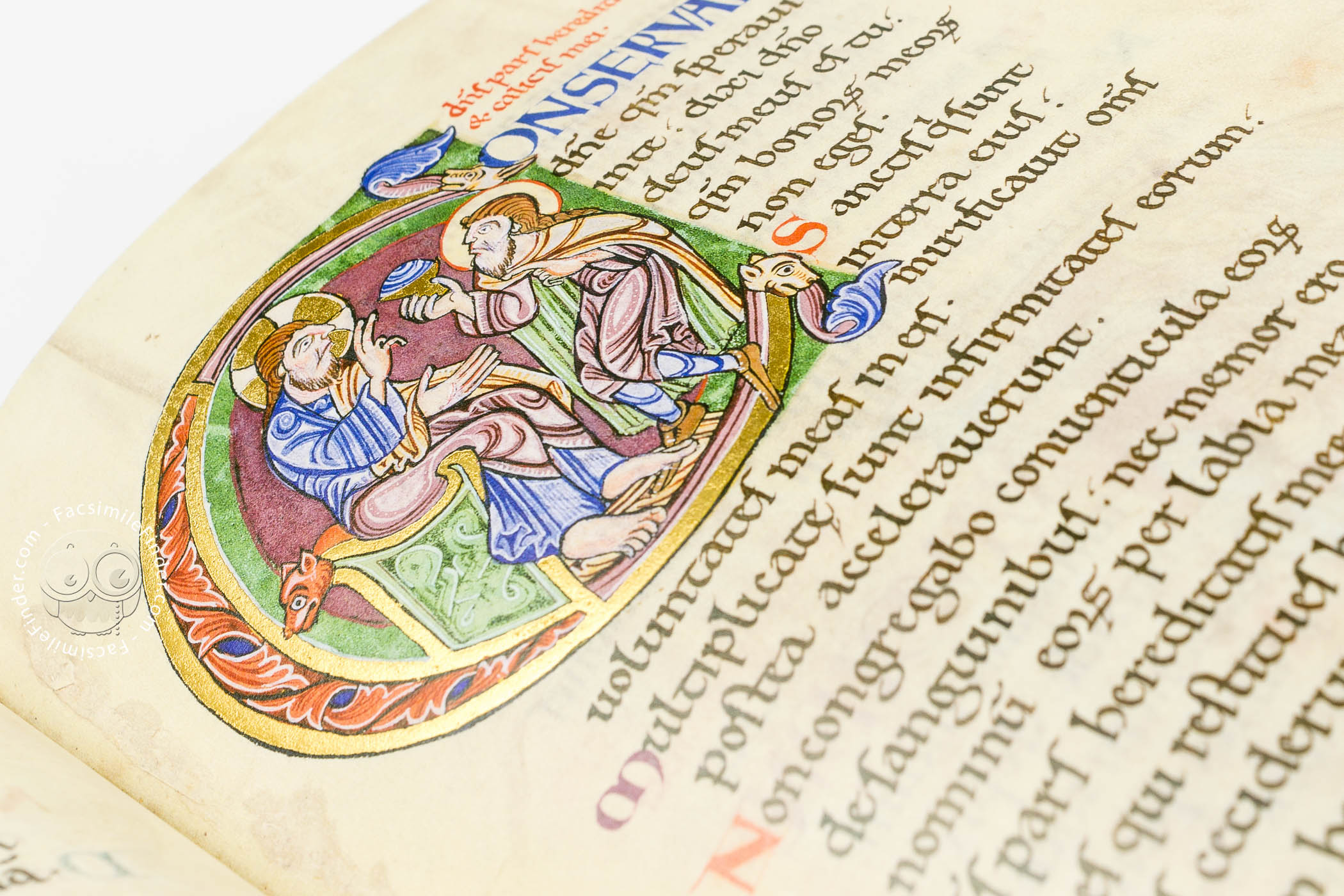
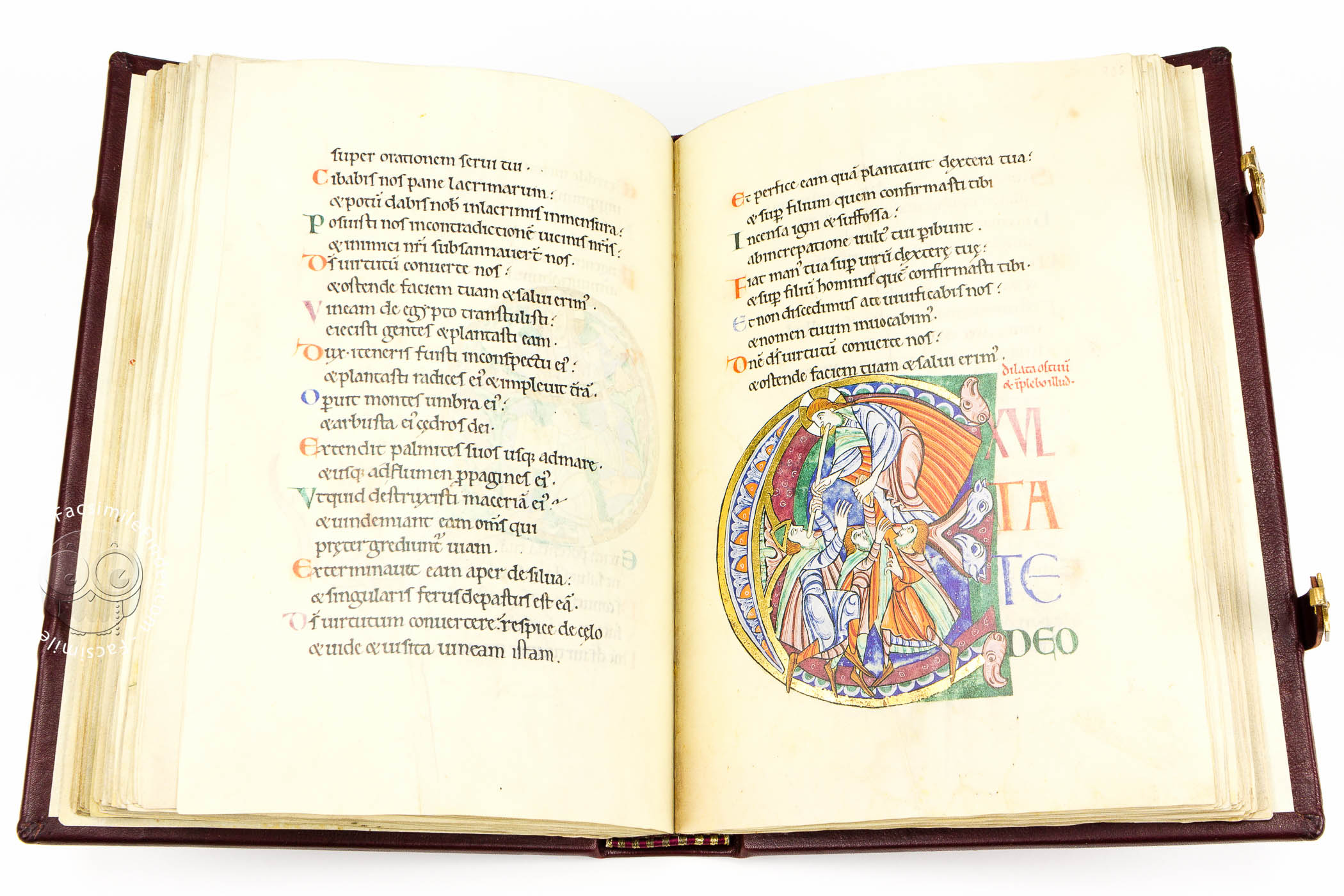
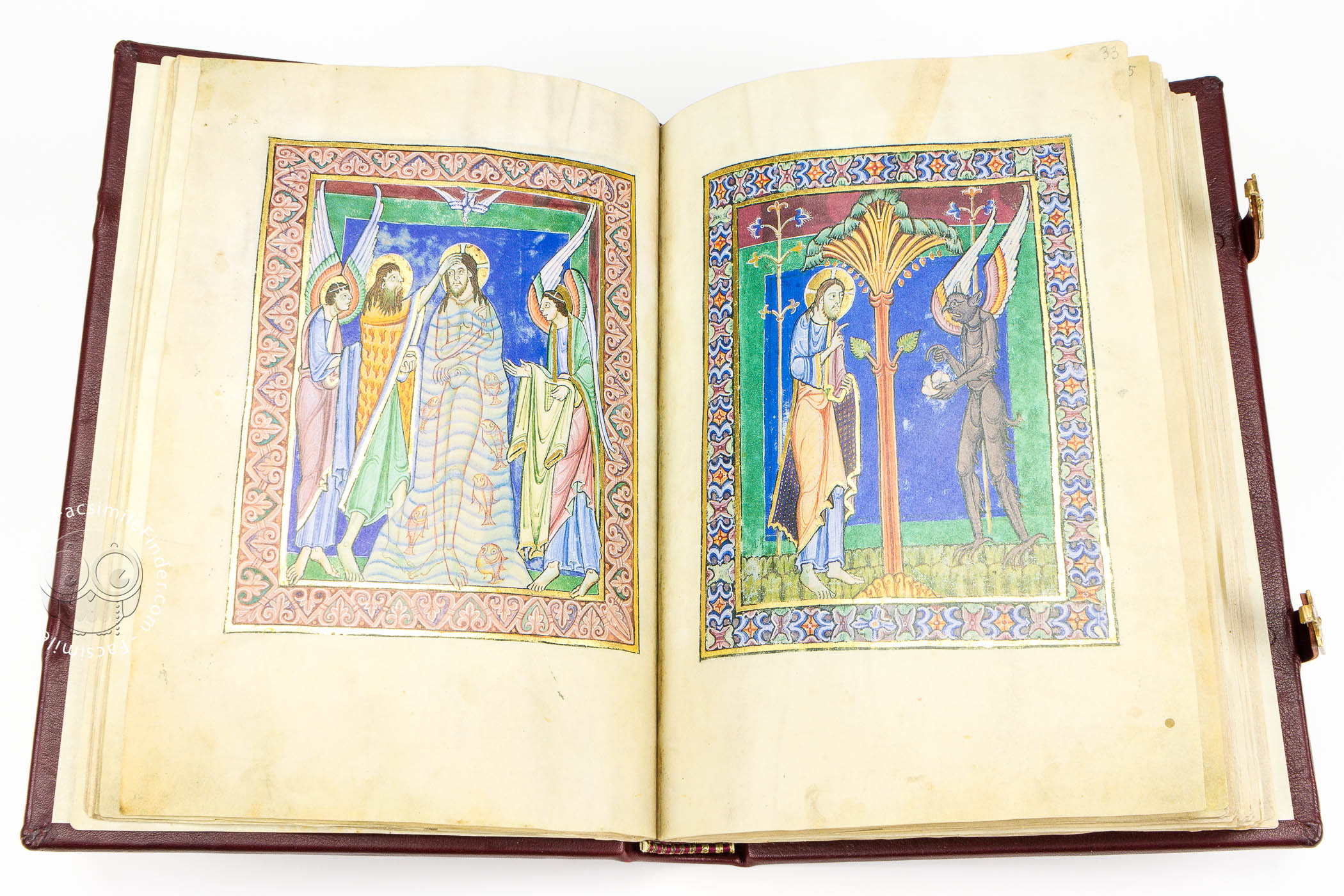
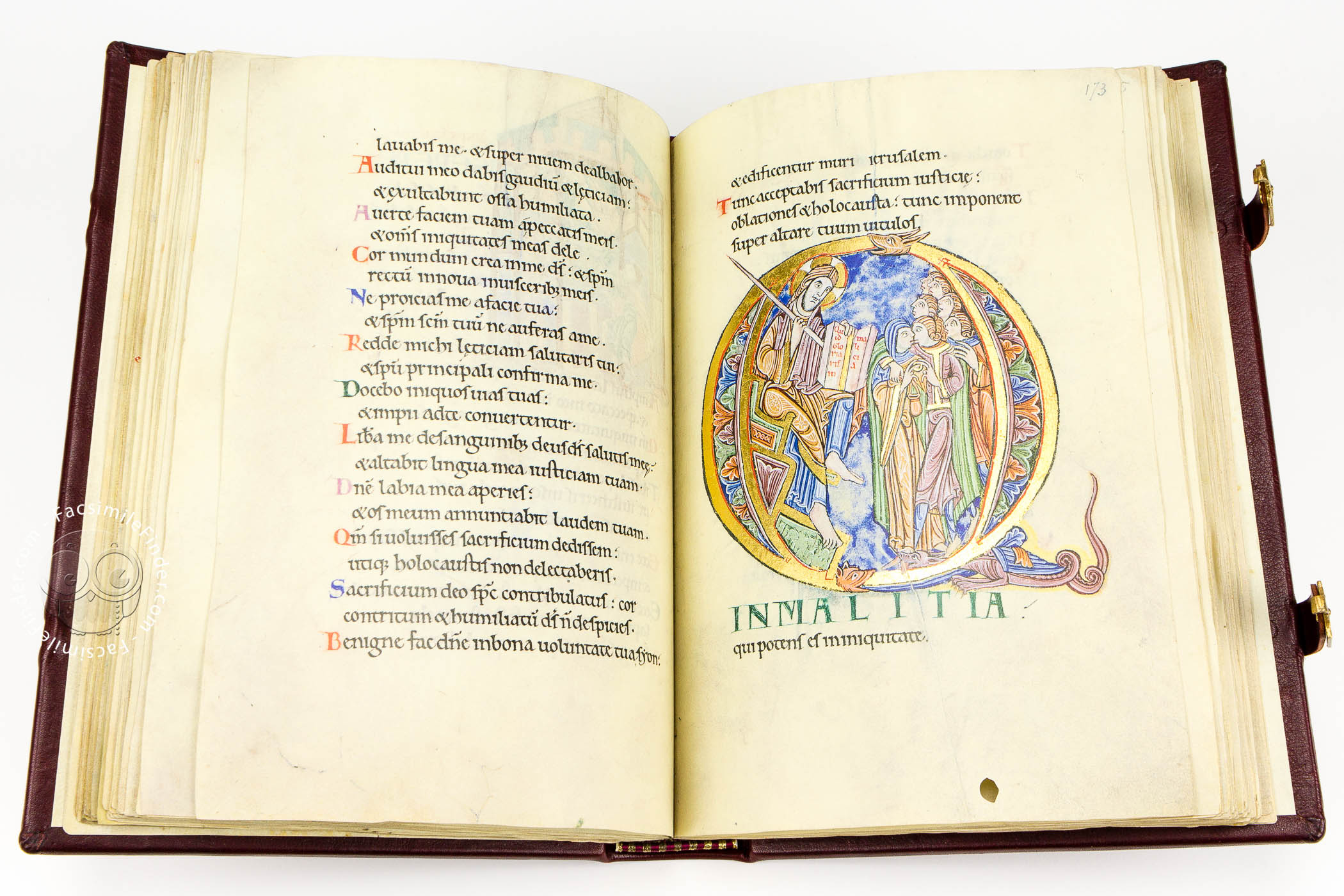
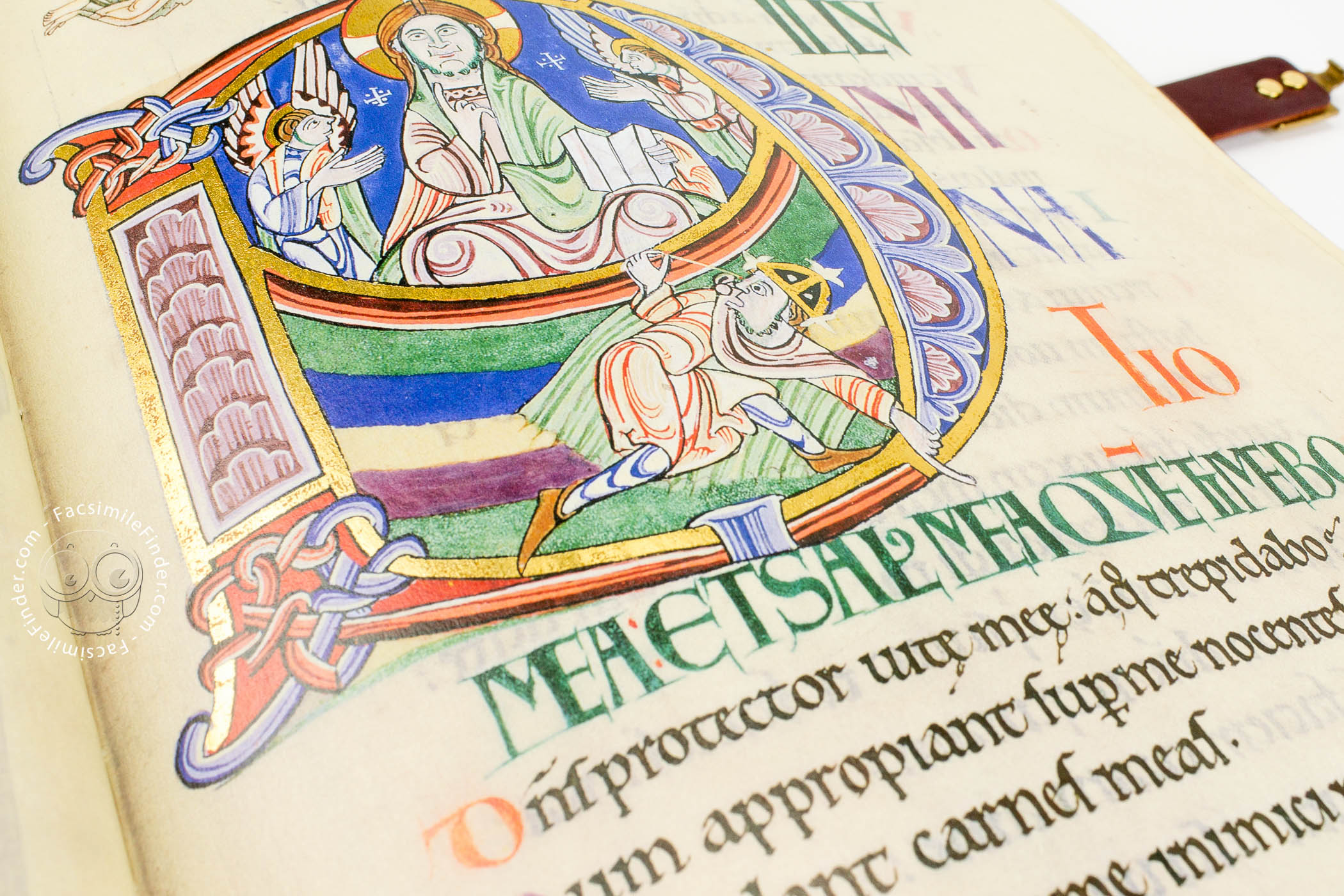
The Saint Albans Psalter, also known as the Albani Psalter, is an exuberant example of the Romanesque style. A large volume (27.6 cm x 18.4 cm), it consists of 418 pages, plus two other leaves: one at the Schnütgen Museum, the other missing. Most pages contain either large full-page miniatures in a range of bright colors or large colorful historiated initials decorated with gold. Dating the manuscript has caused controversy, but it is generally agreed that it was made at St Albans abbey between 1120 and 1130. The date is significant because this is the first extant manuscript with full-page miniatures to be made in England since the tenth century — that is, after the Norman conquest.
Earlier scholarship suggested that it was made for the early twelfth-century anchoress Christina of Markyate. But recent scholarship suggests it was made for Geoffrey of Gorron, Abbot of St Albans (1119–1146), possibly specifically for Christina's use.
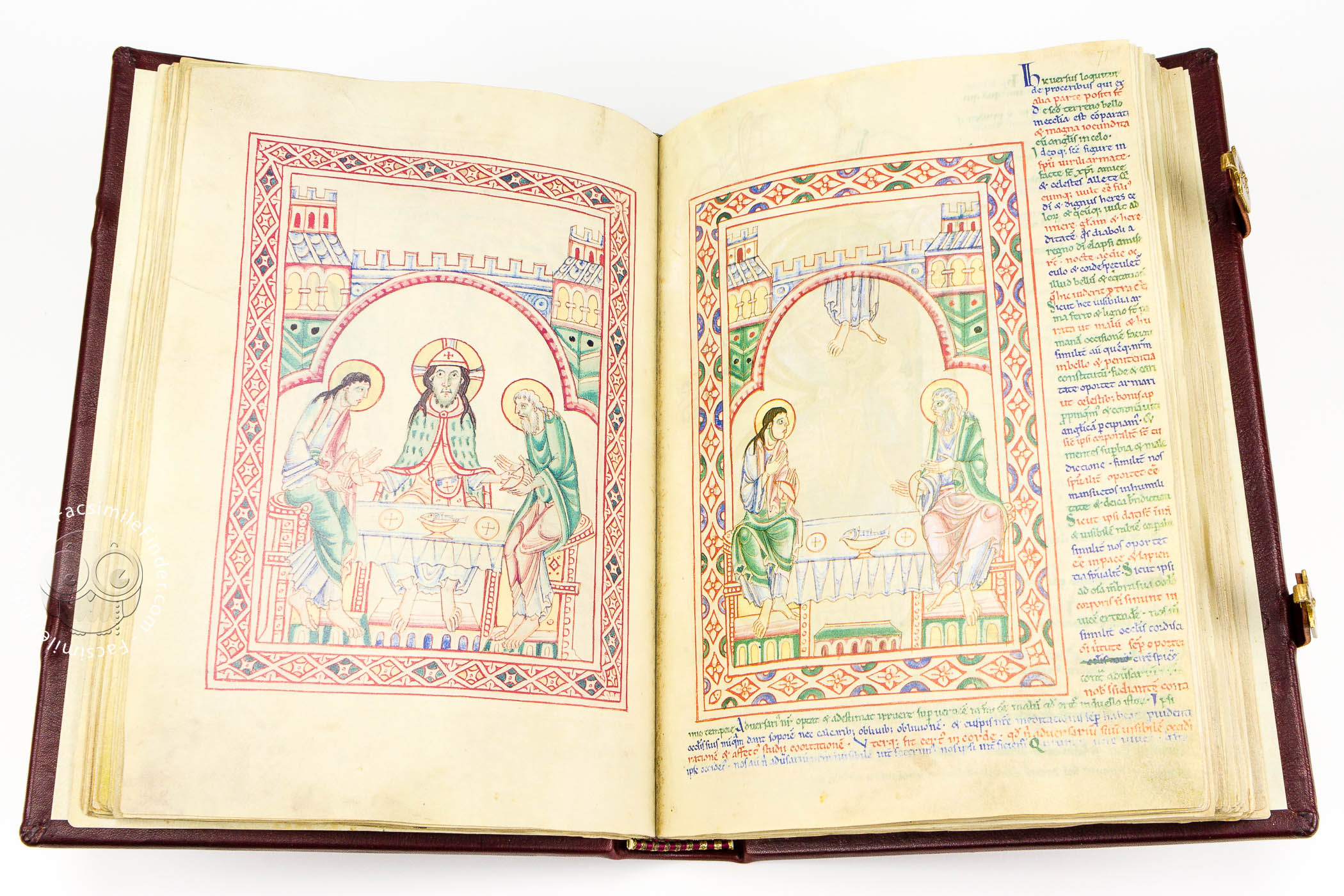
The manuscript is the work of at least four artists and seven scribes. The quality and quantity of the miniatures alone, with over forty full-page miniatures and 150 historiated initials, is breathtaking. Scholars are divided as to whether the manuscript was conceived as a single project, or was made in parts over a long period of time. It represents a form not seen in previous extant manuscripts since it includes an extended narrative of full-page miniatures, French literature, and unusual iconographic motifs.
Innovative Iconography and Bold Use of Color
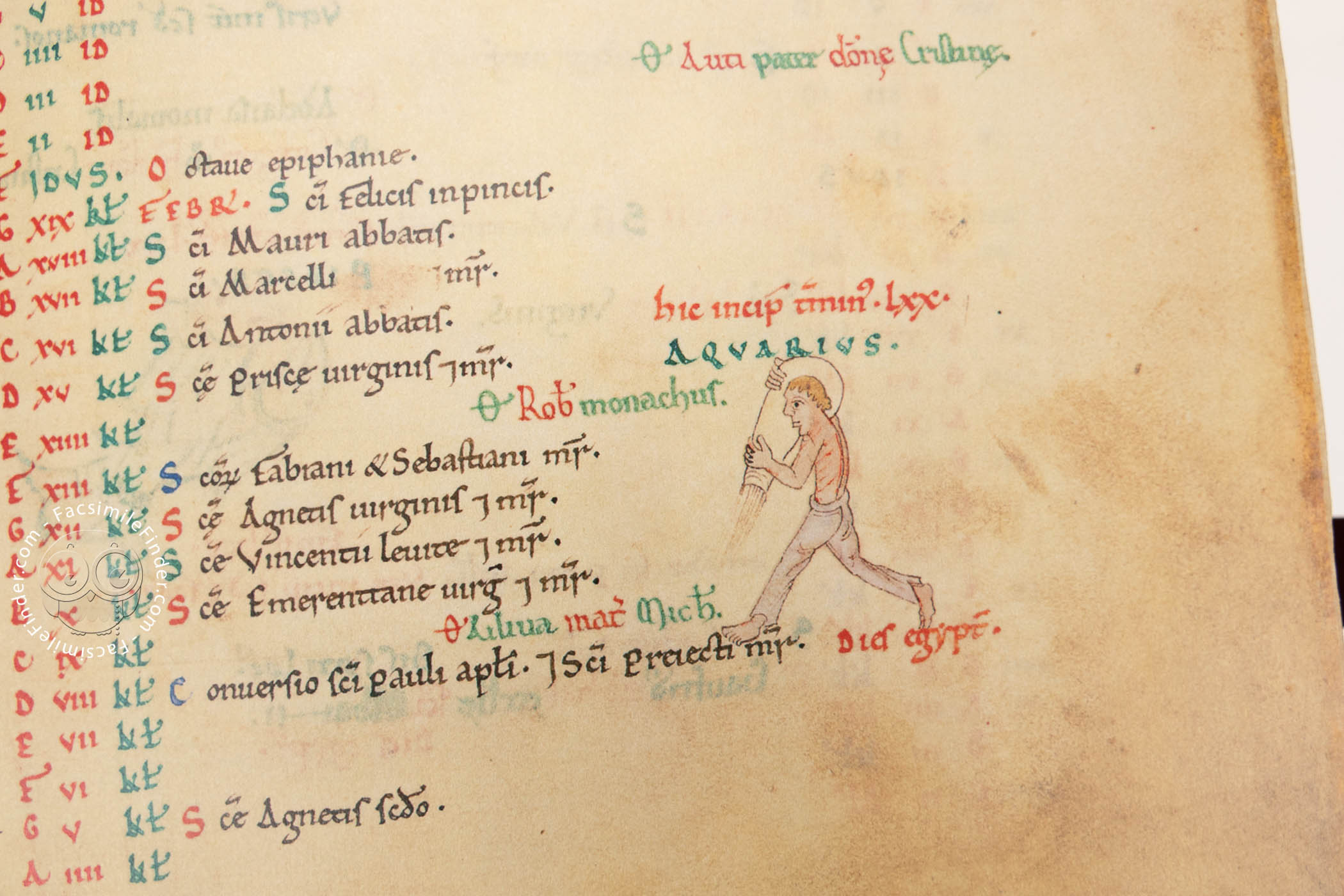
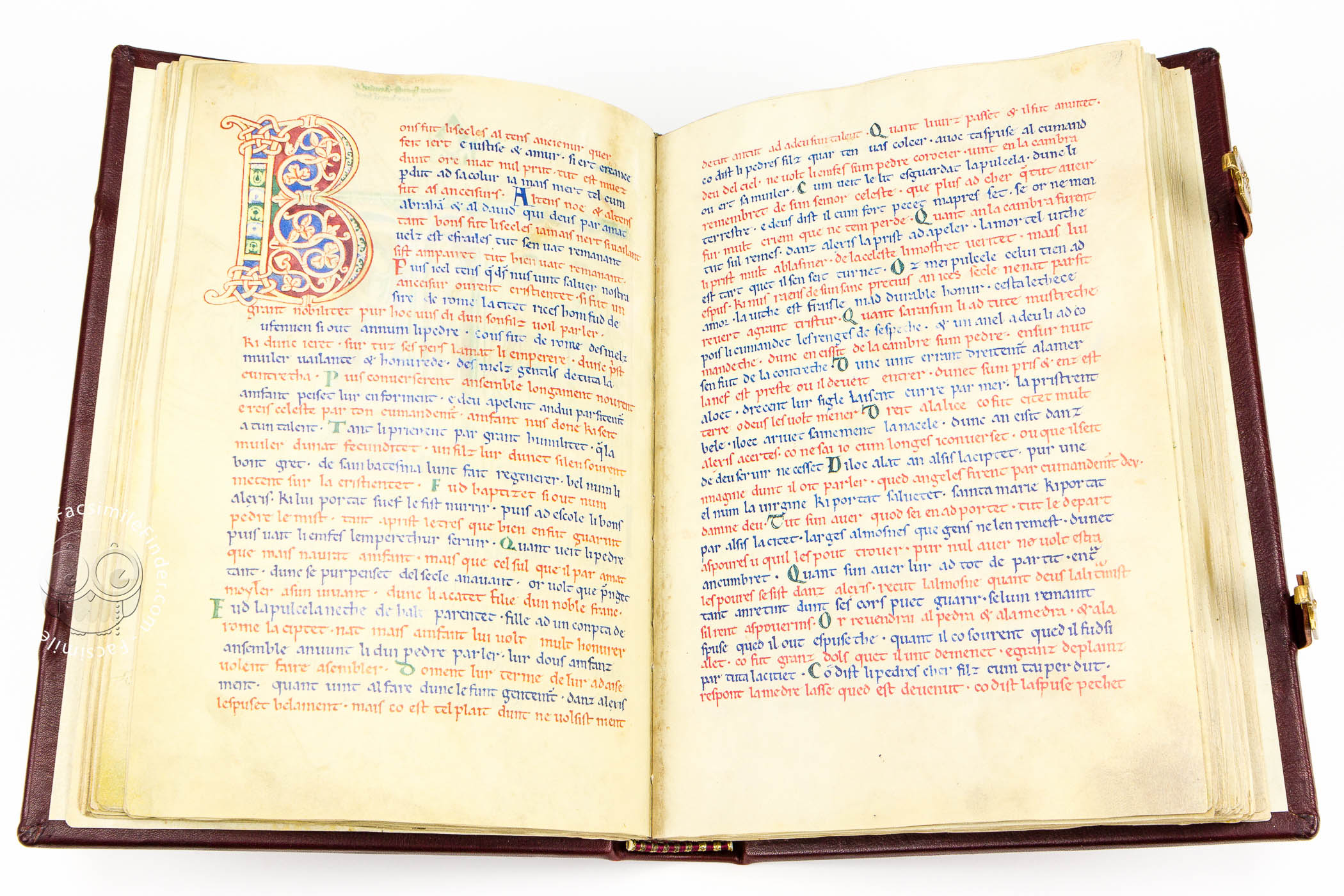
The five sections in the manuscript include: a liturgical calendar, the Life of Christ, the Alexis quire, psalms, prayers and canticles, and a diptych of St Alban and David. At least four artists participated in the creation of the initials and miniatures, however, scholars do not agree on the artists involved in each section.
One artist, named by scholars as the Alexis Master due to his work on the Alexis quire, is of particular importance because of his influence on later manuscripts.
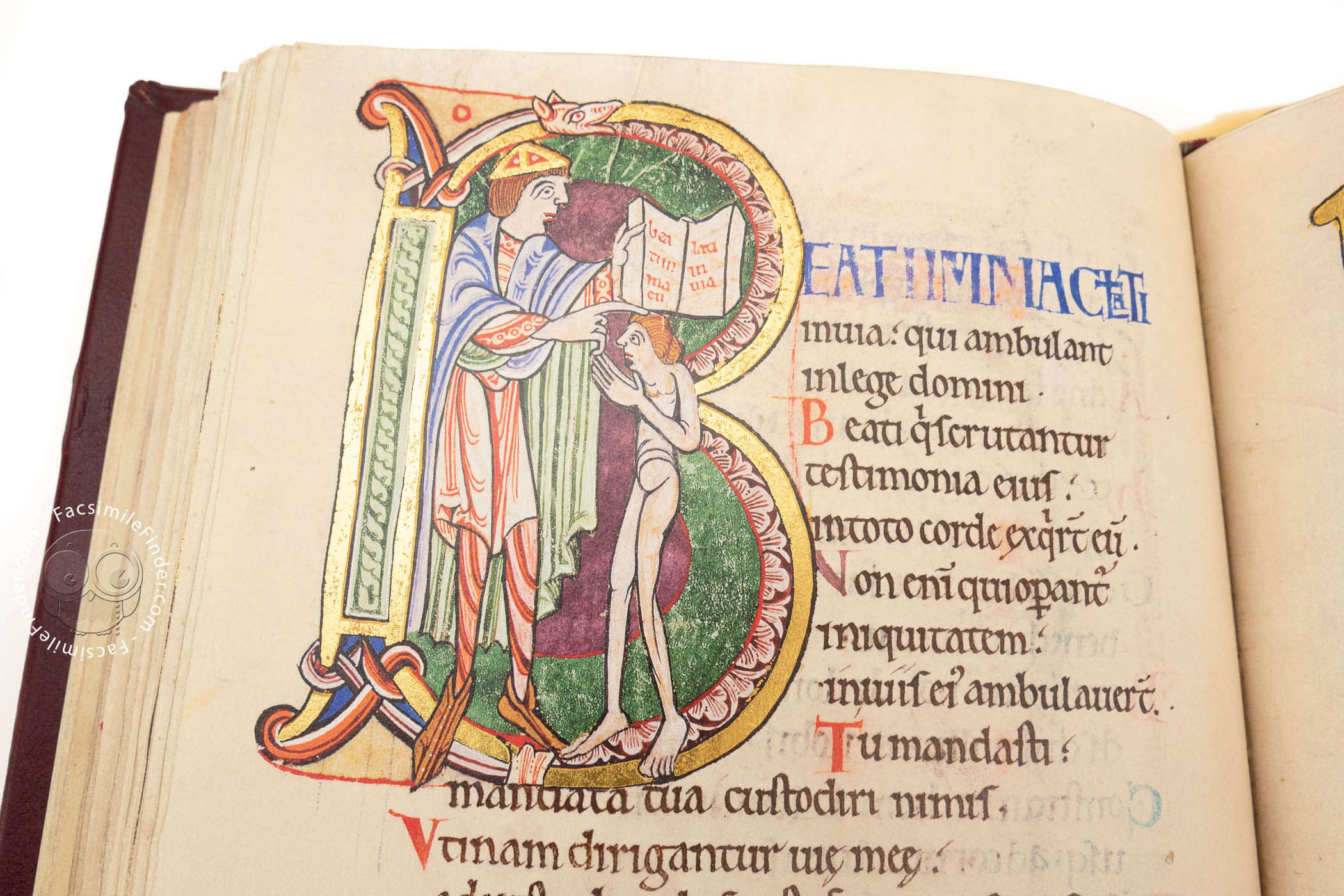
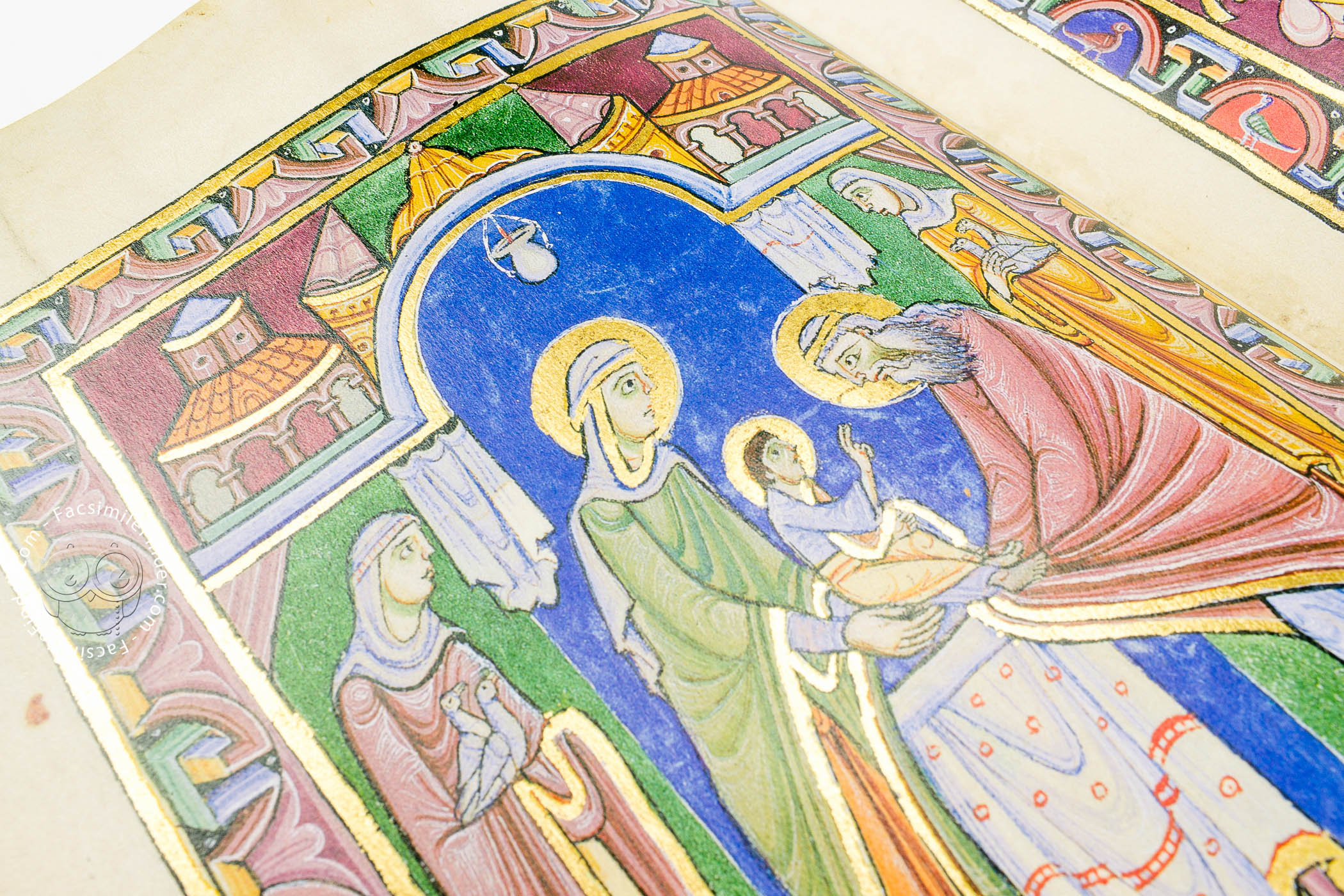
Strong colors with heavy outline, which feature in the manuscript, contrast with the line and wash of preconquest manuscripts. Unusually, most figures are in profile, and large gesticulating hands indicate either a figure speaking or direct the reader’s attention to something.
The iconography in the miniature cycles relates to the later Eadwine Psalter, with both showing links to earlier Ottonian sources. Rare and innovative depictions for the period include: the use of redemption imagery to precede the psalms, rather than the struggle between good and evil; Mary Magdalene announcing the Resurrection; and the Annunciation with the Virgin holding a book.
Colorful and Distinctive Writing
St Albans abbey, like other scriptoria, created their own style of script, and this is evident in the St Albans Psalter. Distinctive letter forms allow identification of at least six scribes but scholars are divided on precisely how they collaborated. Evidence of alterations within a text reveals that at least one of these scribes was also involved in correcting the texts produced.
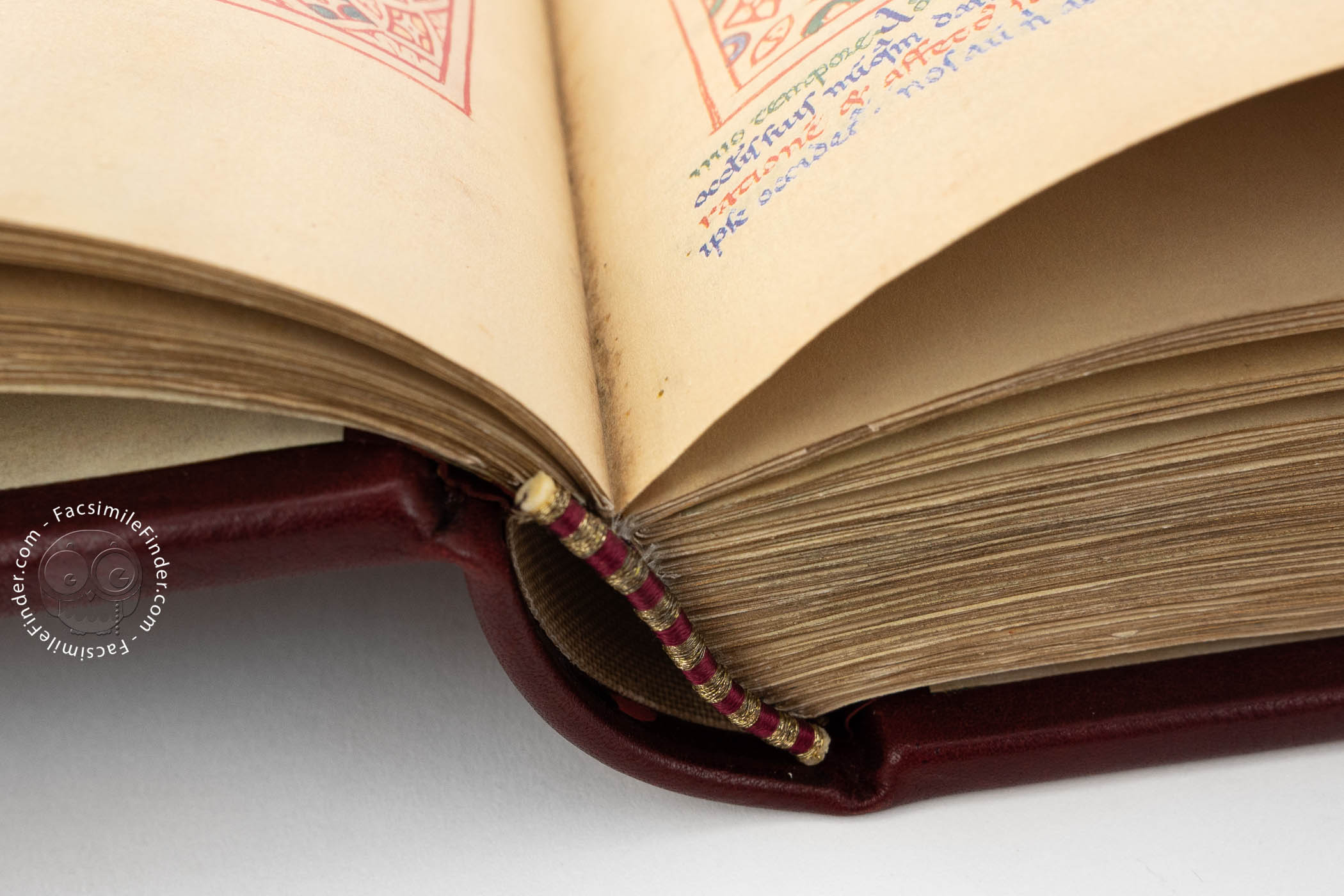
Although predominantly black with colored capitals, the text is also written in red and green (calendar section); red and blue (Alexis quire), and red, blue, and green (Beatus page).
Survivor of Religious and Secular Reform
Erasures in the manuscript confirm its location in England in 1535. These erasures follow a directive from Henry VIII to remove references to the Pope. This is evident in the manuscript so it must have been in England at that time. The psalter probably remained at Markyate, but was removed during the Reformation when the priory was dissolved, some two years after the King’s directive.
An inscription dated 1657 indicates it was then at Lamspringe monastery, which in 1643 was given to English Benedictine monks. The manuscript may have been taken there by one of the monks although it may have been given by Henry Mordaunt (d. 1697), second Earl of Peterborough, who was the owner of other books in the Lamspringe library.
In 1803 the Lamspringe monastery was secularized and a large number of books were auctioned. The manuscript, however, was given to the church of the Benedictine abbey of St. Godehard and is identified as being in the cathedral library since 1827.
Around 1890 two leaves were noted missing: the final leaf, and a leaf between pp. 266 and 267. The final leaf was in the collection of Hermann Joseph Lückger (1864–1951) but its connection with the St Albans Psalter was not understood until the 1950s. This single leaf is now in the Schnütgen museum. The other missing leaf has yet to be found.
During the Second World War the manuscript was moved to a Hildesheim bank vault for safety, but when the bank caught fire in an air raid (March 1945) it was housed at a priest’s home until around the 1960s, when it returned to the cathedral library.
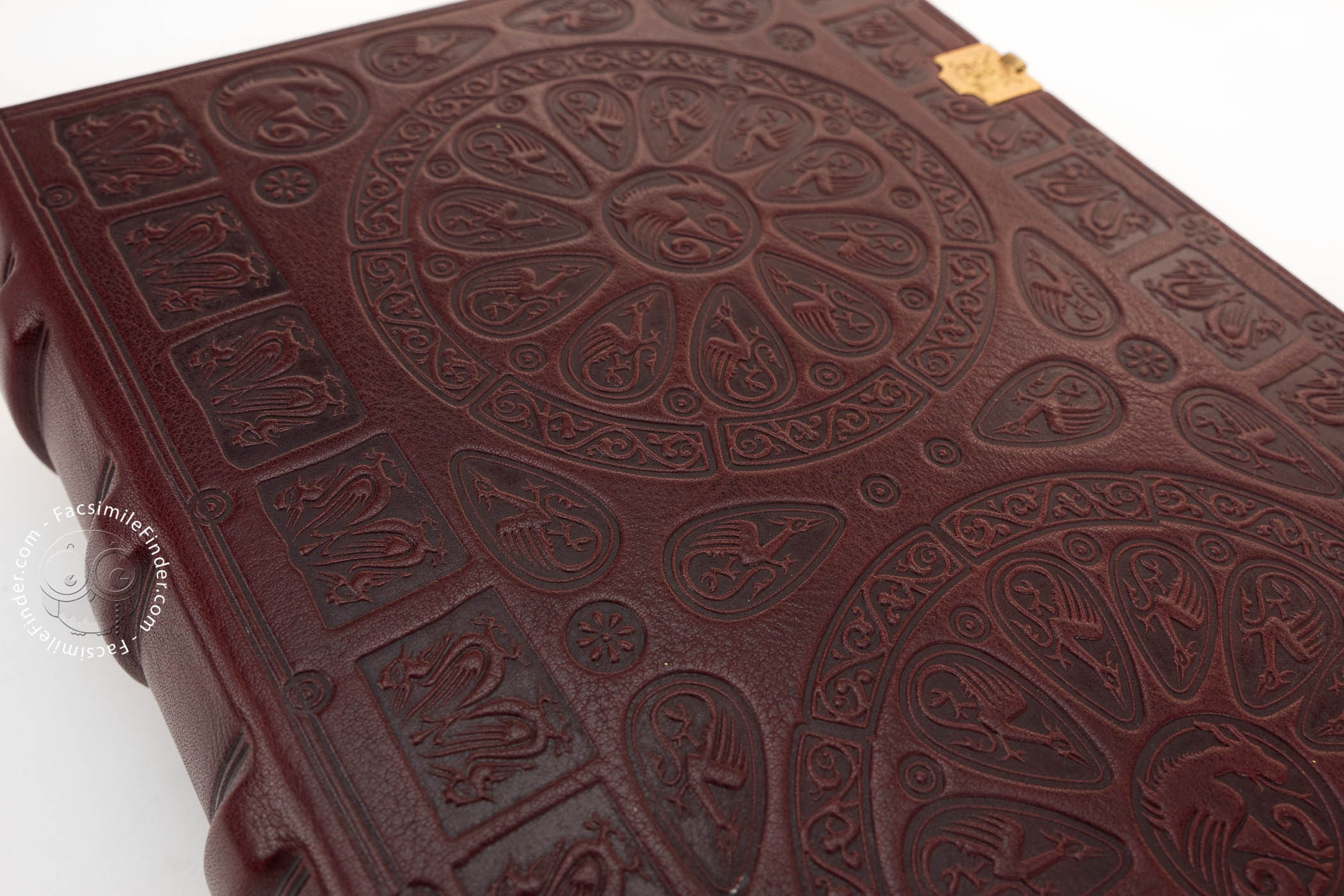
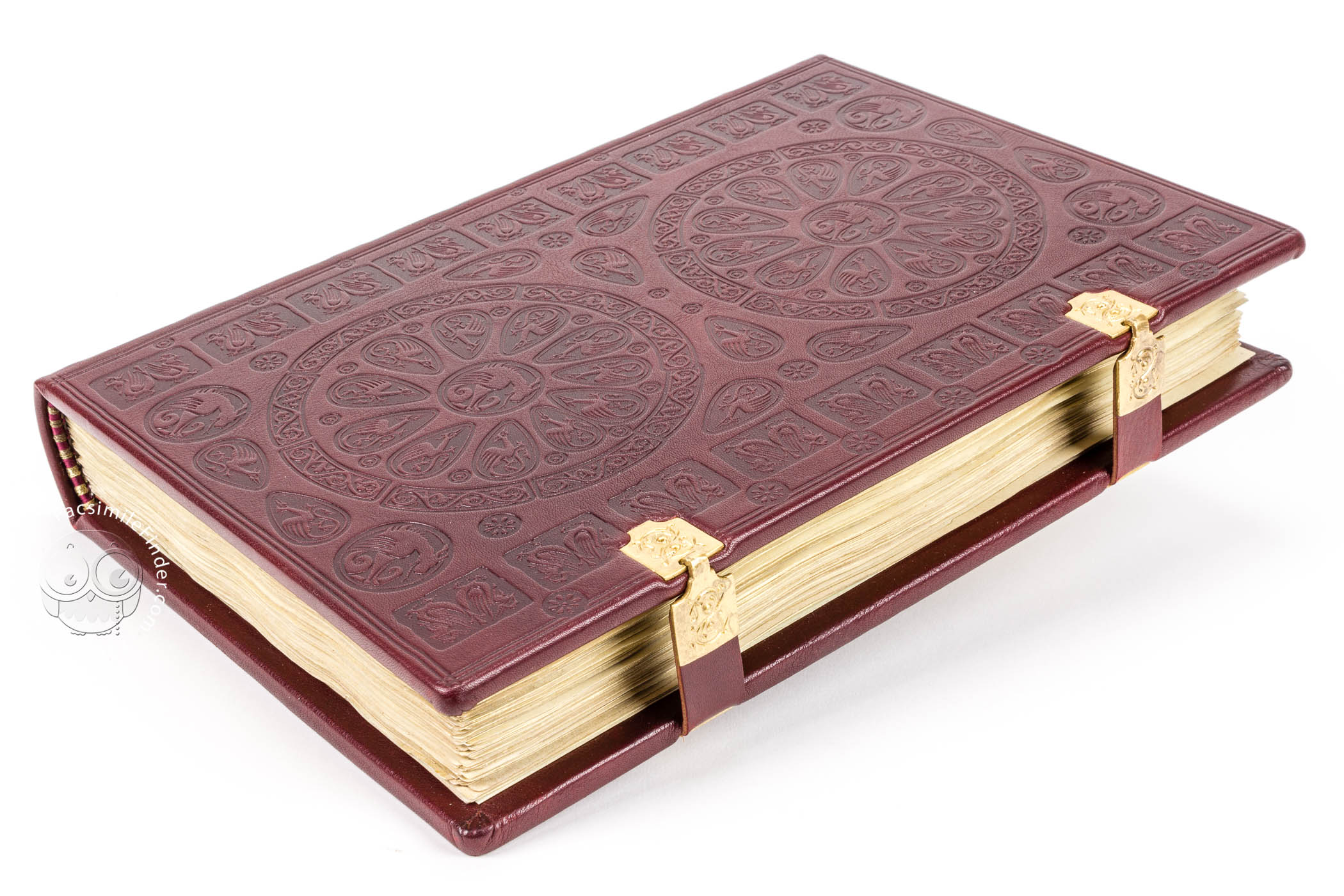
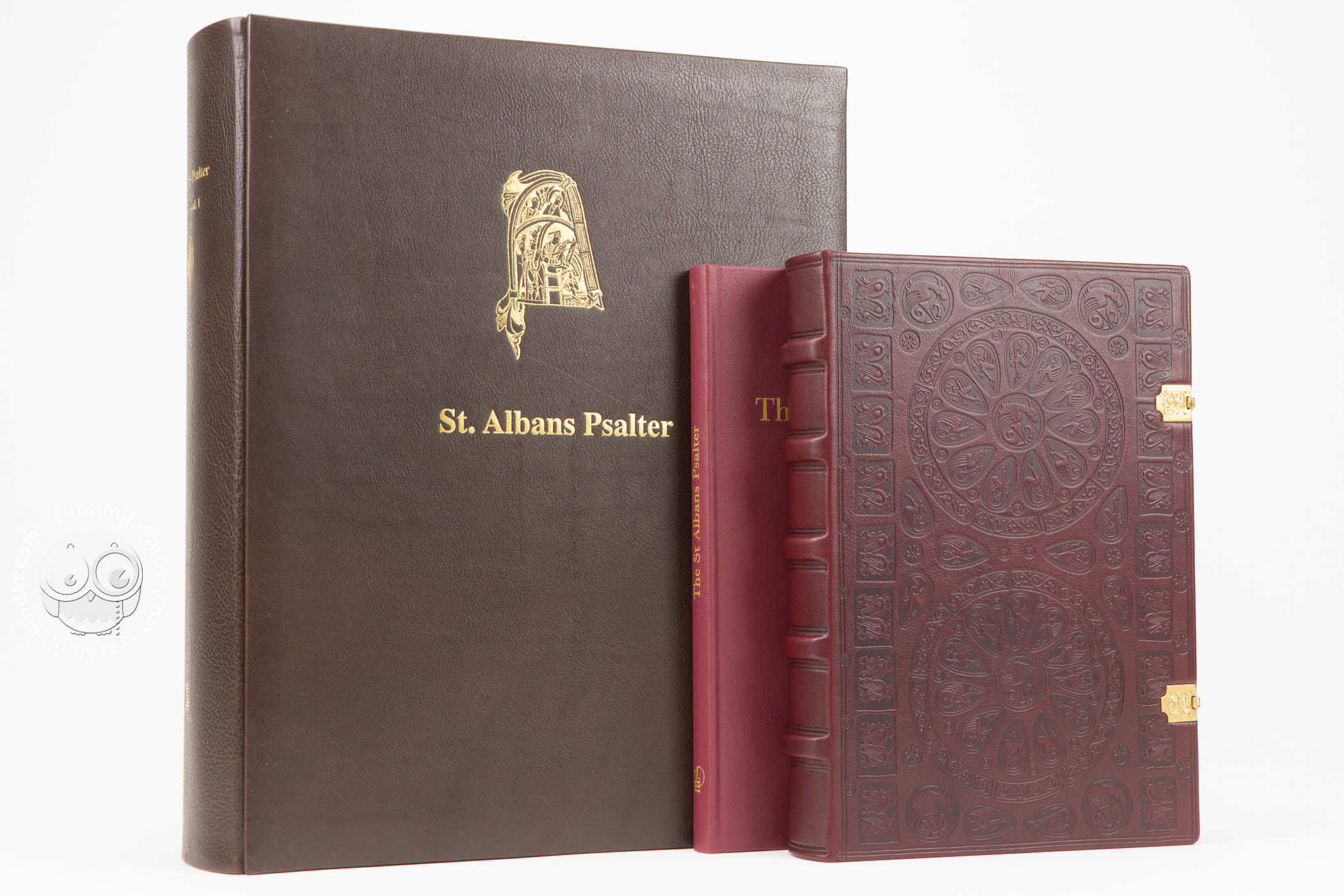
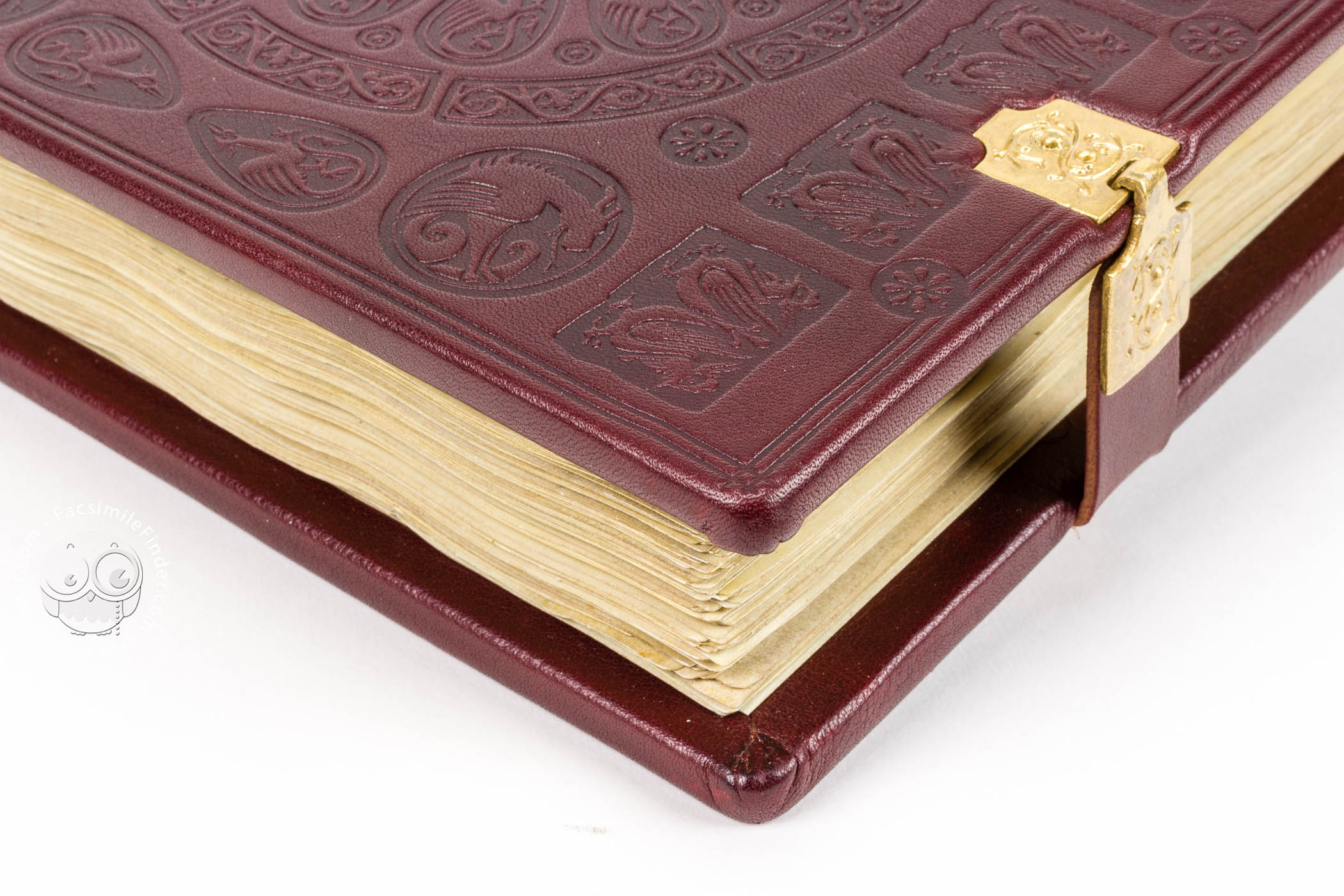
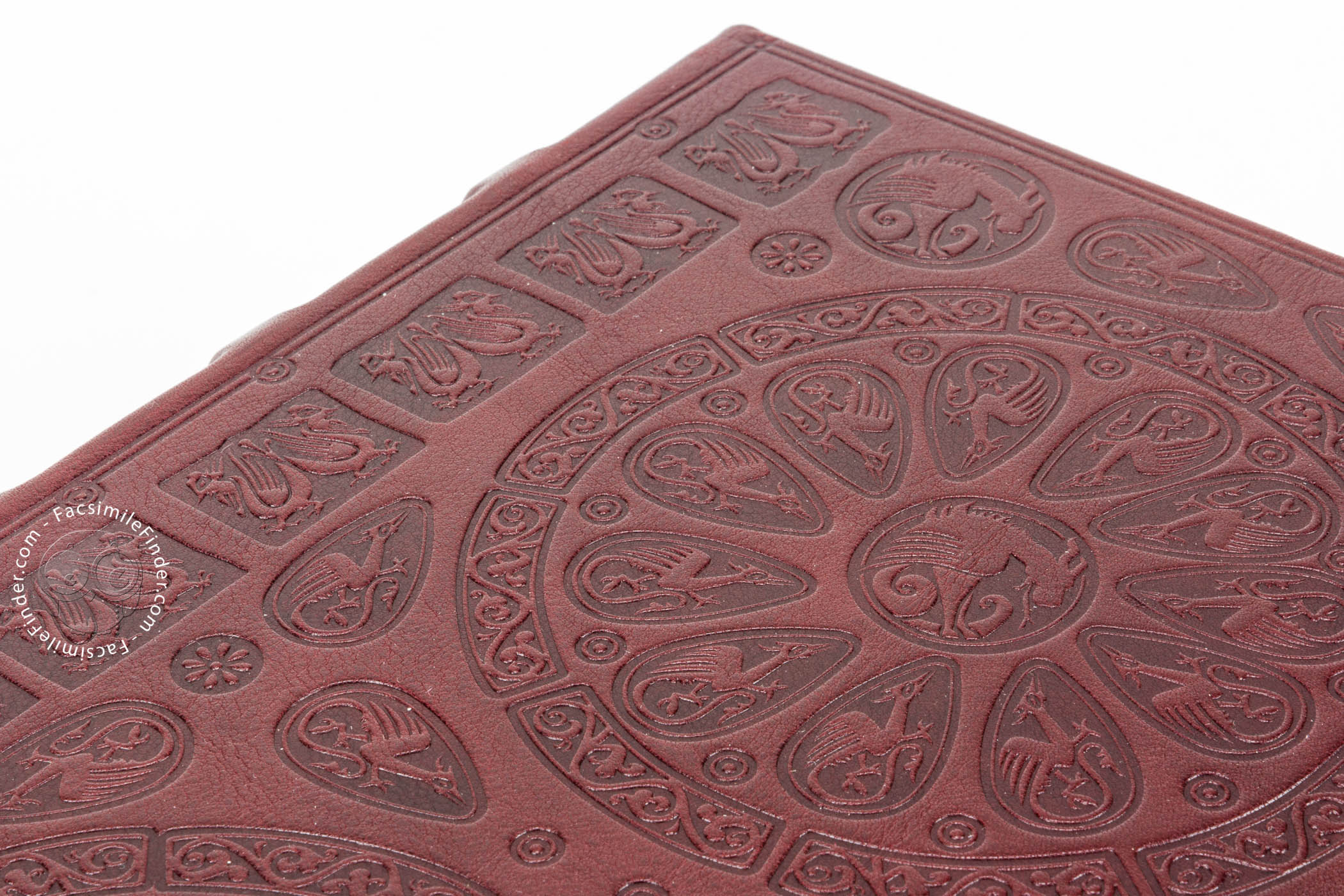
The manuscript has been rebound at least three times; its current binding dates to 1936. It consists of brown leather over paste boards and preserves the previous binding of pigskin. Evidence from previous materials used demonstrates that the manuscript was bound in the twelfth century, rebound in the fourteenth or fifteenth century in England, rebound again in the fourteenth or fifteenth century, and again in 1936 in Germany.
We have 3 facsimiles of the manuscript "Saint Albans Psalter":
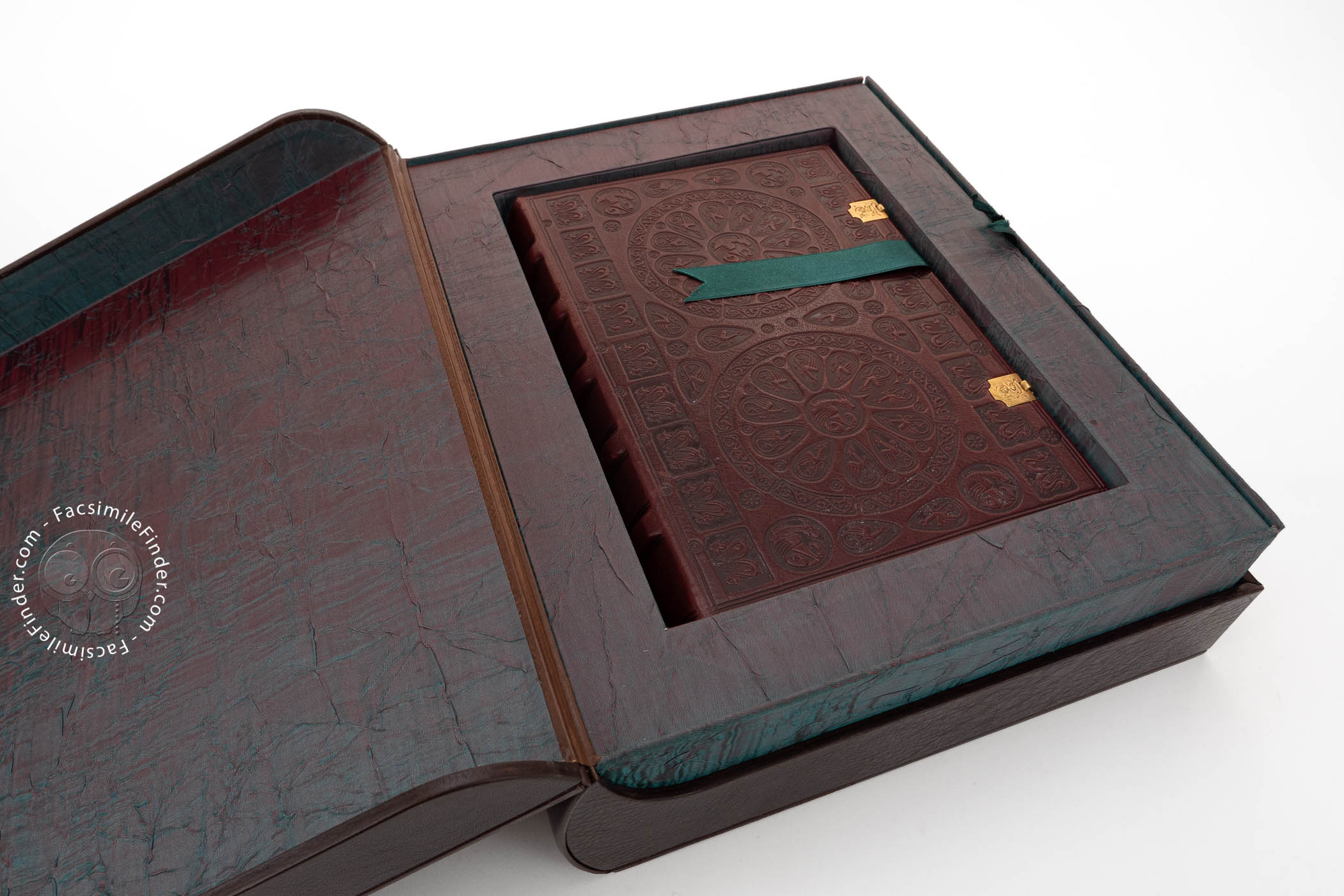
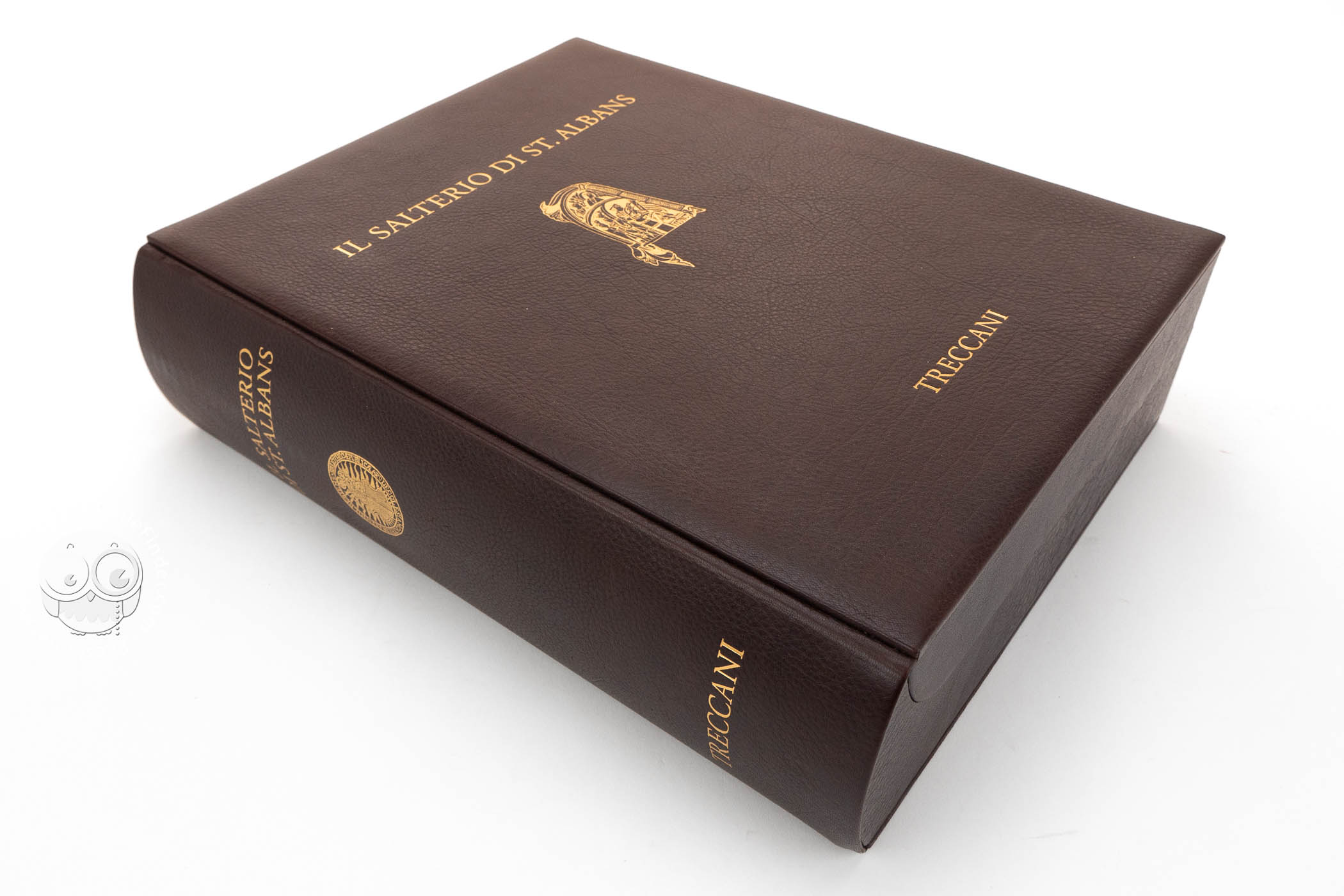
- Salterio di St. Albans facsimile edition published by Istituto dell'Enciclopedia Italiana - Treccani, 2007
- Salterio de San Albans facsimile edition published by Eikon Editores, 2007
- Albani-Psalter facsimile edition published by Mueller & Schindler, 2007