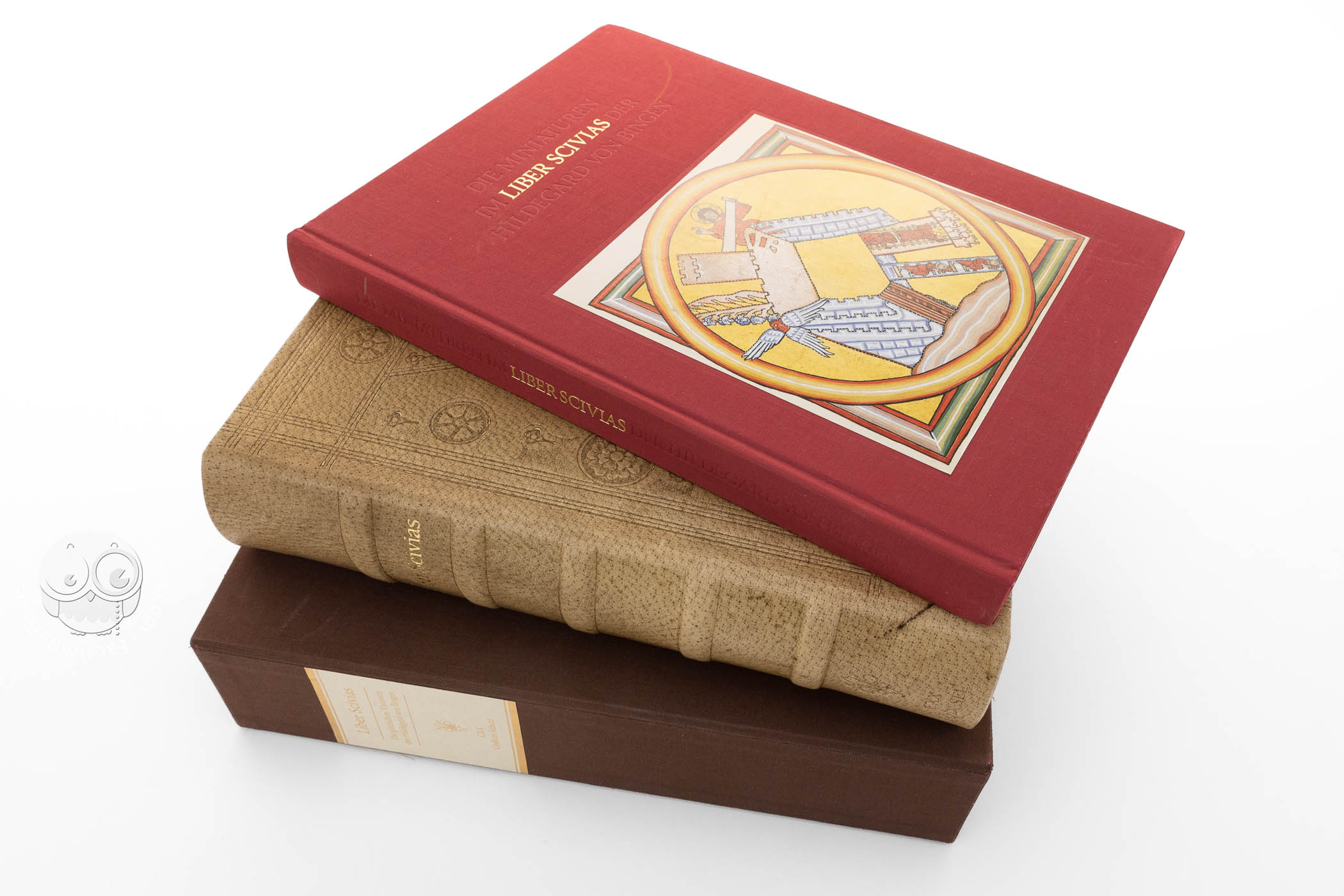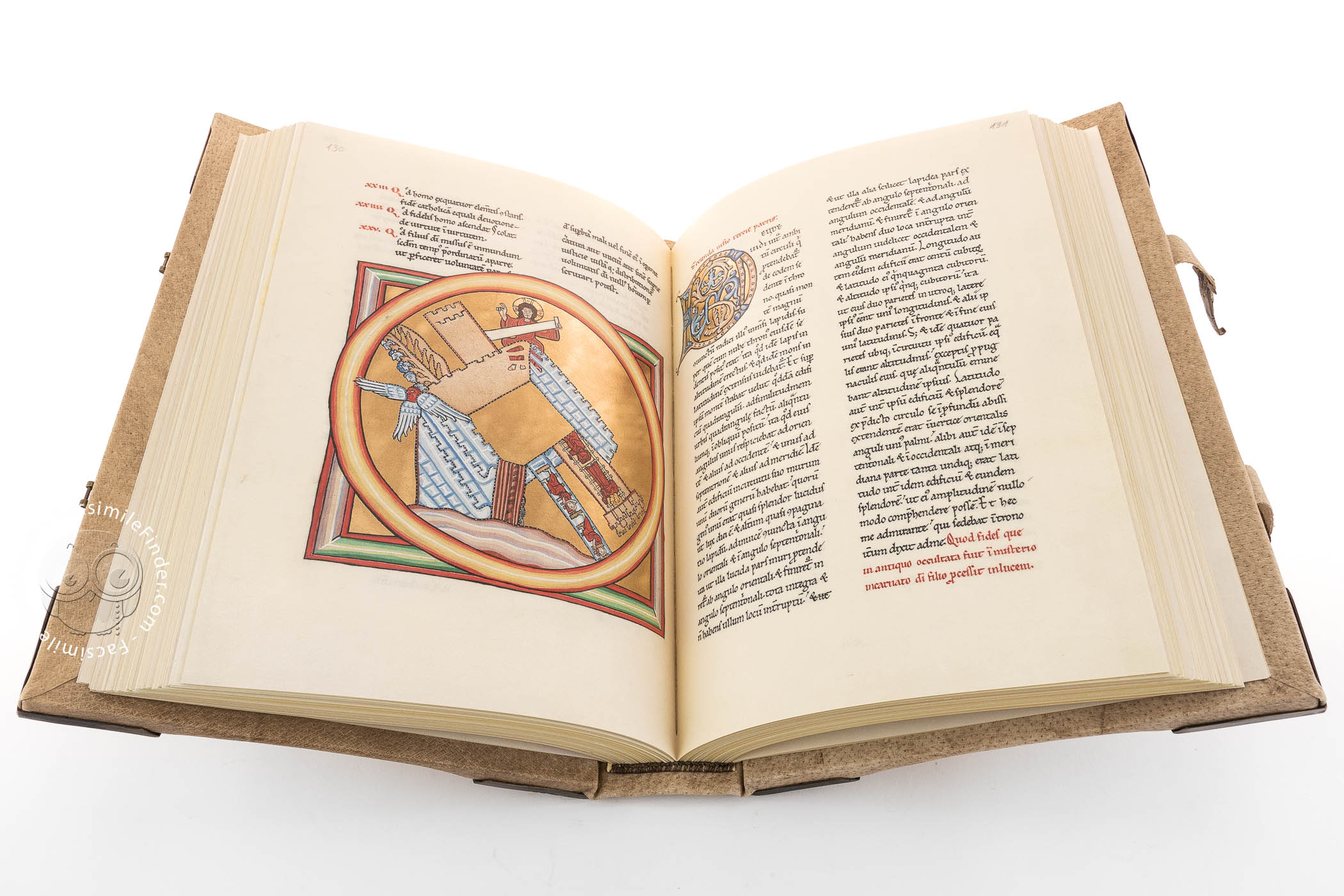


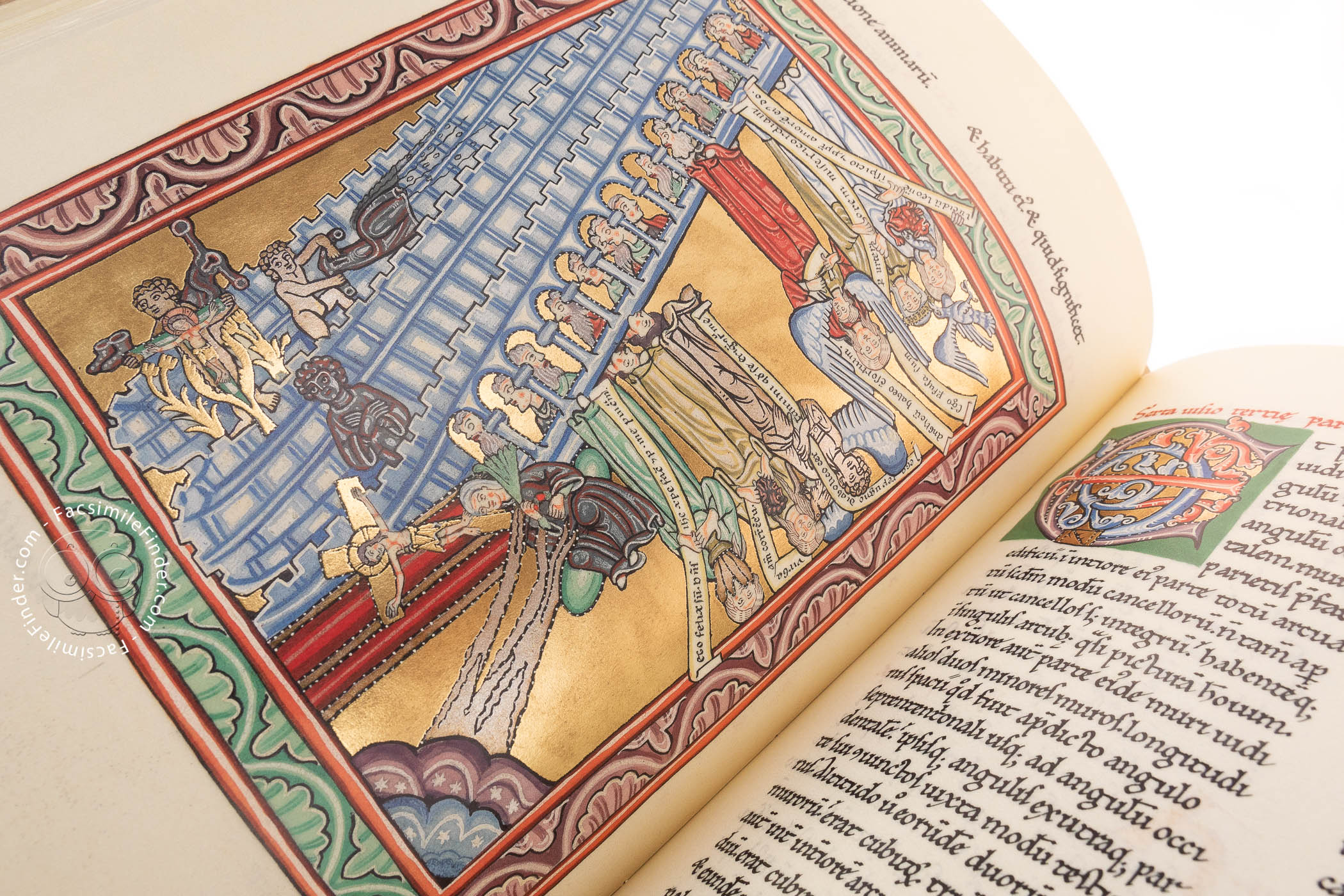


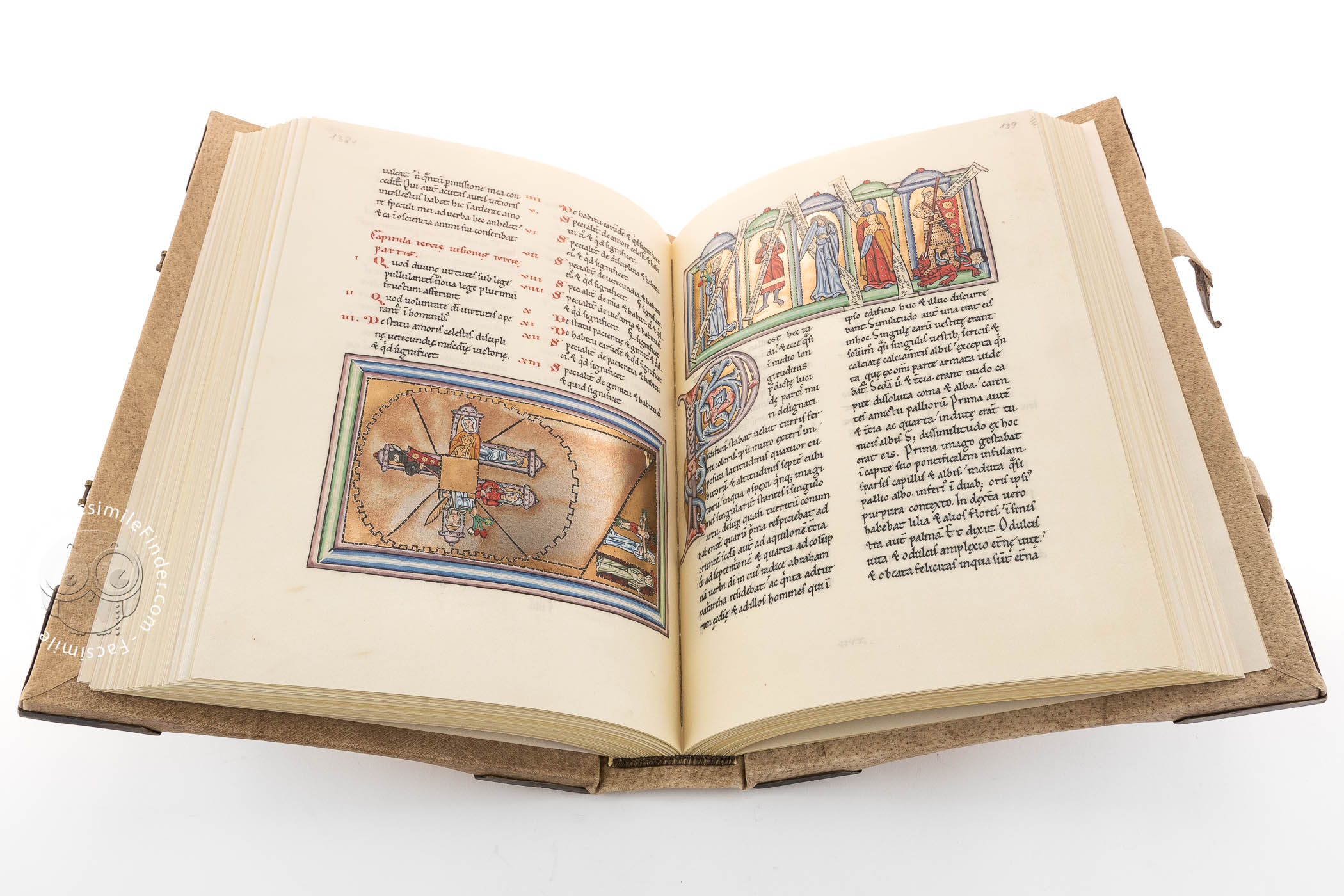


The Liber Scivias is a now-untraced illuminated manuscript of the earliest visionary work by the Christian mystic Saint Hildegard of Bingen. Its remarkable text describes and interprets twenty-six visions Hildegard experienced. The manuscript was probably created around 1175 under Hildegard's direction at the Benedictine nunnery she founded at Rupertsberg. Known now through photographs and a twentieth-century handmade copy, it boasts fifty-six miniatures in vivid color, gold, and silver that picture aspects of her visions.
Scivias—short for Sci vias domini ("Know the ways of the Lord")—arranges the visions into three "books," the first (six visions) addressing Creation and the cosmos, the second (seven visions) redemption, and the last (thirteen visions) salvation and the end of the world.
Made under Hildegard's Supervision
Although there is debate on the topic, most scholars accept that Saint Hildegard (1098-1179) supervised the manuscript's production and was involved in designing the miniatures. They are remarkable not only for their unique visionary content but also for their formats, which vary considerably.
Some miniatures are full-page or nearly so, others the width of a column of text (many of those very tall), and three are reverse-L-shaped, with the lower part extending across the width of two columns. The painted frames feature a variety of foliate and geometric motifs, and elements of the miniatures sometimes breach the frame.
The Author as Authority
The miniature introducing the prologue shows Hildegard seated within an architectural setting (fol. 1r). She is hunched, stylus in hand, over three wax tablets representing the three books of Scivias. Volmer of Disibodenberg, who transcribed or improved the Latin of Hildegard's visionary text, is given secondary status, both smaller in scale and partially obscured by the architecture.
Hildegard reports that she was commanded by the Lord to "say and inscribe" what she "saw and heard" (Dic et scribe quae vides et audis.). The Latin verb scribere can mean draw or design, and she may be understood to be drawing her visions in the portrait. There is no question that she is inspired: flames of inspiration seem to grab at her head.
The Author as Visionary
The flames that inspire the author Hildegard have a visual echo in the very next miniature, in which golden flames completely obscure the head of the personification of "poor in spirit," who might be understood to be Hildegard as she experiences a remarkable vision of a figure of great brightness with enormous wings. She is accompanied by the personification of "fear of the Lord" (fol. 2r).
The Old Law as a Wall
Among the unique aspects of Hildegard's visions are an egg-shaped cosmos and the Christian Trinity as an architectural complex of a column shaft at the corner of two walls (fols. 14r and 172r). Hildegard saw the Old Testament as a wall with an arcade of pictures viewed by six figures who offer words of wisdom (fol. 161v).
From Creation to End Times
Each of Hildegard's visions includes a detailed description of what she saw and her interpretations of its various elements. The last vision incorporates a liturgical drama. The text is written in two columns in the Transitional Script of the twelfth century. The prologue and each vision are introduced by a painted initial with foliate motifs.
Lost, but Not Undocumented
After a time at Hildegard's foundation at Eibingen (presumably starting after the destruction of Rupertsberg in 1632), the manuscript was transferred to the Nassauische Landesbibliothek (later Hessische Landesbibliothek) in Wiesbaden. The nuns of Eibingen (now Rüdesheim) borrowed it from the Landesbibliothek and created a full-color copy by hand between 1927 and 1933, with the miniatures in the copy being painted by Josepha Knips. Not long after its return to Wiesbaden from Eibingen, the manuscript was removed to Dresden for safekeeping during World War II. It disappeared during the Soviet occupation of the city after the war.
We have 2 facsimiles of the manuscript "Liber Scivias":
- Liber Scivias (Standard Edition) facsimile edition published by Akademische Druck- u. Verlagsanstalt (ADEVA), 2013
- Liber Scivias (Real Gold Edition) facsimile edition published by Akademische Druck- u. Verlagsanstalt (ADEVA), 2013